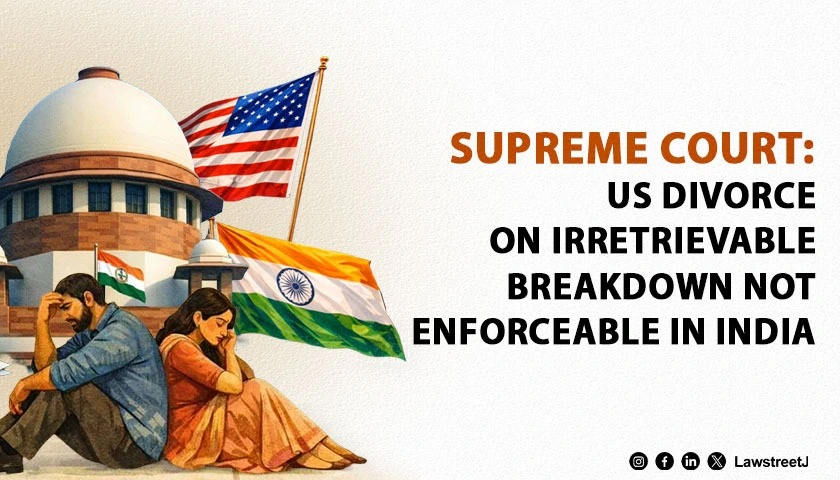
New Delhi: The Supreme Court of India has held that a decree of divorce granted by a court in the United States of America on the ground of irretrievable breakdown of marriage is not enforceable in India, since that ground is not recognised under the Hindu Marriage Act, 1955.
The Court further held that where a party only files a written statement by post contesting the jurisdiction of the foreign court and does not participate in the proceedings thereafter, it cannot be said that such a party voluntarily or effectively submitted to the jurisdiction of the foreign forum.
Having found the US decree to be inconclusive, the Court exercised its extraordinary jurisdiction under Article 142 of the Constitution and dissolved the marriage on the ground of irretrievable breakdown, noting that the parties had been separated for nearly eighteen years with no prospect of reconciliation.
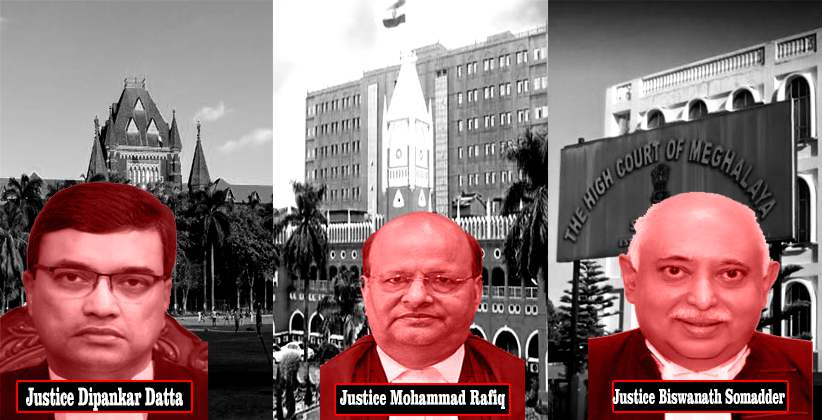
A Bench of Justices Vikram Nath and Sandeep Mehta passed the order on January 15, 2026, allowing an appeal filed by the husband against a judgment of the Bombay High Court dated March 4, 2010.
The parties were married on December 25, 2005, in Mumbai according to Hindu rites and rituals. At the time of their marriage, both were residing in the United States, and they returned there after the wedding, living together until September 2008. In December 2007, both parties briefly visited India and stayed together for one night at the family residence in Pune. On September 25, 2008, the wife filed for divorce before the Circuit Court for the County of Oakland, Michigan, USA. The husband was served on September 27, 2008. He responded by filing a written statement by post on October 13, 2008, contesting the jurisdiction of the US court on the ground that the parties were governed by the Hindu Marriage Act. He did not appear in person before the US court at any subsequent stage.
Meanwhile, the husband returned to India and filed a divorce petition on October 24, 2008, before the Family Court, Pune, under Section 13(1)(i)(a) of the Hindu Marriage Act, claiming that Pune constituted the matrimonial home since the parties had resided there during their visits to India. The US Circuit Court proceeded with the wife’s petition and granted a decree of divorce on February 13, 2009, on the ground of irretrievable breakdown of marriage, also directing financial settlements between the parties.
When the wife challenged the jurisdiction of the Family Court, Pune, before the High Court, the High Court allowed her writ petition and held that both parties were domiciled in the US, that the HMA was inapplicable to them, and that the US court had jurisdiction as the parties had last resided together in Oakland. The husband appealed this order before the Supreme Court.
Before the Supreme Court, the husband contended that Indian courts had jurisdiction since the marriage was solemnised in India and both parties were Indian citizens, and that the US decree was an ex parte order since he had only filed a written statement contesting jurisdiction and had not participated further. The wife, on the other hand, contended that both parties were domiciled in the US, their last joint residence was in Oakland, and that the US divorce decree was conclusive under Section 13 of the Code of Civil Procedure, 1908.
The Supreme Court examined the question of enforceability of the US decree with reference to its earlier three-judge Bench decision in Y. Narasimha Rao v. Y. Venkata Lakshmi, (1991) 3 SCC 451, which laid down that a foreign divorce decree would be recognised in India only where the relief was granted on a ground available under the matrimonial law governing the parties, or where the opposite party had voluntarily and effectively submitted to the jurisdiction of the foreign forum and contested the claim on a valid ground under the applicable law, or where the opposite party had consented to the relief.
The Court also held in that decision that mere service of summons is not sufficient, and that the opposite party must have had a meaningful opportunity and must have effectively participated in the foreign proceedings.
Applying these principles, the Supreme Court found that the US court had granted the divorce on the ground of irretrievable breakdown of marriage, which is not a recognised ground under the HMA, the matrimonial law applicable to the parties. Further, the husband had only filed a written statement by post expressly contesting the jurisdiction of the US court and had not participated beyond that.
The Court held that this did not amount to voluntary or effective submission to the foreign forum’s jurisdiction, and that the principles of natural justice could not be said to have been satisfied.
Having found the foreign decree to be inconclusive and legally unsustainable, the Court observed that it was nonetheless necessary to bring finality to the matter.
The parties had been separated since 2008—a period of nearly eighteen years—and it was evident that no matrimonial bond subsisted between them. The Court accordingly exercised its jurisdiction under Article 142 of the Constitution and dissolved the marriage by granting a decree of divorce on the ground of irretrievable breakdown of marriage.
The High Court’s judgment was set aside, and the divorce petition pending before the Family Court, Pune, was directed to stand closed in view of the decree granted by the Supreme Court.
Case Title: Kishorekumar Mohan Kale v. Kashmira Kale (Civil Appeal No. 1342 of 2013)