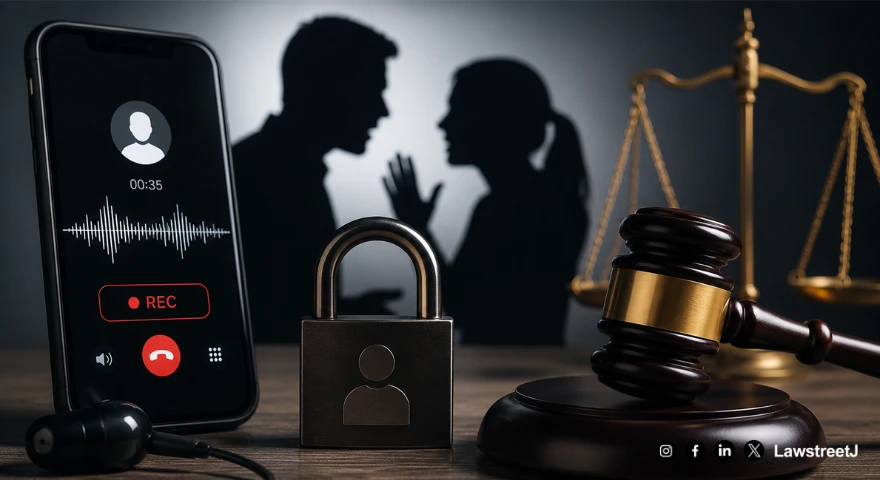
Hyderabad: The Telangana High Court has held that call and voice recordings obtained by a spouse without the other party's consent cannot be admitted in evidence in matrimonial proceedings, as such recording amounts to a breach of the right to privacy guaranteed under Article 21 of the Constitution.
Justice Namavarapu Rajeshwar Rao was disposing of two Civil Revision Petitions filed by a husband, challenging a trial court's common order that had rejected his applications to place certain documents, including electronic evidence, on record in his divorce petition filed on the ground of cruelty.
The husband had filed applications under Order VII Rule 14(3) read with Section 151 of the Code of Civil Procedure, 1908, and under Section 65-B of the Indian Evidence Act, 1872, seeking to introduce a set of documents as primary and secondary evidence before the Senior Civil Judge-cum-Assistant Sessions Judge at Metpalli. The trial court dismissed both applications, finding that the electronic records had been filed without the certificate mandated under Section 65-B and that there was no clarity on whether the husband possessed the original device on which the recordings were made.
Before the High Court, counsel for the husband argued that the trial court ought to have admitted the documents and left their evidentiary value to be tested through cross-examination, rather than rejecting them at the threshold. It was submitted that the authenticity of the call and voice recordings had been verified by a forensic organisation, Truth Labs, and that the recordings had been produced in a sealed cover. Counsel further submitted that several of the documents were downloaded directly from bank and credit card websites, and that the husband was willing to demonstrate their source by logging into his own accounts before the trial court.
Counsel for the wife opposed the petitions, submitting that the trial court had correctly dismissed both applications and that the revisions were devoid of merit.
On the question of the call recordings, the High Court squarely upheld the trial court's reasoning:
“With regard to the recordings of conversations between the parties, the trial Court rightly held that recording calls without the consent of the other party constitutes a breach of privacy and the right to privacy guaranteed under Article 21 of the Constitution of India. Therefore, in the absence of consent, such recordings cannot be admitted in evidence,”
the Court held, declining to disturb the trial court's rejection of the recordings on this ground.
Turning to the remaining documents, the Court examined their contents and found that most of them, including medical records, proof of payments, air travel tickets between the USA and India, records of pleasure trips, photographs, and money transfers, had little bearing on the husband's case of cruelty. The Bench observed:
“This Court is not able to understand how these documents would assist the petitioner in proving the allegation of cruelty. On the contrary, the documents appear to relate to the cordial and successful marital life shared by the petitioner and the respondent. It is not evident how these documents support the petitioner's case for divorce on the ground of cruelty,”
the Court noted, adding that it was the husband's responsibility as a spouse to incur such expenses during the subsistence of a normal married life.
Holding that the trial court had rightly dismissed both applications and that the documents in question did not, in any event, advance the husband's case for divorce on the ground of cruelty, the High Court declined to interfere with the impugned common order. The Civil Revision Petitions were accordingly dismissed, with no order as to costs.
Case Details: Civil Revision Petition Nos. 247 and 253 of 2025 (Husband vs. Wife)


!['No common intention to kill,' SC alters conviction from murder to culpable homicide not amounting to murder [Read Judgment]](/secure/uploads/2024/02/lj_7197_f77c706e-b667-41fe-9c36-9e633e880b85.jpg)
![Remaining silent during an investigation is a fundamental right: Telangana HC [Read Judgment]](/secure/uploads/2024/04/lj_3728_c8f7ecd3-a0e9-44f7-85aa-f77b9dae3a49.webp)