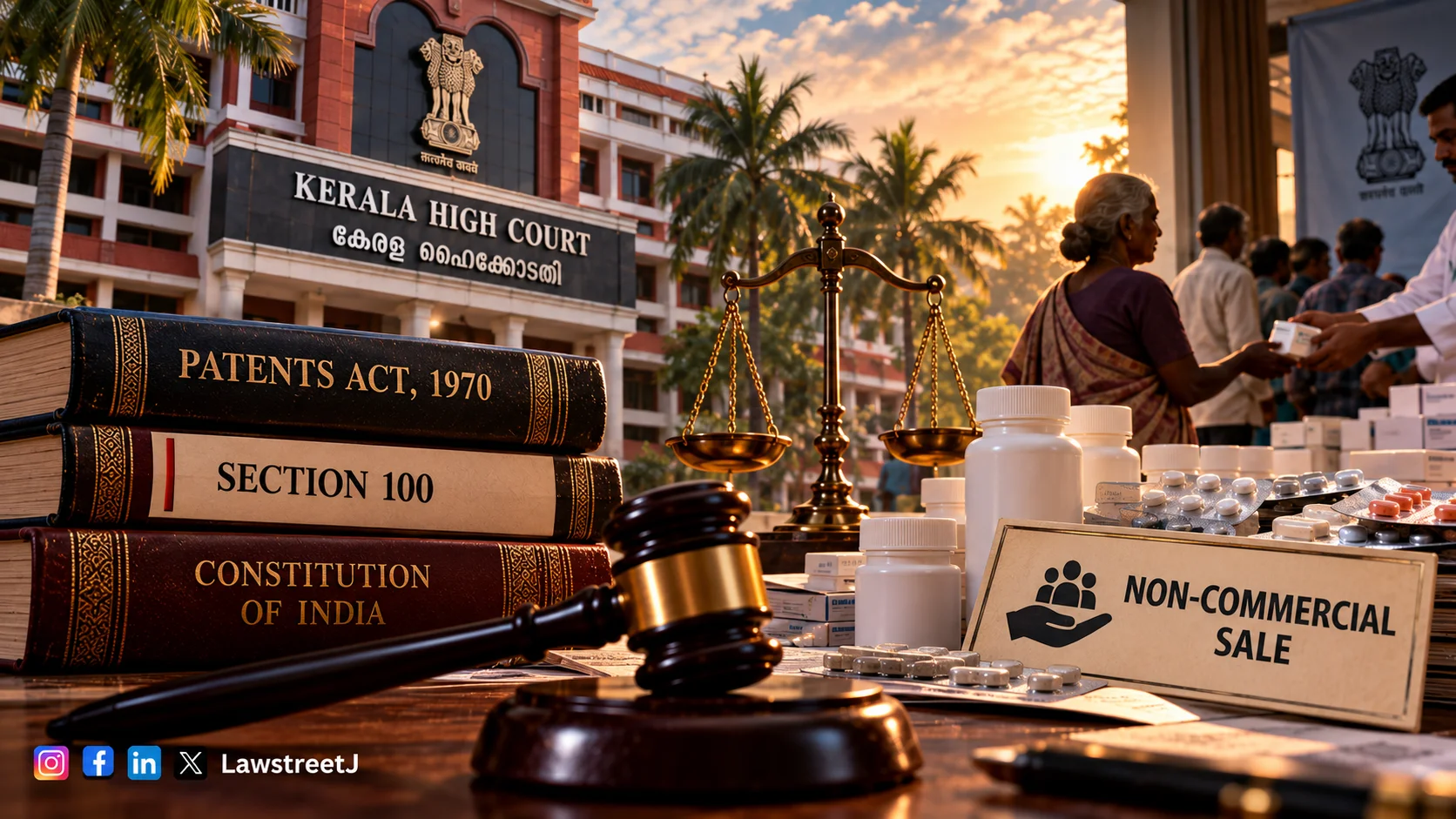
Ernakulam: The Kerala High Court has held that the Central Government's power under Section 100 of the Patents Act, 1970 to use a patented invention “for the purposes of Government” extends to manufacturing a patented medicine and selling it to needy patients on a non-commercial basis, though it stopped short of directing the Government to invoke that power in respect of specific cancer drugs.
Justice Harisankar V. Menon, disposing of W.P.(C) No. 18999 of 2022, In Re: Exorbitant Pricing of Life Saving Patented Medicines, was hearing a petition originally filed by a retired bank pensioner diagnosed with HR+/HER2- Metastatic Breast Cancer, who contended that the targeted-therapy drug Ribociclib, costing about ₹58,140 for 21 days, was unaffordable, and that the Government was obliged to intervene under Sections 92 or 100 of the Patents Act. The petition was later substituted and proceeded with the assistance of an Amicus Curiae, with Eli Lilly, Novartis and several government and medical bodies subsequently impleaded.
Examining the interplay between Sections 99 and 100 of the Act, the Court rejected the respondents' contention that Government use of a patent was confined strictly to Government's own purposes, holding that sub-section (6) of Section 100 makes the right to make, use and vend an invention include “the right to sell, on non-commercial basis, the goods which have been made in exercise of that right,” and that the “provisions of Section 100 impose no restriction on who the purchaser could be.”
The Court held that this interpretation was reinforced by the specific inclusion of “medicines or drugs” under sub-section (4) of Section 100, which entitles the Government to authorise a person to make, use, exercise or vend a patented medicine, including for import.
However, the Court declined to issue a mandatory direction to invoke Section 100 for the specific medicines in question, holding that “the required data to decide whether the particular medicines in question are affordable or not, has not been brought on record,” and that the Government must first collate data on the number of patients affected, the consumption of the medicines, and the effectiveness of existing subsidy schemes.
Referring to the Supreme Court's recent observations in Siddharth Dalmia v. Union of India on the limits of judicial intervention in matters of health-sector policy, the Court agreed that such questions “primarily involve policy decisions, for which the policy-makers are the best equipped to take a holistic view.”
The Court accordingly disposed of the writ petition with findings that Section 100 includes the Government's entitlement to manufacture a patented medicine and sell it to a needy patient on a non-commercial basis, that the provision is to be invoked where a patented medicine is being sold at an exorbitant price, and that the Government must collate the necessary data to decide on affordability before proceeding under the Section.
In a concluding epilogue invoking Jnanpith laureate M.T. Vasudevan Nair's film Sukrutham, the Court observed that the plight of cancer patients and their families who are driven into debt for treatment has remained unchanged for decades, and called upon the Government, the public and stakeholders to ensure that “no man is refused or refuses treatment exclusively due to financial constraints.”
The Court also placed on record its appreciation for the assistance rendered by the Amicus Curiae.
Appearances: Smt. Maitreyi Sachidananda Hegde appeared as Amicus Curiae. Smt. O.M. Shalina, Deputy Solicitor General of India, and Sri P. Sreekumar, ASGI, appeared for the Union of India and official respondents. Sri G. Shrikumar, Senior Counsel, Sri Joseph Kodianthara, Senior Counsel, and Sri T.A. Shaji, Senior Counsel, along with other counsel, appeared for the impleaded pharmaceutical companies and other private respondents. Sri Rahul Bajaj appeared in person as Additional Respondent No. 7.
Case Title: In Re: Exorbitant Pricing of Life Saving Patented Medicines (W.P.(C) No. 18999 of 2022)



![Kerala HC Quashes 498A Dowry Harassment Case Against Live-In Partner, Citing Lack of Relative Status [Read Order]](/secure/uploads/2023/08/lj_5693_1057c042-1e57-4e27-8c9e-25af0ec38ec4.jpg)
![Watching porn on mobile: Kerala HC highlights importance of mother cooked meals, outdoor sports [Read Order]](/secure/uploads/2023/09/lj_9155_Parental_supervision_of_mobile_phone_usage.jpg)
![Lakshadweep MP Mohammed Faizal Disqualified from Lok Sabha After Conviction Suspension Plea Rejected by Kerala High Court [Read Notice]](/secure/uploads/2023/10/lj_9640_87b5fd97-0e05-4ff8-9a99-3be1e4446192.jpg)