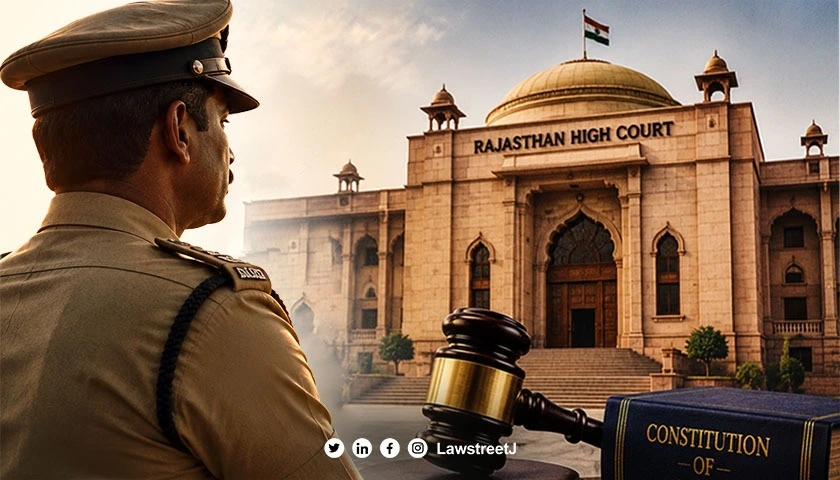
Jodhpur: The Rajasthan High Court has held that the protection of Section 197 Cr.P.C. is not attracted merely because accused persons are police personnel who visited a house to execute a warrant, and that it cannot be converted into a protective umbrella for acts of gratuitous violence.
It set aside a Sessions Judge’s order that had discharged four accused for want of sanction and restored the Magistrate’s order taking cognizance for offences under Sections 452, 323, 325 and 120-B IPC.
Justice Farjand Ali was hearing a criminal revision filed by Ganga Singh against the order of 07.10.2013 of the Sessions Judge, Bikaner, which had set aside the order of 17.04.2010 of the Additional Chief Judicial Magistrate No. 2, Bikaner, taking cognizance against Bhupendra Singh, Surendra Kumar, Ramchandra and Ram Lal. The complaint alleged that the accused came to the petitioner’s house enquiring about his brother, Durga Singh, and assaulted him. When his mother, Nain Kanwar, intervened, Bhupendra Singh allegedly struck her on the mouth with a danda, breaking a tooth, while the others bit her hand and assaulted her, and the petitioner was later beaten at the police station and made to sign blank papers.
The Court held that Section 197 is a safeguard against vexatious prosecution, but the protection is neither absolute nor automatic by virtue of official status, and requires a reasonable and direct nexus between the act complained of and official duty. It relied on Matajog Dobey v. H.C. Bhari (AIR 1956 SC 44), B. Saha v. M.S. Kochar ((1979) 4 SCC 177) and P.K. Pradhan v. State of Sikkim ((2001) 6 SCC 704), noting that the question depends on the nature of allegations and not on a mechanical formula. The Court observed that the power to arrest or execute a warrant does not extend to inflicting punitive or retaliatory injuries, and that law permits only such force as is reasonably necessary.
The Court considered D. Devaraja v. Owais Sabeer Hussain ((2020) 7 SCC 695) and D.T. Virupakshappa v. C. Subash ((2015) 12 SCC 231), observing that applicability of Section 197 is fact-specific. It found Dr. S.M. Mansoori v. Surekha Parmar (2023 SCC OnLine SC 436) particularly instructive, where, on allegations of assault by police who visited a house in connection with an arrest, the Supreme Court held it premature to conclude that sanction was necessary and left the question open for evidence. Applying this, it held:
“No police officer is vested with the authority to break the bones or teeth of a citizen under the pretext of performing official duty.”
The Court said the authority to apprehend a person cannot be equated with authority to assault his family members or persons who intervene, and such conduct, if established, would be an abuse of official position and not an ordinary incident of executing a warrant. It also held that the revisional court wrongly relied on the absence of conclusive medical proof that the tooth was broken, since at the stage of cognizance the court need not insist on proof of each ingredient, and whether the injury was caused and corroborated are matters for trial. The revisional court had further erred in comparing injury reports of both sides and accepting the defence version, since a cross-version or an FIR by the police does not by itself make a private complaint false.
The Court added that the statutory requirements of the status and removability of the public servant, apart from nexus with official duty, were not satisfactorily examined by the Sessions Judge. It clarified that its finding is confined to the legality of the revisional order, and the accused may raise the question of sanction at an appropriate stage if later material warrants.
The revision was allowed, the Sessions Judge’s order was set aside, and the Magistrate’s order taking cognizance was restored and affirmed. The matter was remanded to the Trial Court to proceed from the stage prior to the impugned order, uninfluenced by the observations on merits.
Appearances:
For the Petitioner: Mr. D.S. Gharsana.
For the Respondents: Mr. Narendra Gehlot.
Case Title: Ganga Singh vs. State of Rajasthan & Ors., S.B. Criminal Revision Petition No. 1276/2014, 2026:RJ-JD:51006