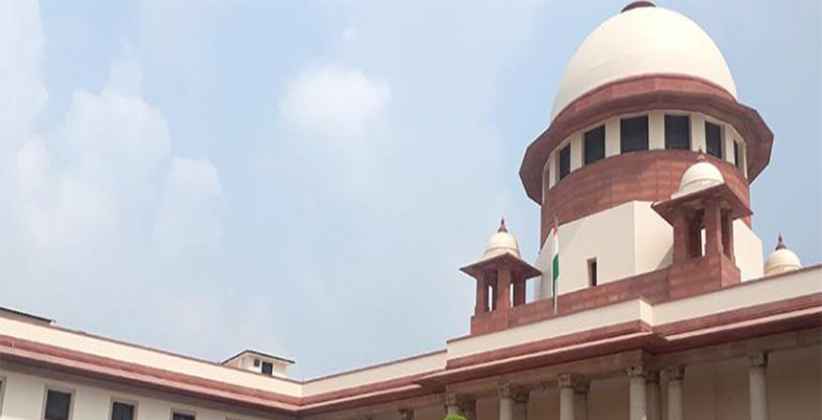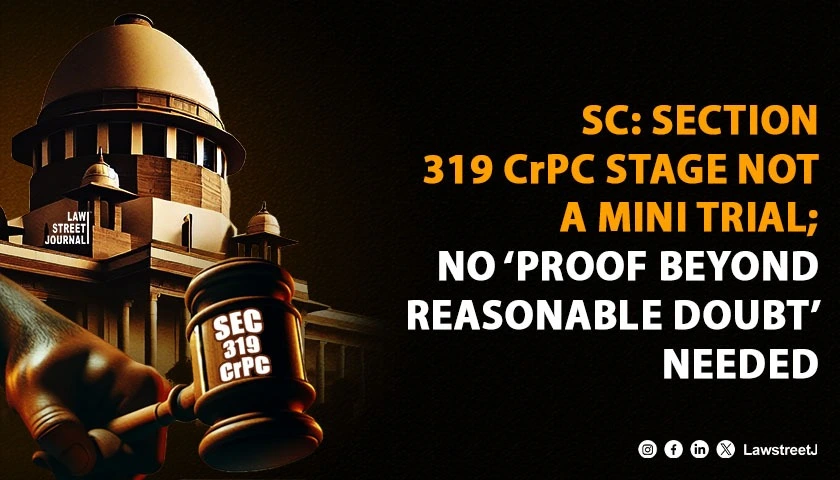
New Delhi: The Supreme Court of India has held that, while considering an application to summon additional accused under Section 319 of the Code of Criminal Procedure, a trial court cannot conduct a microscopic analysis of evidence or apply the standard of proof beyond reasonable doubt.
The Court made it clear that, at this stage, the only question before the court is whether the evidence on record, taken as a whole, is strong and cogent enough to reasonably indicate the involvement of the proposed accused.
A Bench of Justices Sanjay Karol and Augustine George Masih set aside concurrent orders passed by the Additional Sessions Judge, Muzaffarnagar, and the Allahabad High Court, both of which had refused to summon two additional accused persons, namely Rajendra and Mausam, under Section 319 CrPC. The Court found that both the courts below had applied a standard far stricter than what the law requires at the Section 319 stage, effectively turning the summoning inquiry into a mini trial.
The case arose from an FIR dated August 22, 2017, registered at Police Station Kotwali Nagar, District Muzaffarnagar. The complainant, Mohammad Kaleem, alleged that one Mohammad Ammar was shot and killed while the two were travelling together on a scooter. The FIR named Dilshad, Mumtaz, and Abid as the shooters and alleged that the murder was carried out at the behest of Gulshanawwar, Naushad, and Jamshed, who were lodged in jail at the time. During the trial, the complainant sought to have Rajendra and Mausam summoned as additional accused, contending that they had acted as intermediaries who conveyed messages from the jailed accused to those who carried out the murder.
The application was supported by the testimony of three witnesses, including the complainant himself as PW-1, and two other witnesses, PW-6 Khalil and PW-7 Tazim, who claimed to have overheard Rajendra and Mausam discussing the conspiracy. The trial court rejected the application by order dated November 30, 2021. It noted several inconsistencies across the three witness accounts, including the fact that PW-1 stated that Rajendra and Mausam had met all three jailed accused persons, while PW-6 stated that the meeting was with Gulshanawwar and Naushad, who mentioned a discussion with Jamshed, and PW-7 stated that the meeting was only with Gulshanawwar.
The trial court also pointed to the absence of jail entry and exit records, the physical implausibility of the witnesses’ route home, the fact that they informed only the complainant rather than the deceased, and contradictions between the FIR and the complainant’s testimony on matters such as how Ammar was taken to the hospital and the number of assailants present.
The High Court upheld this order. Aggrieved, the complainant approached the Supreme Court.
The Supreme Court, while dealing with the matter, clearly laid out how courts assess evidence at three distinct levels depending on the stage of proceedings. The lowest threshold, described as the prima facie standard, requires only a connection sufficient to frame charges. The middle threshold, which is the standard applicable under Section 319 CrPC, requires evidence that is strong and cogent, reliable, and reasonably persuasive, though proof beyond reasonable doubt is not required. The highest threshold is the proof beyond reasonable doubt standard, which applies only at the stage of conviction.
The Court found that the trial court had misdirected itself by applying a standard higher than the one legally required. Evaluating whether the complainant could have physically avoided injury, insisting on documentary corroboration in the form of jail records, and scrutinising minor discrepancies in hospital admission details were all matters that went beyond the scope of a Section 319 inquiry. The Court held that oral evidence alone, if credible, may be sufficient at this stage, and that documentary corroboration is not a prerequisite.
The Court also found fault with the trial court’s fragmented approach to evidence appreciation. Rather than assessing the cumulative weight of the testimonies and circumstances, the trial court had treated each inconsistency in isolation. The Supreme Court held that, while the inconsistencies identified by the trial court were not entirely baseless, they were questions that go to the weight and reliability of evidence during trial, not matters to be resolved threadbare at the pre-trial summoning stage. Credibility assessment and detailed examination of contradictions belong to the domain of the trial itself, not to the limited inquiry under Section 319.
The Court relied on its earlier decisions in Hardeep Singh v. State of Punjab, (2014) 3 SCC 92, and Neeraj Kumar v. State of Uttar Pradesh, 2025 SCC OnLine SC 2639, both of which hold that the power under Section 319 CrPC is extraordinary in nature and should be exercised sparingly, but also that the Court need not establish guilt or conduct a detailed credibility analysis at this stage. What is required is a reasonable inference of involvement drawn from the totality of the evidence, not a finding of guilt.
Applying these principles, the Supreme Court held that the sworn testimony of three witnesses, including the complainant, naming Rajendra and Mausam as persons involved in the larger conspiracy, was sufficient to meet the “strong and cogent evidence” standard in the facts of this case. Inconsistencies in their accounts, while present, were matters for the trial and did not justify a refusal to summon the proposed accused.
The Court accordingly set aside the orders of both the trial court and the High Court and directed that Rajendra and Mausam be produced as additional accused and proceeded against in accordance with law. A copy of the order was directed to be sent to the trial court through the Registrar General, High Court of Judicature at Allahabad.
Case Title: Mohammad Kaleem v. State of Uttar Pradesh & Ors. (Criminal Appeal arising out of SLP (Crl.) No. 11085 of 2023 and SLP (Crl.) No. 11510 of 2023)