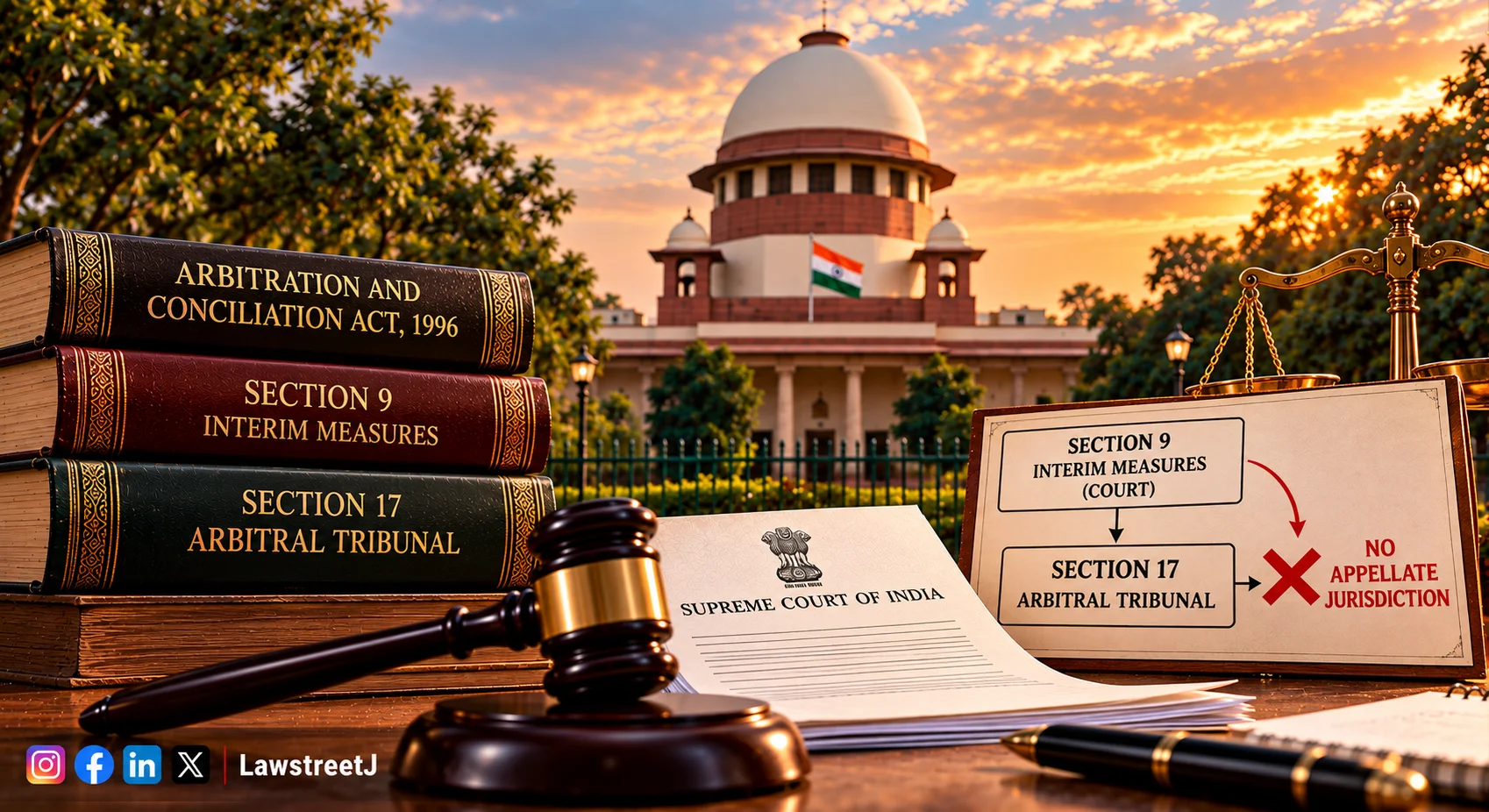
New Delhi: The Supreme Court has set aside, to a limited extent, a Bombay High Court order that had remitted a pending Section 37 arbitration appeal to a newly constituted Arbitral Tribunal with a direction to treat it as an application under Section 17 of the Arbitration and Conciliation Act, 1996.
A Bench of Justice Aravind Kumar and Justice Prasanna B. Varale, allowing the appeal of the Union of India in Civil Appeal arising out of SLP (Civil) No. 33087 of 2026 against Hariom Projects Pvt. Ltd., framed the question as “whether the High Court . . . can by consent of the parties, remit the appellate proceedings to the . . . Arbitral Tribunal” to be treated as a Section 17 application.
The dispute arose out of a contract for administrative and training infrastructure at NDA Khadakwasla, in the course of which the respondent's Section 9 application for interim relief before the District Judge, Pune was dismissed, leading to a Section 37 appeal before the High Court. While that appeal was pending, the Union terminated the contract, and the High Court, upon appointing a Sole Arbitrator, remitted the Section 37 proceedings to the Tribunal to be treated as a Section 17 application.
The Union of India did not challenge the appointment of the arbitrator but confined its challenge to the remand direction, contending that the appellate jurisdiction under Section 37(1)(b) “could be challenged only by way of a statutory appeal” and vested exclusively in the Court, so that an Arbitral Tribunal “could neither entertain nor adjudicate the issues pending in Section 37 appeal.”
Senior Counsel for the respondent fairly conceded that the direction to treat the Section 37 proceedings as a Section 17 application “cannot be sustained, as the same is impermissible in law,” while urging that the constitution of the Arbitral Tribunal itself be left undisturbed, since the parties had since entered into a Supplementary Agreement.
Agreeing with this position, the Court held that the appellate jurisdiction under Section 37 vests exclusively in the “Court” as defined under Section 2(1)(e) of the Act, and that an Arbitral Tribunal exercising powers under Section 17 “does not exercise appellate jurisdiction over an order passed by a competent Court under Section 9,” so the two powers “cannot be interchanged merely by transmitting or remitting the appellate proceedings to the Tribunal.”
The Court observed that, at the highest, the High Court could only have granted the claimant liberty to independently approach the Tribunal under Section 17 for interim measures, and that the original prayer against termination of the contract had in any event “got spent itself” once the contract was terminated.
The Court accordingly set aside the impugned order “to that limited extent,” while leaving the constitution of the Arbitral Tribunal intact and clarifying that all other issues between the parties would continue to be adjudicated by the Tribunal, with the appeal disposed of with this modification.
Case Title: Union of India & Others vs. Hariom Projects Pvt. Ltd.