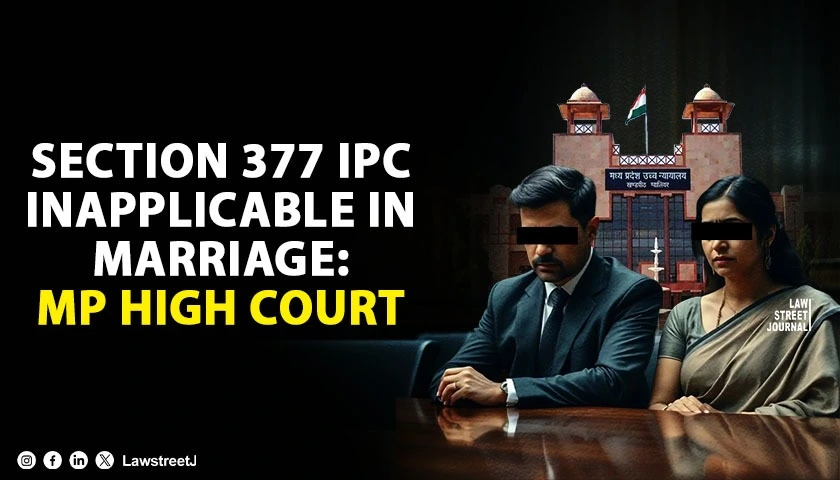
Gwalior: The Gwalior Bench of the Madhya Pradesh High Court has held that, in view of the expanded definition of rape under Section 375 of the Indian Penal Code as amended by Act No. 13 of 2013, and the statutory marital exception carved out therein, the offence of unnatural intercourse under Section 377 IPC cannot be invoked for sexual acts committed between a husband and wife during the subsistence of a valid marriage.
The Court, comprising Justice Milind Ramesh Phadke, further held that where only general and omnibus allegations are made against a family member without attribution of any specific overt act, and where she finds no mention whatsoever in the complainant’s statement recorded under Section 164 Cr.P.C. before the Magistrate, her implication is prima facie an abuse of the process of law warranting quashment.
The petition under Section 482 of the Code of Criminal Procedure was filed by the petitioners seeking quashing of the FIR, charge sheet, and all consequential proceedings for offences punishable under Sections 377, 354, 498-A, 323, 294, 506, and 34 of the Indian Penal Code; Sections 3/4 of the Dowry Prohibition Act; and Section 30 of the Arms Act.
The prosecution’s case was that the complainant was lawfully married to petitioner No. 1 in accordance with Hindu rites and customs. At the time of marriage, the complainant’s parents provided dowry articles, including Rs. 4,00,000 in cash, gold ornaments, and various household items. Despite this, the accused persons allegedly remained dissatisfied and persistently demanded the remaining Rs. 6,00,000 along with a Bullet motorcycle, continuously subjecting the complainant to cruelty and harassment in connection with these unlawful demands.
It was further alleged that the father-in-law subjected the complainant to inappropriate conduct, including coercing her to accept him as a husband; that the mother-in-law dismissed her complaints and supported the accused; and that the husband subjected her to physical and sexual abuse, including unnatural acts causing severe pain, accompanied by threats that such treatment would continue until the dowry demands were fulfilled. On 11.04.2023, when the complainant was suffering from viral fever, the father-in-law allegedly threatened her with a licensed firearm, following which the husband dispossessed her of all her stridhan and forcibly abandoned her at her parental home.
Before the High Court, counsel for the petitioners submitted that petitioner No. 4 (sister-in-law) had neither been named nor assigned any role in the complainant’s statement recorded under Section 164 Cr.P.C. before the Magistrate, and that no allegations whatsoever had been made against her in earlier proceedings under Section 125 Cr.P.C. filed prior to the FIR. It was further contended that the matrimonial dispute arose due to incompatibility, that the complainant had voluntarily left the matrimonial home on 13.01.2021, and that serious allegations such as sexual assault and life threats—conspicuously absent in the earlier maintenance proceedings—were subsequently introduced in the FIR, indicating embellishment and exaggeration.
As regards petitioner No. 1, counsel contended that the medical examination did not support the allegations of forcible unnatural acts, as no injuries or signs of such acts were found, and that petitioner No. 1 had been coerced into withdrawing his divorce petition under threat of false implication under Section 377 IPC.
The State and the complainant vehemently opposed the petition, submitting that the FIR, charge sheet, and material collected during investigation disclosed the commission of cognizable and serious offences. It was contended that the allegations were specific and grave, supported by statements recorded under Sections 161 and 164 Cr.P.C.
Given that the scope of interference under Section 482 Cr.P.C. is limited, it was argued that the Court could not appreciate evidence or adjudicate disputed questions of fact at this stage, and that minor inconsistencies were matters for trial. The complainant’s counsel further submitted that a victim of sustained domestic violence may not disclose all incidents at the earliest opportunity, which is consistent with natural human conduct.
The High Court, after hearing counsel for all parties, observed that the inherent powers under Section 482 Cr.P.C. are to be exercised sparingly, with circumspection, and only in cases where the allegations do not disclose the commission of any offence or where continuation of proceedings would amount to an abuse of the process of law.
So far as petitioner No. 4 (sister-in-law) was concerned, the Court found that only general and omnibus allegations had been levelled against her without attributing any specific overt act. Crucially, no role had been assigned to her in the complainant’s statement under Section 164 Cr.P.C. before the Magistrate, and she was not mentioned in the earlier Section 125 Cr.P.C. proceedings. The Court accordingly quashed the FIR and all consequential proceedings against her.
On the question of Section 377 IPC as against petitioner No. 1, the Court undertook a detailed analysis of the definition of “rape” under Section 375 IPC both prior to and after the amendment by Act No. 13 of 2013. The Court noted that the amended provision significantly expands the scope of the offence by including various forms of penetration—oral, anal, and otherwise—within the ambit of rape. Clause (a) of the amended Section 375 clearly includes penetration of the penis into the mouth, urethra, or anus of a woman—acts which were previously categorised as “unnatural offences” under Section 377 IPC.
The Court placed reliance on coordinate Bench decisions in Manish Sahu v. State of M.P. (M.Cr.C. No. 8388/2023), which, following the Supreme Court’s judgment in Navtej Singh Johar v. Union of India (2018) 1 SCC 791, held that consent is the determinative factor for attracting Section 377 IPC; and in Umang Singhar v. State of M.P. (2023 SCC OnLine MP 3221), which held that in view of Exception 2 to Section 375 IPC, the offence under Section 377 IPC cannot be invoked for sexual acts between a husband and wife during the subsistence of marriage. The Court held that since the marital exception renders the aspect of consent legally immaterial for the purpose of prosecuting such acts as rape, and since the expanded definition of rape already encompasses the acts complained of, Section 377 IPC is rendered inapplicable to such conduct within a valid marriage.
Applying this legal position to the facts, the Court held that the allegations made against petitioner No. 1, even if taken at face value, pertain to acts committed within the marital relationship and, accordingly, do not prima facie disclose the commission of an offence under Section 377 IPC. The proceedings against petitioner No. 1 for the offence under Section 377 IPC were therefore quashed.
However, the Court declined to quash the remaining offences alleged against petitioner Nos. 1 to 3, including those under Sections 498-A, 354, 323, 294, 506, and 34 IPC, as well as Sections 3/4 of the Dowry Prohibition Act, holding that the FIR and investigation material disclosed prima facie commission of cognizable offences. The contentions regarding false implication, inconsistencies in statements, and absence of medical corroboration were held to involve disputed questions of fact to be examined during trial.
The petition was accordingly partly allowed. The FIR and consequential proceedings were quashed to the extent of petitioner No. 4, and the offence under Section 377 IPC was quashed qua petitioner No. 1. The proceedings in respect of the remaining offences against petitioner Nos. 1 to 3 were directed to continue in accordance with law.
For the Petitioners: Shri Tapendra Sharma, Advocate
For the Respondent/State: Shri Brijesh Kumar Tyagi, Public Prosecutor
For Respondent No. 2: Shri Madan Mohan Tripathi, Advocate
Case Title: [Husband & Others] v. The State of Madhya Pradesh and Others
Neutral Citation: 2026:MPHC-GWL:9922


.jpeg)
![Supporting defamatory WhatsApp posts doesn’t constitute involvement in offence of defamation: MP HC [Read Order]](/secure/uploads/2024/09/lj_6675_WhatsApp_Image_2024-09-16_at_12.24.54_PM.webp)