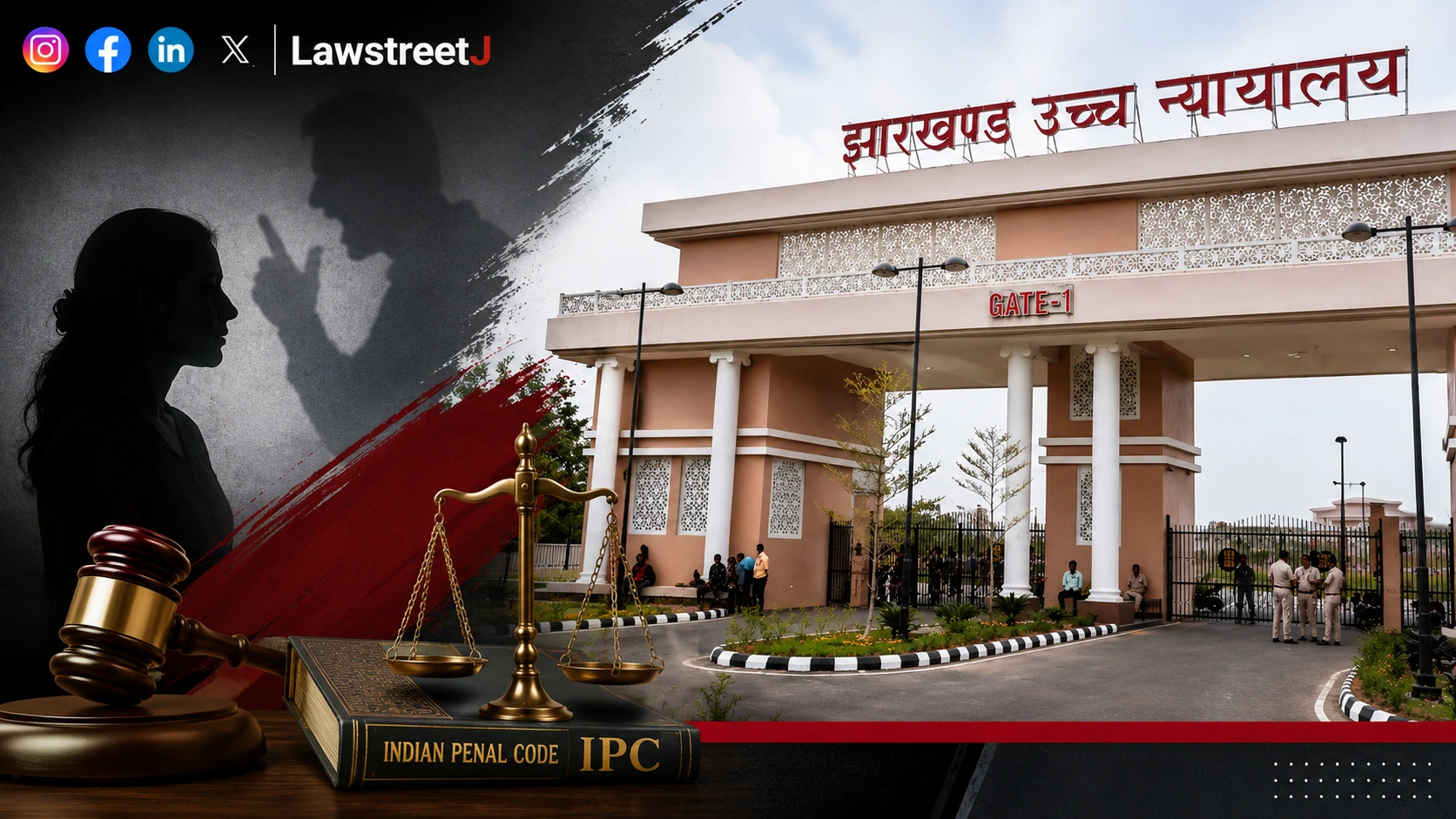
Ranchi: The Jharkhand High Court has set aside an acquittal recorded in a dowry harassment case and restored the conviction of a husband and his parents under Sections 498A and 323 of the Indian Penal Code, holding that the offence of cruelty under Section 498A does not require the unlawful demand to specifically be one of dowry, and covers any unlawful demand for money or property.
A criminal revision was filed by the complainant, against a judgment of the District and Additional Sessions Judge-I, Ghatshila, which had allowed an appeal filed by her husband and his parents, and had acquitted them of the charges. They had earlier been convicted by the learned Judicial Magistrate 1st Class, Ghatshila, in a complaint case filed by her in 2009.
According to the complaint, the petitioner was married in June 2008. It was alleged that cash of Rs.1,00,000, gold ornaments and household articles were given at the time of marriage, and that these ornaments were kept by her in-laws. After she became pregnant in September 2008, her husband allegedly began demanding a further Rs.1,00,000 from her father to purchase a machine for his rice business. When her father expressed his inability to meet the demand, the complainant alleged that she was subjected to physical and mental cruelty, denied food and other necessities, assaulted, and eventually driven out of her matrimonial home. It was further alleged that during her pregnancy she was assaulted with an intention to cause her to miscarry.
The trial court, after examining four witnesses including the complainant, convicted the accused persons under Sections 498A and 323 IPC. On appeal, the Sessions Court set aside the conviction, holding that the demand of Rs.1,00,000 was for the development of the husband's business and not for dowry, and that Section 498A was therefore not attracted. It also noted that no independent witness had deposed in the case and relied on a precedent to hold that this was a case of lack of adjustment between the spouses rather than cruelty.
Before the High Court, counsel for the petitioner argued that the Appellate Court had failed to properly appreciate the consistent testimony of the complainant and the other witnesses, which established that she was subjected to cruelty over the unfulfilled demand and was ultimately ousted from her matrimonial home. It was submitted that the Appellate Court had also ignored the circumstances of an interim order passed in a related case, pursuant to which the complainant had briefly resumed residence at her matrimonial home before again being subjected to cruelty.
Counsel for the State and for the husband supported the order of acquittal, submitting that the prosecution had failed to establish the ingredients of Section 498A beyond reasonable doubt, that the allegations were not corroborated by sufficient independent evidence, and that a revisional court ought to be slow to interfere where the Appellate Court had taken a possible view of the evidence.
Justice Pradeep Kumar Srivastava, on a scrutiny of the evidence, found that the demand of money by the husband was well corroborated by the testimony of witnesses, including an independent villager who supported the complainant's version of events. The Court held that the Appellate Court had erred in treating the case as falling outside Section 498A merely because the demand pertained to business development rather than dowry.
Examining the language of Section 498A, the Court observed that the provision defines cruelty to include harassment with a view to coercing a woman or her relatives to meet any unlawful demand for property or valuable security, and does not confine the demand to dowry alone. The Court noted that there was no plea that the sum demanded was a loan to be repaid, and held that it was a purely unlawful demand accompanied by coercive ill treatment.
“Section 498A of the I.P.C. does not speak about demand of dowry rather demand of any property or valuable security which should be unlawful.”
Holding that the Appellate Court's view that the case fell outside Section 498A was absurd and unwarranted, the High Court set aside the judgment of acquittal and restored the judgment of conviction and sentence passed by the Trial Court. The husband and his parents were directed to surrender before the Trial Court within two months to receive their sentence, failing which the Trial Court was directed to take coercive steps to secure their custody. The criminal revision was accordingly allowed.
Appearances:
For the Petitioner: Mr. Pramod Kumar and Mr. Kishlay Kumar, Advocates.
For the State: Ms. Shweta Singh, Additional Public Prosecutor.
For the Opposite Party No.2: Mr. Manoj Kumar Dash, Advocate.
Case Title: Smt. Anita Bhakat v. The State of Jharkhand and Ors., Cr. Revision No. 337 of 2017


![Supreme Court Collegium approves new Chief Justices for five key High Courts in India [Read Recommendations]](/secure/uploads/2023/12/lj_8000_380d1135-6f3a-4988-a00a-4d5cd5901815.jpg)
!['Arbitrary, impermissible,' SC quashes HC's resolution raising aggregate cut off marks on district judges appointment [Read Judgment]](/secure/uploads/2024/02/lj_3605_Rule-for-Judge-Selection.webp)