Kerala: The High Court of Kerala has allowed an arbitration appeal and set aside an interim order directing the release of Rs.98,50,365/-, representing half of the final bill amount of Rs.1,97,00,730/-, to the first respondent from the amounts payable by the Kerala Water Authority.
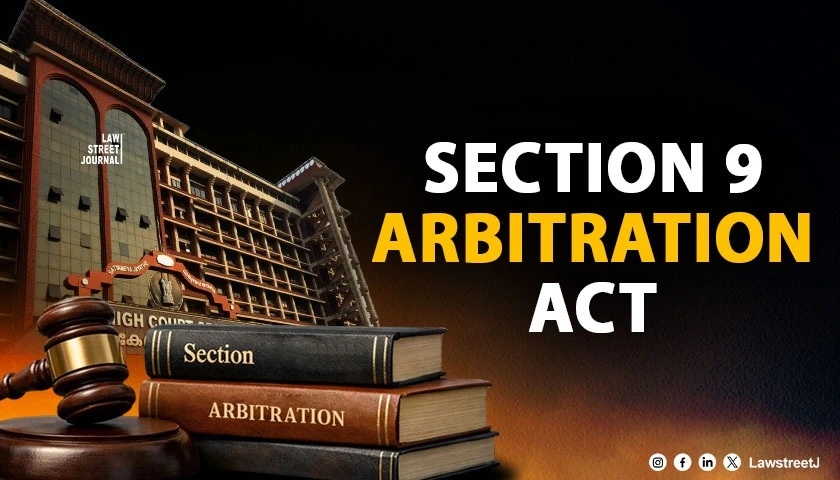
Justice S. Manu held that the vacation Judge had exceeded the jurisdiction under Section 9 of the Arbitration and Conciliation Act, 1996, by adjudicating the dispute on merits, a function reserved exclusively for the arbitrator.
The appellant and the first respondent, both registered ‘A’ Class contractors of the KWA, entered into a partnership deed on 11 February 2011 for the joint execution of a contract awarded to the first respondent for the construction of an overhead reservoir at Chellanam. Under the deed, the parties agreed to contribute capital equally, receive all KWA payments through a joint account, share profits equally, and refer disputes to arbitration.
The work was completed in 2016, and payments under 13 part-bills were credited to the joint account. However, when the final bill became due, the appellant discovered that the first respondent had requested the KWA to transfer the amount to his personal bank account instead of the joint account. The appellant thereafter filed M.A. (Arbitration) No. 2/2026 before the Commercial Court, Kochi, and obtained an interim restraint order on 13 March 2026. Pursuant to a Gazette Notification dated 5 March 2026, the matter was transferred to the District Court, Ernakulam, and renumbered as M.A. (Arbitration) No. 921/2026, where it was heard on 8 April 2026 and posted for further hearing on 18 May 2026.
The first respondent then filed urgent interlocutory applications before the vacation court. On 28 April 2026, the vacation Judge held that the Sub Judge’s earlier restraint order was without jurisdiction and passed a fresh order directing the KWA to withhold Rs.98,50,365/- on the premise that, since the partnership deed provided for equal profit-sharing, 50% of the final bill represented the first respondent’s share and had to be preserved for him.
Before the High Court, Senior Advocate Elvin Peter, appearing for the appellant, argued that Section 9 jurisdiction is intended solely to protect the subject matter of the dispute and facilitate effective arbitral proceedings, and not to effectuate the partial distribution of disputed amounts. He submitted that the vacation Judge had proceeded on the erroneous assumption that the final bill amount constituted the net profit, whereas the apportionment of profits is squarely a matter for the arbitrator. He also argued that the vacation court ought not to have intervened when the case was already posted before the regular court for 18 May 2026. Advocate K.C. Santhoshkumar, appearing for the first respondent, defended the order as a legitimate exercise of Section 9 jurisdiction and additionally challenged the validity of the partnership agreement as a suspicious and concocted document, claiming that the appellant was merely a financier.
The Court held that, by directing the release of 50% of the final bill amount, the vacation Judge had entered the realm of adjudicating the dispute on merits under the mistaken impression that the final bill amount equalled the net profit. The Court observed that whether the appellant was entitled to a share of the profits, and whether the partnership agreement was genuine, were matters requiring evidence and determination by the arbitrator. It further held that it was improper for the vacation court to pass such a consequential order when the matter was already scheduled for hearing before the regular court.
Accordingly, the appeal was allowed, the impugned order was set aside, and the Additional District Judge was directed to dispose of the M.A. (Arbitration) as expeditiously as possible. The Court also granted liberty to the first respondent to seek an expedited hearing of the application to vacate the interim order, if necessary. No costs were awarded.
Case Title: M.J. Thomas v. V.P. Abdul Azeez & Another, Arb.A. No. 15 of 2026.



![Kerala HC Quashes 498A Dowry Harassment Case Against Live-In Partner, Citing Lack of Relative Status [Read Order]](/secure/uploads/2023/08/lj_5693_1057c042-1e57-4e27-8c9e-25af0ec38ec4.jpg)
![Watching porn on mobile: Kerala HC highlights importance of mother cooked meals, outdoor sports [Read Order]](/secure/uploads/2023/09/lj_9155_Parental_supervision_of_mobile_phone_usage.jpg)
![Lakshadweep MP Mohammed Faizal Disqualified from Lok Sabha After Conviction Suspension Plea Rejected by Kerala High Court [Read Notice]](/secure/uploads/2023/10/lj_9640_87b5fd97-0e05-4ff8-9a99-3be1e4446192.jpg)