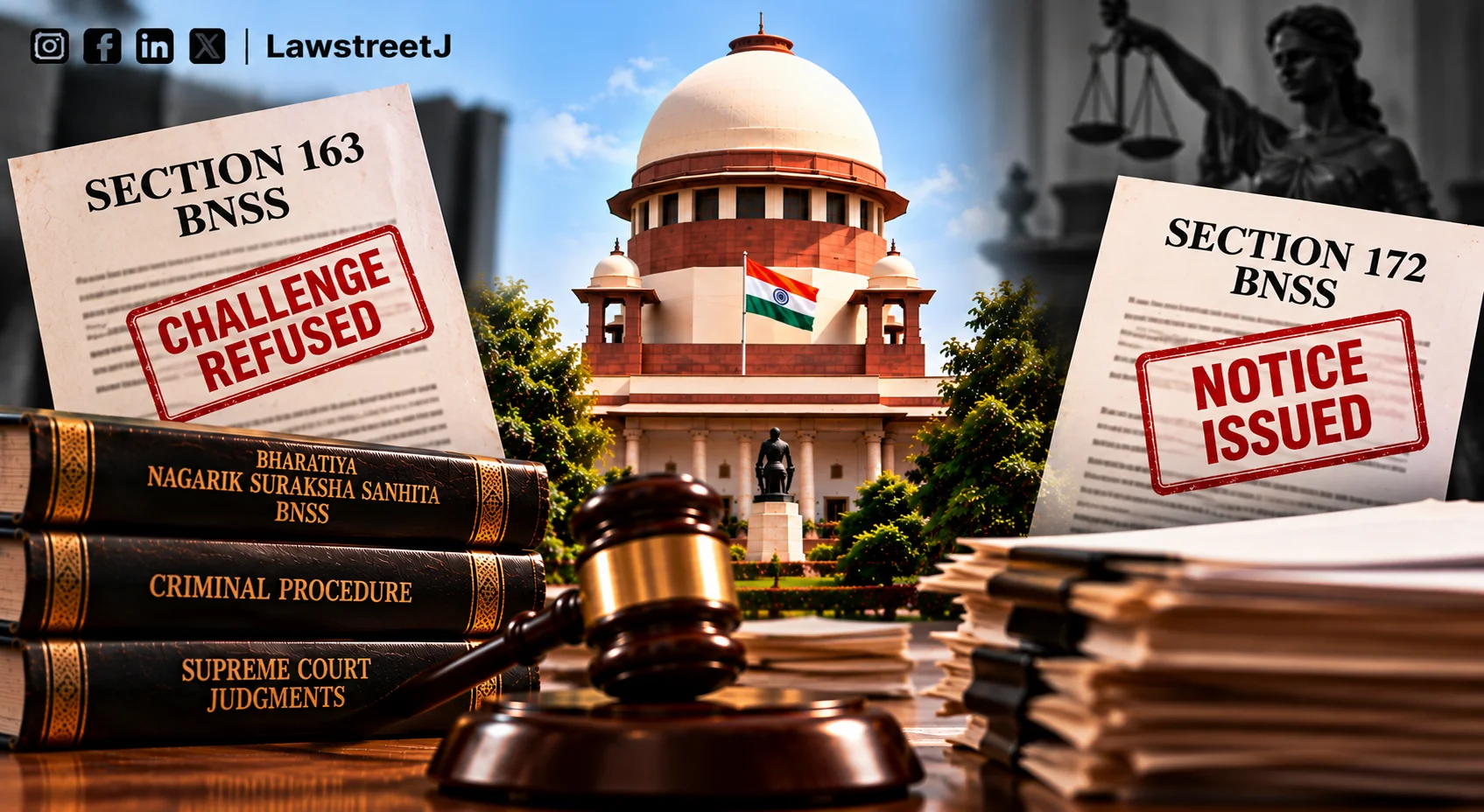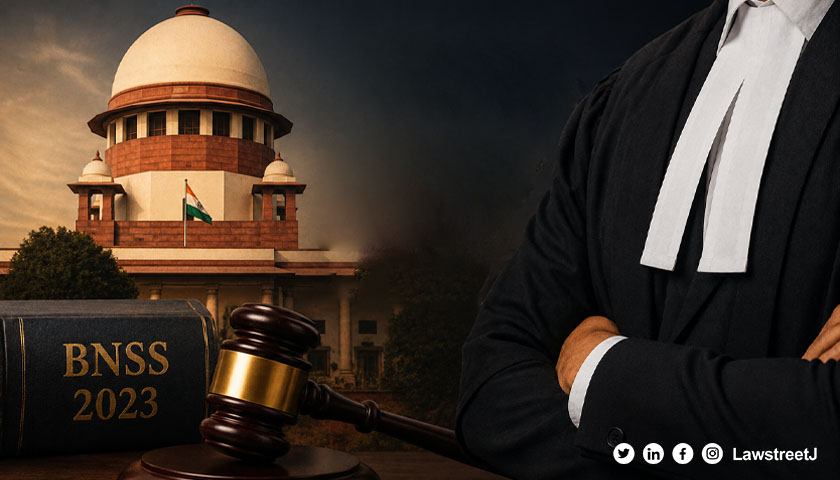
New Delhi: Clarifying the scope of Section 38 of the Bharatiya Nagarik Suraksha Sanhita, 2023, the Supreme Court has held that the provision entitles an arrested person to meet an advocate of choice during interrogation, but does not contemplate the continuous physical presence of an advocate throughout each interrogation session.
The Bench of Justice Vikram Nath and Justice Sandeep Mehta was hearing an appeal filed by the State of Andhra Pradesh against an order of the Andhra Pradesh High Court which had modified, but substantially retained, a slew of restrictive conditions imposed by a Magistrate while granting police custody of a police Inspector arraigned as an accused in a custodial death case.
The respondent-accused, an Inspector of Police, was named in an FIR relating to the custodial death of one Gade Sai Krishna, who was apprehended by Task Force personnel at Markapur in the early hours of 6th May 2026 and brought to Krishna Lanka Police Station, Vijayawada, where he was entrusted to the respondent-accused. According to the prosecution, the deceased was never produced before a Magistrate and was seen by witnesses with visible injuries. After the deceased's mother moved a habeas corpus petition, and the respondent-accused was found to have suppressed the fact of the detention, he was suspended, an FIR was registered on the mother's complaint, and a Special Investigation Team arrested him on 23rd June 2026.
On the prosecution's request for police remand under Section 187 BNSS to trace the deceased's body, recover evidence and identify co-accused, the Magistrate had granted eight days' custody confined entirely to the Central Prison, Rajamahendravaram, subject to conditions including continuous videography of the entire custody period, presence of an advocate at all times during interrogation, and an absolute, non-extendable outer limit on the custody period. The High Court, while modifying some of these conditions, retained most of them and directed that even the accused's transit between the prison and Vijayawada be continuously videographed.
Appearing for the State, Mr. Sidharth Luthra, senior counsel, argued that confining interrogation to a facility 160 kilometres from the crime scene, coupled with an omnibus videography regime, rendered the very object of police custody illusory. Appearing for the respondent-accused, Mr. L. Narasimha Reddy, senior counsel, opposed the appeal, submitting that his client's life would be at risk if lodged at a facility in Vijayawada where persons he had previously arrested were confined, and that the conditions merely reiterated constitutional safeguards available to every accused.
The Court held that the apprehension of the investigating agency regarding hurdles to effective custodial investigation was realistic, while noting that the safety and dignity of the accused already stood protected under Article 21 of the Constitution, irrespective of the specific conditions imposed. Considering that the body of the deceased remained untraced and discoveries under Section 23 of the Bharatiya Sakshya Adhiniyam, 2023 were imminent, the Court held that confining the entire interrogation to the Central Prison was neither justified nor sustainable, since its efficacy depended on the investigating officer being able to take the accused to the actual place of discovery.
On the statutory scheme governing police custody, the Court noted that Section 187(2) and (3) BNSS, unlike the erstwhile Section 167 of the Code of Criminal Procedure, 1973, enlarges the window during which custody, not exceeding fifteen days in the aggregate, may be sought in parts during the first forty or sixty days of permissible detention, rather than being confined to the first fifteen days of remand.
“We are, therefore, unable to sustain Condition 28.15, which places an absolute and non-extendable outer limit on custody, since such a limit forecloses recourse to Section 187(2) BNSS regardless of what the investigation may yet reveal.”
“When any person is arrested and interrogated by the police, he shall be entitled to meet an advocate of his choice during interrogation, though not throughout interrogation.”
Interpreting this provision, the Court held that while conditions permitting nomination of an advocate and regulating the manner and distance of the advocate's presence to prevent interference with interrogation were unobjectionable, any reading that conferred an unqualified entitlement to the advocate's continuous presence travelled beyond what Section 38 BNSS itself contemplates.
“The direction that every movement of the accused... must be continuously videographed without interruption, is, in our view, unworkable in practice... What the safeguard requires is that the interrogation itself... be continuously and contemporaneously recorded; the requirement cannot extend to an inflexible mandate to record every minute of transit, which is a totally logistical exercise.”
On the safety concerns raised on behalf of the accused, the Court held these could be adequately addressed by directing that interrogation outside the Central Prison be conducted at the SIT's designated interrogation centre or an equivalent secure facility, while continuing to fix joint and several responsibility on the named officers for his safety.
Accordingly, the Court modified the custody conditions to run for seven days from the date of the accused's production pursuant to the judgment, keeping the aggregate period of police remand within the fifteen-day statutory limit; permitted interrogation at the SIT's designated centre or an equivalent facility at Vijayawada instead of exclusively at the Central Prison; clarified that videography requirements would cover the interrogation and any discovery or recovery proceedings but not the transit between locations; retained the bar on third-degree methods and the advocate's presence within sight but without any right to intervene; and directed that the recordings, along with a certificate under Section 63 of the Bharatiya Sakshya Adhiniyam, 2023, be produced before the Magistrate at Vijayawada on completion of custody.
The appeal was allowed in these terms.
Appearances: For the Appellant: Mr. Sidharth Luthra, Senior Advocate. For the Respondent: Mr. L. Narasimha Reddy, Senior Advocate.
Case Title: State of Andhra Pradesh v. Suda Suresh Veera Venkata Naga Raju, (SLP(Crl.) No. 12344 of 2026)