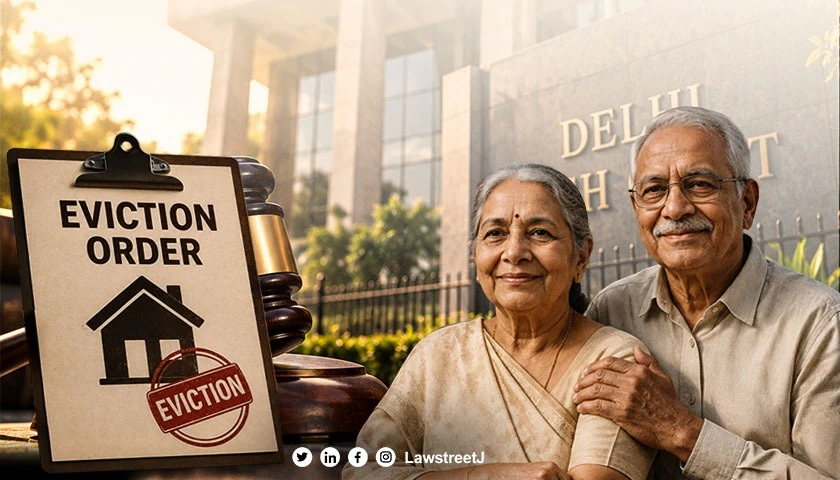
New Delhi: The Delhi High Court has held that a senior citizen seeking eviction of his children from his self-acquired property under the Maintenance and Welfare of Parents and Senior Citizens Act, 2007 need not establish ill-treatment by clear and credible evidence, and it is enough that he shows that his property needs protection so that he can live in peace and dignity.
It set aside the orders of the District Magistrate and the Divisional Commissioner and directed the son and daughter-in-law to vacate the house within four weeks.
Justice Amit Mahajan was hearing a writ petition by an 85-year-old man who owns the house, acquired from the DDA in 1980 and converted to freehold in 2000. His eldest son and daughter-in-law have lived there since their marriage in 2003, and refused to move out after his other sons married. He alleged that they stopped supporting him, threatened him and assaulted his youngest son in September 2022, and that harassment intensified after his wife’s death in 2020. His petition for eviction and maintenance before the District Magistrate was dismissed in 2023 on an enquiry report of the Sub-Divisional Magistrate (SDM), which could not ascertain whether the complaint was genuine and thought it to be a dispute between brothers. The Divisional Commissioner remanded the matter, but after a fresh SDM report the District Magistrate again dismissed it on 28.10.2025, and the Divisional Commissionerupheld this on 28.04.2026, saying that the Act cannot settle private family or property disputes without clear and credible evidence of neglect or harassment.
The father relied on Pritam Singh v. Government of NCT of Delhi to argue that eviction can be sought without proving ill-treatment. The son argued that this was a business dispute between brothers with concurrent findings of fact, relying on S. Vanitha v. Deputy Commissioner, Bengaluru Urban District, (2021) 15 SCC 730, and Shri Chand Gautam v. Govt. of NCT of Delhi.
The Court found the father’s ownership undisputed, since both enquiry reports recorded it, and the son and daughter-in-law claimed no title and lived there only as family. Its writ interference is limited to perversity or error of jurisdiction, but is warranted where authorities wrongly interpret the provisions.
The Court relied on Ravi Kant Gupta v. State of Uttar Pradesh (Supreme Court, 04.08.2026), which held that the tribunal under the Act, through its incidental powers read with Sections 7, 8 and 27, may order eviction where necessary and expedient to ensure the maintenance and protection of a senior citizen. It also relied on Pritam Singh, which held that the senior citizen need only show that his property needs protection and need not show that he needs maintenance or has been ill-treated, and on Vinay Varma v. Kanika Pasricha. It concluded that the authorities below committed an error of law by insisting on clear and cogent evidence of harassment, a condition that the Act and the Delhi Rules of 2009 do not contemplate.
The Court also found that the authorities had mechanically relied on two SDM enquiry reports that were themselves flawed. The first report said that genuineness could not be ascertained, and an inconclusive report could not prove that harassment stood disproved. The second report recorded the father’s grievances, including a video of verbal abuse at a residents’ meeting, a house visit and pen drives, but noted nothing observed, and concluded in a single line that no clear evidence was seen. The Court said that “a conclusion bereft of reasons cannot be termed a finding”. The authorities had also ignored the many police complaints and its own orders of 26.08.2025 and 29.10.2025 directing the police to protect the father. A business dispute between the sons could not by itself make his grievance not genuine.
The Court distinguished S. Vanitha, which was concerned with the shared household right of a woman under the Domestic Violence Act, where no proceedings under that Act were initiated by the daughter-in-law, and Shri Chand Gautam, where the children had filed a civil suit claiming rights in the property. It added:
“Instances of harassment of senior citizens by their children often take place within the four walls of the house and may be difficult to establish by way of independent evidence. The proceedings under the Act are summary in nature, and the authorities under the Act are not expected to insist upon a standard of proof as is required in a civil or criminal trial.”
The Court held that a senior citizen cannot be compelled to share his own house against his wishes, when relations have deteriorated so that he has had to litigate since 2022 and seek police help, and that at 85 he is entitled to live in his own house in peace and dignity. The orders of 28.04.2026 and 28.10.2025 were set aside, the son and daughter-in-law were directed to vacate within four weeks, and the SHO was directed to give all necessary assistance for compliance.
Appearances:
For the Petitioner: Mr. Madhav Khurana, Senior Advocate, with Ms. Riya Arora, Mr. Ayush Kumar, Ms. Ananya Saxena, Ms. Garima Rai Singhania, Mr. Shashank Dewan, Mr. Uttam Kumar and Mr. Hardik Arora, Advocates.
For Respondent No. 1: Mr. Anurag Ahluwalia, Senior Advocate, with Mr. Mayank Bansal, Advocate. For GNCTD: Ms. Nitika Bhutani, Panel Counsel. For the Union of India: Ms. Puja S. Kalra, CGSC.
Case Title: XXX vs. XXX & Ors., W.P.(C) 6452/2026