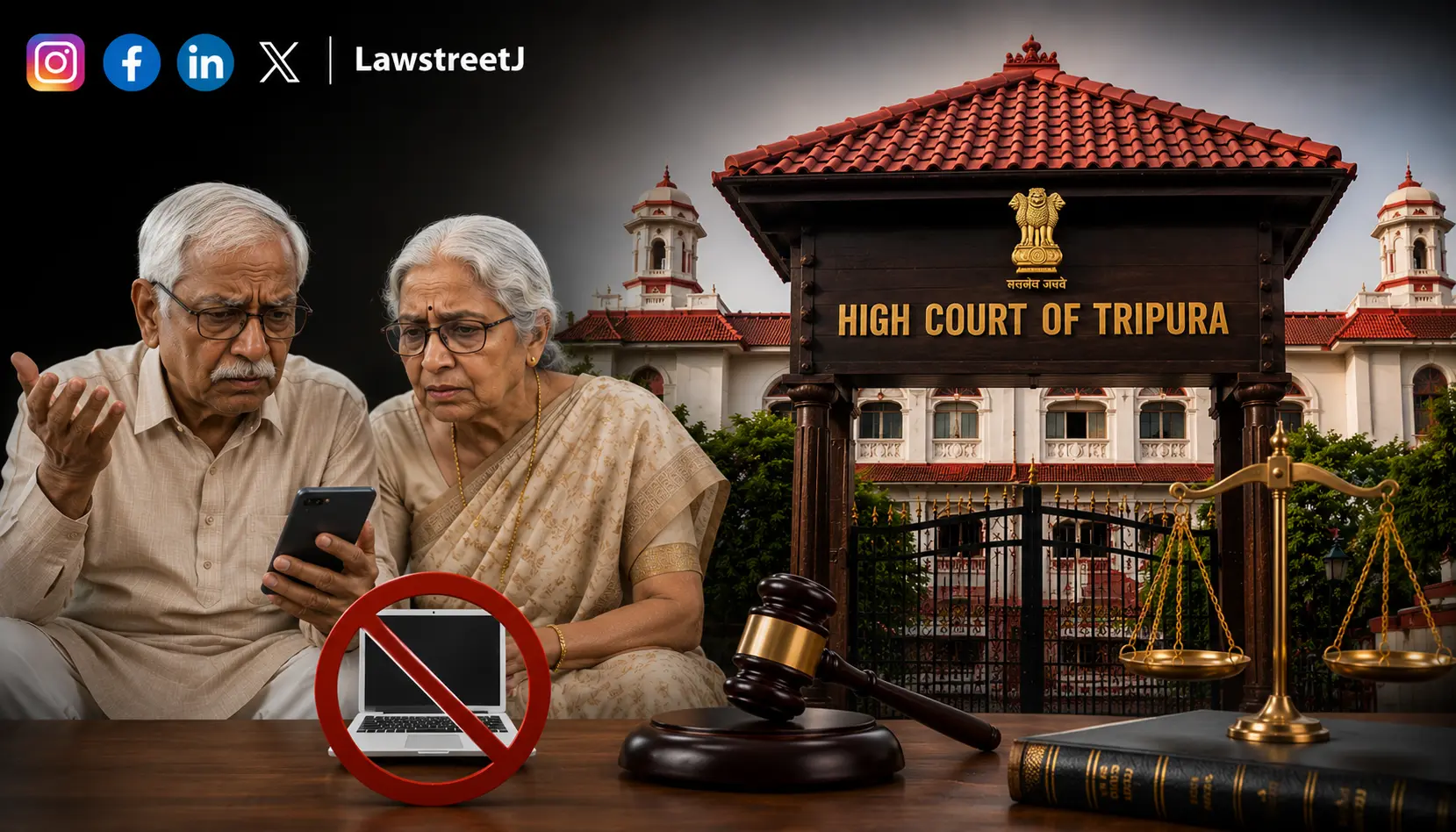
Agartala: The High Court of Tripura has ruled that senior citizens cannot be penalised for failing to monitor their case on the official court website, setting aside a District Judge's refusal to condone delay in filing a first appeal and to bring the legal heirs of a deceased appellant on record.
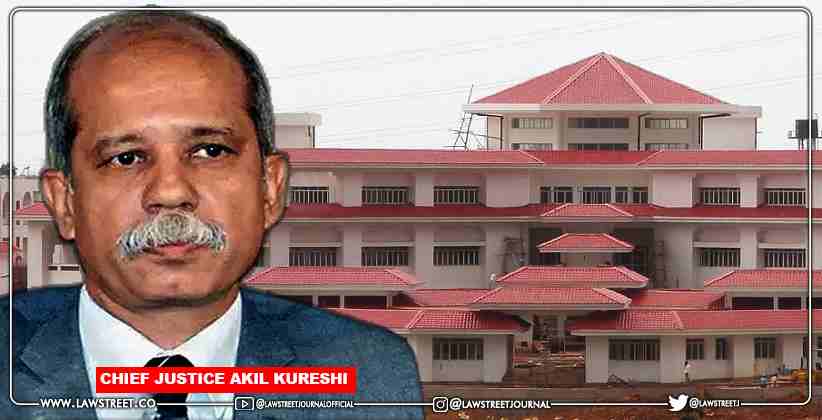
A Bench of Chief Justice M.S. Ramachandra Rao was hearing a civil revision petition and a regular second appeal filed by defendants in a suit for declaration of title and recovery of possession before the Civil Judge (Senior Division), Udaipur, Gomati District. The plaintiff had claimed that the suit property belonged to his mother, that the defendants' predecessor had been permitted to remain on the land as a permissive possessor, and that the defendants were consequently trespassers liable to be evicted.
The defendants' counsel withdrew from the suit citing an inability to communicate with his clients, following which the trial court proceeded ex parte and decreed the suit on 22 August 2023. Their application under Order IX Rule 13 of the Code of Civil Procedure to set aside the ex parte decree, along with a plea for condonation of over fifteen months' delay, was dismissed on 21 June 2025.
The defendants then filed a first appeal before the District Judge, Gomati District, along with an application under Section 5 of the Limitation Act, 1963 seeking condonation of a delay of twenty-three months and eight days. They explained that the first defendant, aged seventy-seven, was intermittently of unsound mind, and that the second defendant had fallen ill and lost touch with counsel after the earlier advocate withdrew without informing them of the ex parte decree.
While the appeal was pending, the second defendant died, and his legal heirs applied under Order XXII Rule 4 read with Section 151 of the Code to be brought on record. By a common order dated 26 November 2025, the District Judge dismissed the substitution application for want of a separate Section 5 Limitation Act plea, and dismissed the condonation application itself, holding that the explanation for delay was vague and that litigants were expected to remain vigilant by checking the court's official website.
Before the High Court, counsel for the appellants argued that the District Judge had overlooked that withdrawal of counsel without notice to the litigants had directly caused the ex parte decree, and that a liberal approach was warranted given their advanced age and infirmity. Counsel for the respondent supported the impugned orders.
Examining Articles 120 and 121 of the Limitation Act, 1963, the Court held that while legal representatives of a deceased party must ordinarily be brought on record within ninety days of death, an application to set aside abatement can still be filed within sixty days of the abatement itself. Since the second defendant died on 20 August 2025 and the substitution application was filed on 26 November 2025, six days after the appeal abated but within the sixty-day window, the Court held there was no requirement in law for the legal heirs to have filed a separate Section 5 application.
Relying on the Supreme Court's ruling in Mithailal Dalsangar Singh versus Annabai Devram Kini, the Court observed that a plain application for substitution of legal representatives, even without an express prayer to set aside abatement, must in substance be treated as seeking that relief, since courts must adopt a justice-oriented approach and not deny a litigant a hearing on merits absent gross negligence or misconduct. It held that the District Judge's insistence on a separate Section 5 application was "patently illegal and amounts to refusal to exercise jurisdiction", warranting interference under Article 227 of the Constitution.
Turning to the condonation plea, the Court found that both appellants were senior citizens when the suit was pending, with the first defendant alleged to be intermittently of unsound mind, and that withdrawal of counsel without informing them had directly resulted in the ex parte decree. Rejecting the District Judge's reliance on the litigants' failure to track the case online, the Court held that "persons who are not technologically savvy like senior citizens in the instant case, cannot be penalised for not doing so." It also noted that the defendants had diligently pursued their Order IX Rule 13 application soon after learning of the ex parte decree, a fact the District Judge had failed to consider, and that denying them a hearing on merits, given the stakes involving title to immovable property, would amount to a travesty of justice.
Relying further on Radhey Shyam versus Chhabi Nath and K.P. Natarajan versus Muthalammal, the Court affirmed that its supervisory jurisdiction under Article 227 of the Constitution remains available to set aside orders passed under Section 5 of the Limitation Act, notwithstanding the curtailment of revisional jurisdiction under Section 115 of the Code of Civil Procedure.
Allowing both the revision petition and the second appeal, the High Court set aside the orders dismissing the substitution application, the condonation plea, and the consequential dismissal of the first appeal. It restored the appeal to the file of the District Judge, Gomati District, directing that it be decided on merits within four months, with execution proceedings arising from the ex parte decree to remain stayed in the meantime.
Appearances: Mr. Abhijit Sengupta appeared for the appellants/petitioners, while Mr. Dilip Kumar Das Chawdhury appeared for the respondent.
Case Title: Sukesh Chandra Saha & Ors. versus Parimal Saha [RSA No.03 of 2026 with CRP No.14 of 2026]


![Filing of chargesheet not a ground for bail in NDPS cases: Tripura High Court [Read Order]](/secure/uploads/2024/06/lj_4838_756ef768-26b3-49f8-bb60-1d6f1fb48d3a.webp)
![Tripura HC Sets Aside Tender, Slams ‘Bangladesh Emergency’ Claim as Pretext to Favour L2 Bidder [Read Judgment]](/secure/uploads/2026/03/lj_3936_Tripura_HC_Sets_Aside_Tender.webp)
![Cannot Penalise Lawyers For Attending Court Despite Boycott Calls: Tripura HC [Read Order]](/secure/uploads/2026/05/lj_8569_Cannot_Penalise_Lawyers_For.webp)