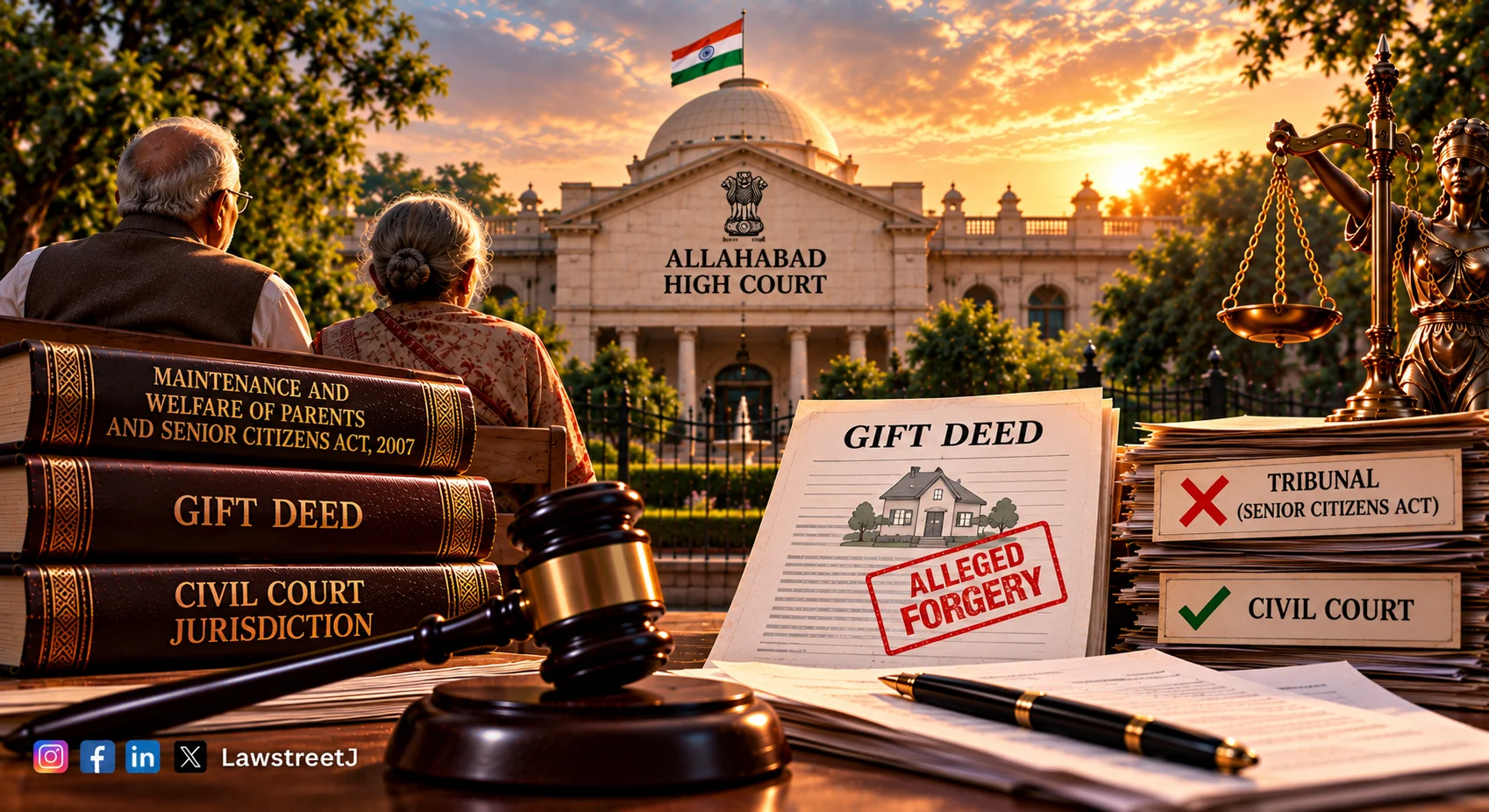
Allahabad/Prayagraj: The Allahabad High Court has dismissed a writ petition filed by a 68-year-old senior citizen seeking to void a gift deed he claimed was forged by his daughter and evict her and her husband from his house, holding that the Tribunal under the Maintenance and Welfare of Parents and Senior Citizens Act, 2007 has no jurisdiction to try allegations of forgery.
A Division Bench of Justice J.J. Munir and Justice Indrajeet Shukla, was examining a challenge to an order of the District Magistrate, Lalitpur, rejecting his application under Section 23 of the Act of 2007 for restoration of possession of his house from his daughter, and son-in-law.
The petitioner alleged that his daughter and son-in-law had fabricated a registered gift deed dated 18.11.2023 purportedly conveying the property to her, and had forcibly dispossessed him after assaulting him and his family, giving rise to a pending criminal case.
Rejecting the plea that the Tribunal could void the deed and order eviction, the Court held that Tribunals under the Act of 2007 “are not replacements for the Courts of civil jurisdiction and cannot be converted into substitutes for such Courts to try civil actions.”
Examining Section 23(1) of the Act, the Court explained that the provision is attracted only where a senior citizen has made a valid transfer subject to a condition that the transferee provide basic amenities, and the transferee later reneges on that condition; it is “not a wide open power to impeach the validity of a document.”
The Court held that where a senior citizen's case is that a conveyance was secured through actual forgery, “it is certainly not the Tribunal, that would have jurisdiction to act at the instance of the senior citizen and declare the conveyance void,” and that only a competent civil court could entertain such a claim.
The Bench also cautioned Tribunals across the State against following an “anomalous procedure of setting up committees” to inquire into disputed facts, noting that the Act of 2007 prescribes a judicial procedure under Sections 6 and 8, and that the “administrative way of functioning” adopted by the District Magistrate in this case had “absolutely no place” in that scheme.
Holding that the petitioner's case for declaring the gift deed void was “completely beyond the scope of proceedings under the Act of 2007,” the Court found no ground to interfere with the impugned order and dismissed the petition, while clarifying that this would “not prevent the petitioner from enforcing his rights by instituting an appropriate action before the Court of competent civil jurisdiction.”
Appearances: Mr. Sarvesh Kumar Pandey, Advocate, holding brief of Mr. Akshay Raj Singh, Advocate, appeared for the petitioner. Ms. Amrita Singh, Additional Chief Standing Counsel, appeared for the State of Uttar Pradesh.
Case Title: Balveer Singh vs. State of Uttar Pradesh and Others


!["No Loudspeakers For Azan, No Fundamental Right To Create Noise," Says Allahabad HC To Two Mosques [Read Judgment]](/secure/uploads/2020/01/lj_4995_Allahabad_HC_AZAN.jpg)