


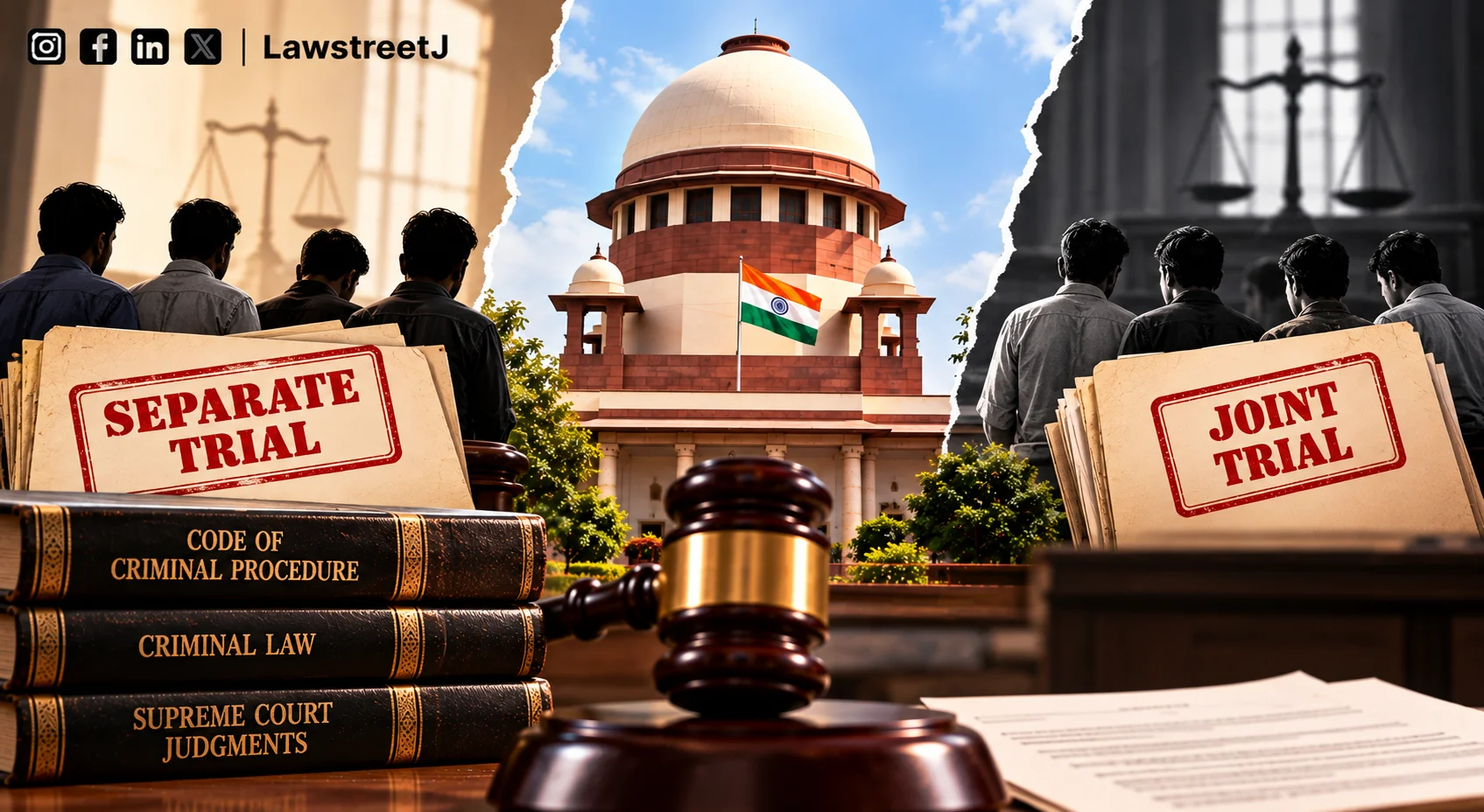
New Delhi: The Supreme Court has set aside an Allahabad High Court order directing the consolidation of a sessions trial with a complaint case arising from a cross-allegation of trespass and assault, holding that separate trial is the norm and that clubbing a serious sessions-triable case with a complaint case was not warranted.
A Bench of Justice Ujjal Bhuyan and Justice Atul S. Chandurkar was hearing an appeal by Danish and others against the High Court's order dated 30.10.2025. The High Court had, in an application under Section 528 of the Bharatiya Nagarik Suraksha Sanhita, 2023, set aside the Additional Sessions Judge's order dated 09.09.2025 rejecting consolidation, and directed that the two cases be tried together.
The dispute arose from an incident of 01.07.2021 in Baraut, Baghpat. An FIR lodged by one Irfan, father of the first appellant, alleged that several persons trespassed into their house armed with sharp-edged weapons and sticks and attacked the inmates, leaving two of his sons with serious head injuries and fractures. It was registered as Case Crime No. 759 of 2021 under Sections 147, 148, 149, 323, 308, 354, 354-B and 506 of the Indian Penal Code, and later became Sessions Trial No. 344 of 2022.
Five days later, on 06.07.2021, Sameena, wife of Momin, filed a complaint before the Chief Judicial Magistrate, Baghpat, against Danish, Aamir, Irfan and others, alleging that at about 10:00 PM on the same day they forcibly entered her house with iron rods, firearms and knives and assaulted her and her husband. This was registered as Complaint Case No. 5725 of 2021. The second respondent then sought clubbing of the complaint case with the sessions trial, which the Additional Sessions Judge refused on the view that the complaint was not a cross case.
Before the Supreme Court, the appellants argued that the sessions trial was at the stage of final arguments and that the consolidation bid was an attempt to delay proceedings. They contended that the two incidents, though in near vicinity, were separate, and that filing of the complaint five days after the FIR showed it was not a cross case. They also submitted that they had not consented to consolidation and had taken steps against the counsel who appeared for them before the High Court, and relied on Lakshmanan v. State.
The second respondent argued that the incidents were connected and that the High Court acted on a concession by the appellants' counsel, with no prejudice caused by a joint trial. Counsel for the State supported the High Court's order, submitting that a joint trial would benefit both sides and that witnesses would be more or less common.
The Court noted that the time of the incident in the FIR was between 8:00 PM and 10:30 PM, while the complaint mentioned about 10:00 PM. It observed that although the two incidents occurred in close proximity, their situs was different, since the FIR concerned trespass at the appellants' residence and the complaint concerned trespass at the second respondent's residence. It also noted that neither Sameena nor her husband Momin was named as an accused in the FIR.
Reviewing Sections 218 to 223 of the Code of Criminal Procedure, 1973, the Court reiterated that separate charge and trial for every distinct offence is the norm under Section 218(1), with joint trial permitted only in the situations provided in the later provisions. It relied on the summary in paragraph 13.3 of Lakshmanan, which holds that even where a joint trial is permissible it remains a matter of judicial discretion, that the decision must ordinarily be taken at the outset and for cogent reasons, and that the paramount considerations are prejudice to the accused and delay or wastage of judicial time.
The Court further noted that one case was a sessions-triable matter with serious consequences, while the other was a complaint case ordinarily adjudicated by a court lower in the hierarchy. In such a situation, the Bench held that “clubbing of the two proceedings is really not warranted.” It concluded that the High Court erred in interfering with the Additional Sessions Judge's order.
Allowing the appeal, the Court set aside the High Court's order and directed that Sessions Trial No. 344 of 2022 and Complaint Case No. 5725 of 2021 be proceeded with separately before the respective courts in accordance with law. The interim stay granted on 21.04.2026 had earlier halted both proceedings. Pending applications were disposed of.
Case Title: Danish & Ors. vs. State of UP & Anr., Criminal Appeal arising out of SLP (Crl.) No. 7334 of 2026


.jpeg)

.jpeg)

