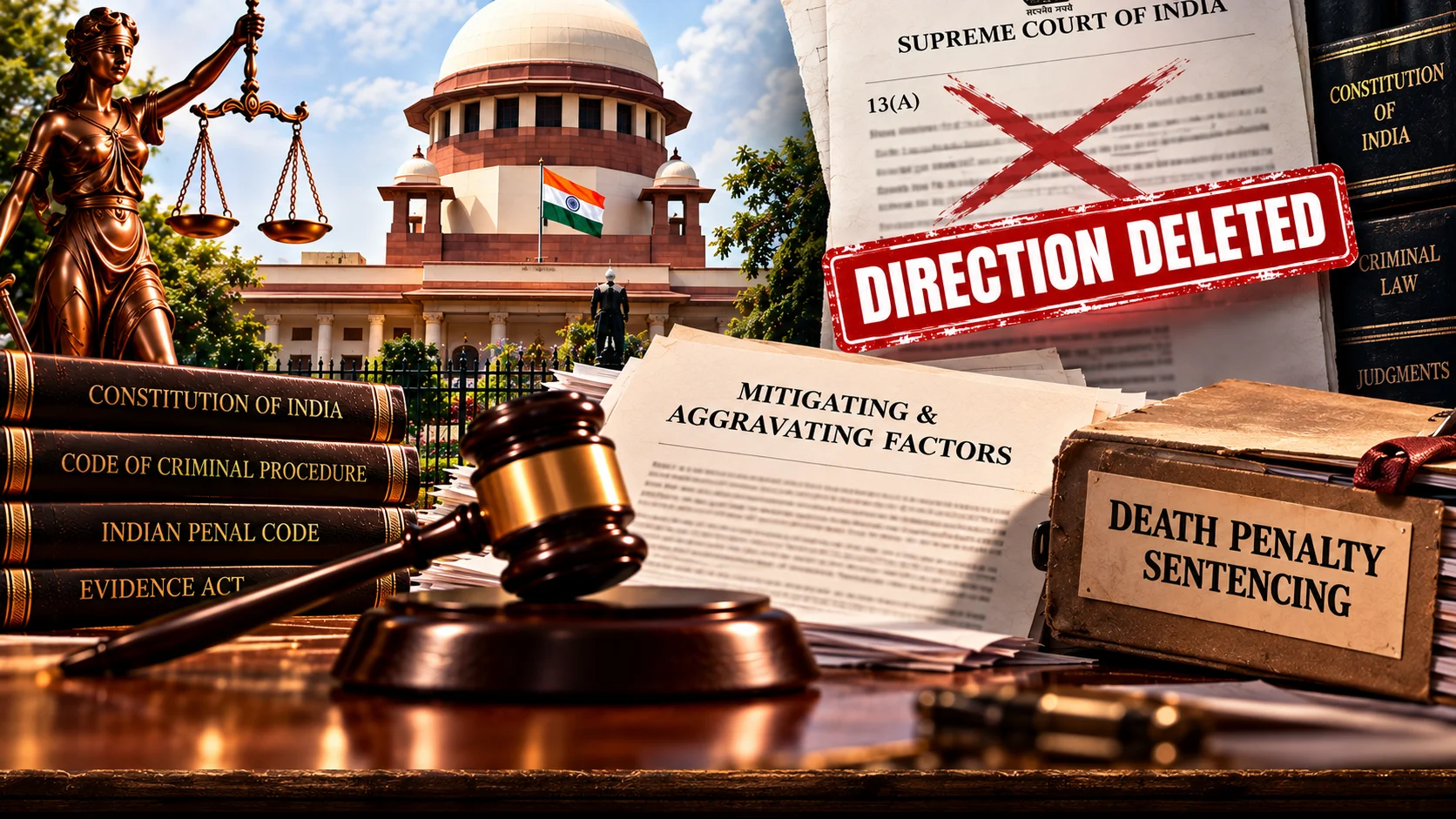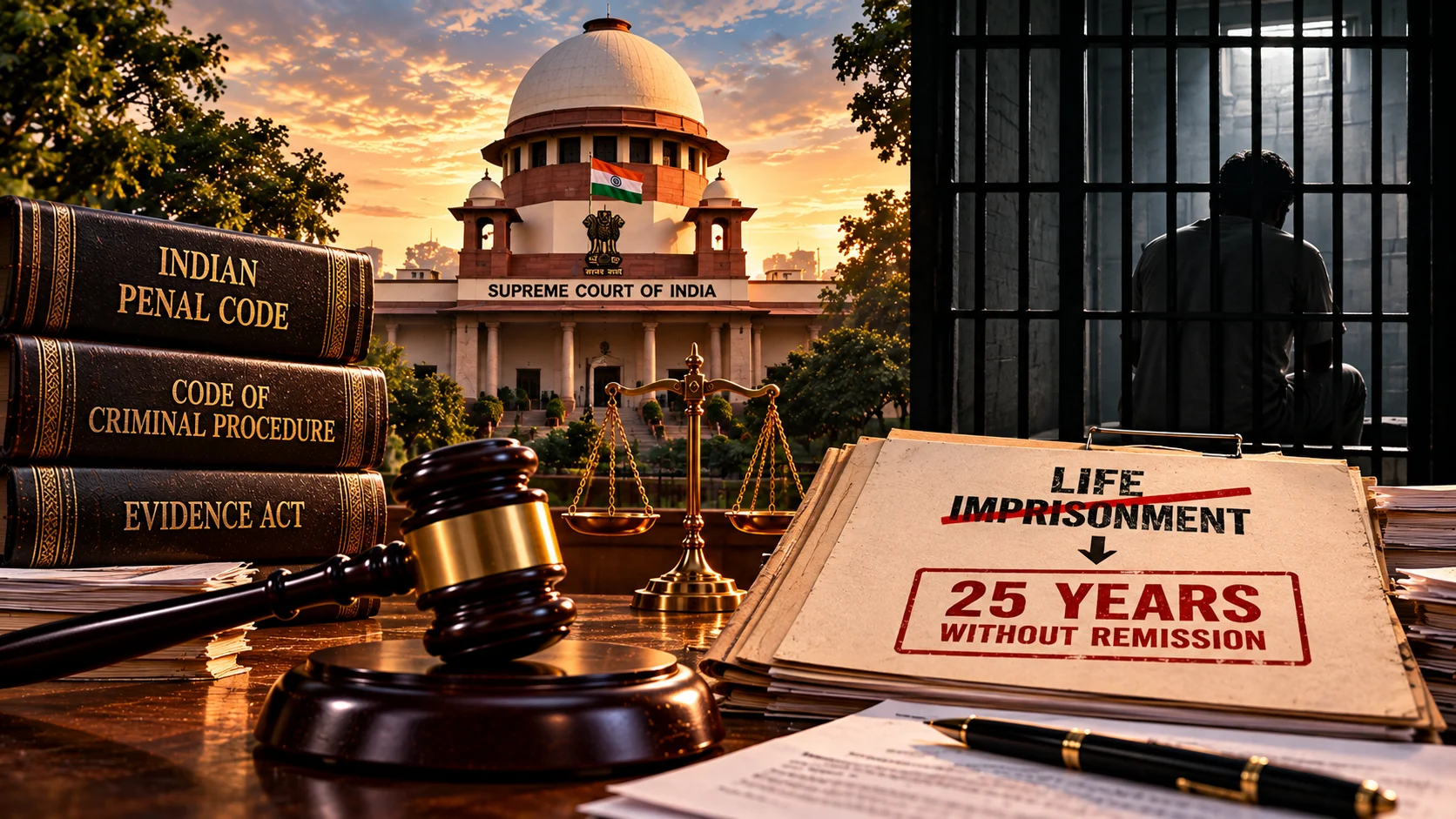
New Delhi: The Supreme Court has held that a Court of Session, while sentencing a convict to imprisonment for life under Section 302 IPC, has no power to direct that the convict shall remain in prison for the rest of his natural life, since such a special category sentence excluding the statutory remission regime can be imposed only by a Constitutional Court. Exercising this power itself, the Court modified the sentence of two convicts in a triple murder case from life imprisonment without any prospect of release to rigorous imprisonment for 25 years without remission.
A bench of Justice Vipul M. Pancholi and Justice Aravind Kumar, was hearing a criminal appeal filed against the judgment of the High Court of Punjab and Haryana, which had affirmed their conviction and sentence by the Trial Court for the murder whose bodies, bearing injuries from sharp-edged weapons, were found near the railway tracks at Ludhiana in December 2009.
The prosecution's case was that Pinki's husband, Ashok Kumar, suspecting her character and doubting the paternity of the children, conspired with his brother Jyoti Kumar and friend Naval Kishore to eliminate them, partly to claim insurance money. The case rested on the last-seen circumstance, an extra-judicial confession, recoveries of blood-stained clothing and the victim's gold earrings pursuant to disclosure statements, and forensic evidence including DNA analysis linking hair recovered from the deceased's clenched fist to Jyoti Kumar. The Trial Court convicted all three accused under Section 302 read with Section 34 IPC and sentenced them to rigorous imprisonment for life with the specific direction that they "remain in prison till rest of their life", a sentence the High Court affirmed without separately examining that direction.
When the matter first came up before the Supreme Court, it found no reason to interfere with the conviction, but confined further hearing to the question of sentence, calling for reports on the appellants' custody period and conduct in prison. Ms. Sampa Sengupta Ray, learned counsel for the appellants, argued that the Trial Court's direction went beyond the punishment contemplated by Section 302 IPC and was legally unsustainable, while the State, represented by Mr. Vivek Jain, learned Additional Advocate General, and Mr. Siddhant Sharma, opposed any interference given the gravity of the offence.
Tracing the law from Swamy Shraddananda (2) v. State of Karnataka, (2008) 13 SCC 767, through the Constitution Bench decision in Union of India v. V. Sriharan alias Murugan, (2016) 7 SCC 1, and the recent decision in Kiran v. State of Karnataka, 2025 SCC OnLine SC 2863, the Court held that the power to impose a special category sentence, curtailing the ordinary statutory remission and commutation regime, vests exclusively in the Constitutional Courts, namely the Supreme Court and the High Courts, and cannot be exercised by a Court of Session. The Court also noted that Parliament, through the Criminal Law (Amendment) Act, 2018, had expressly defined "imprisonment for life" as imprisonment for the remainder of the convict's natural life in certain aggravated sexual offence provisions, while leaving Section 302 IPC unamended, reinforcing that such an enhanced meaning could not be read into an ordinary life sentence under Section 302.
The Court held: “the Trial Court was competent to impose the punishment of imprisonment for life upon the appellants...however, it was not competent to direct that the appellants shall ‘remain in prison till rest of their life’.”
Having so held, the Court proceeded to determine the appropriate sentence itself, weighing the gravity of the offence, being the premeditated killing of three persons including two minor children, against the mitigating circumstances that the appellants had already undergone over eleven and twelve years of custody respectively, with satisfactory conduct throughout their incarceration. Applying the sentencing factors laid down in Navas alias Mulanavas v. State of Kerala, (2024) 14 SCC 82, the Court held that ordinary life imprisonment subject to remission would be inadequate, while imprisonment for the remainder of natural life would be disproportionate, and accordingly altered the sentence to rigorous imprisonment for 25 years without the benefit of statutory remission.
The conviction of the appellants was affirmed, the direction that they remain in prison for the rest of their lives was set aside, and the appeal was allowed in part to the extent of this modification of sentence.
Appearances:
For the Appellants: Ms. Sampa Sengupta Ray, Advocate.
For the Respondent-State: Mr. Vivek Jain, Additional Advocate General; Mr. Siddhant Sharma, Advocate.
Case Title: Naval Kishore & Anr. vs. State of Punjab