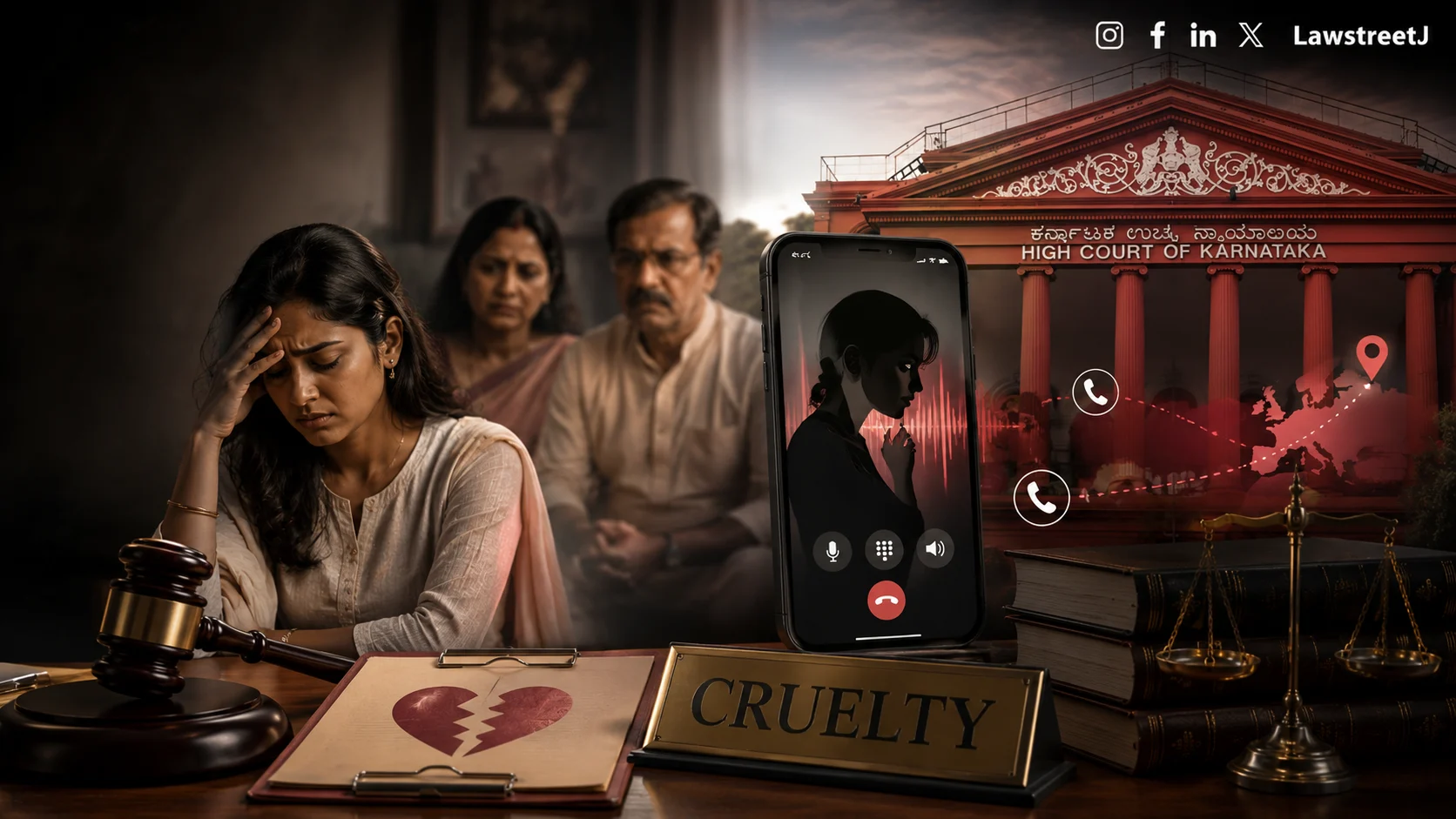
Bengaluru: The Karnataka High Court has quashed a cruelty case registered against a woman's sister-in-law, holding that merely instigating her mother-in-law and father-in-law over repeated telephone calls from Luxembourg, where she has resided since her own marriage in 2017, does not constitute an offence under Section 498A of the Indian Penal Code.
Justice M. Nagaprasanna was hearing a petition filed under Section 482 of the Cr.P.C., seeking quashing of an FIR registered for offences punishable under Sections 498A, 312, 504 and 506 of the IPC and Sections 3 and 4 of the Dowry Prohibition Act.
The petitioner is the sister-in-law of the complainant. The complainant married accused No. 1 on July 23, 2022. According to the case, the marriage broke down within a year, leading to several legal proceedings between the spouses. Thereafter, a criminal complaint was lodged against four members of the husband's family, namely the husband, the mother-in-law, the father-in-law, and the petitioner, who is the complainant's sister-in-law.
Counsel for the petitioner submitted that she had married in 2017, long before the wedding between accused No. 1 and the complainant, and had since been residing in Luxembourg, so that no allegation could reasonably be laid against her. Counsel appearing for respondent No. 2, however, contended that although the petitioner was not physically present in India, she had, over the telephone, always tortured the complainant, and that the allegations warranted investigation. The learned High Court Government Pleader, appearing for the State, echoed this submission, stating that the complaint pointed to allegations against the petitioner at certain points. It was also placed on record that this court had, in 2024, stayed the investigation qua the petitioner, so that no charge sheet had been filed against her while the trial continued against the other accused.
On a perusal of the complaint, the court found that the only allegation against the petitioner was that she was filling the ears of the mother-in-law and father-in-law by repeatedly calling them over the telephone from Luxembourg. Holding that instigation by way of a telephonic conversation would not, by itself, satisfy the ingredients of Section 498A, the court relied on the Supreme Court's decisions in Kahkashan Kausar v. State of Bihar, Maram Nirmala v. State of Telangana and Dara Lakshmi Narayana v. State of Telangana, all of which caution against roping in relatives of the husband on the strength of vague and omnibus allegations unsupported by specific instances.
The court also took note of the broader observations of the Supreme Court in the aforesaid line of judgments, which have repeatedly flagged the phenomenal increase in matrimonial litigation and the growing tendency to invoke Section 498A as a tool to settle personal scores against the husband's relatives, including bedridden grandparents and sisters living abroad for decades. It was reiterated that a mere reference to the name of a family member, without specific allegations indicating active involvement, ought to be nipped in the bud, and that courts must guard against the misuse of the provision while remaining equally alert to genuine cases of dowry harassment.
As regards the offences under Sections 312, 504 and 506 of the IPC, the court examined the ingredients laid down by the Supreme Court in Mohammad Wajid v. State of U.P. and found that the complaint did not disclose the essential elements of criminal intimidation, insult or the offence relating to causing miscarriage against the petitioner. The court noted that these offences require specific, attributable conduct on the part of the accused, which was conspicuously absent from the allegations levelled against the petitioner in the present case.
Rejecting the submission that the petitioner's repeated telephone calls to her parents-in-law amounted to criminal culpability, the court observed that every telephonic communication by an in-law to a daughter-in-law could be projected as criminal culpability and that such an interpretation would be wholly untenable, since it would dangerously widen the dragnet of criminal law.
Even if such allegation is accepted at its highest, it scarcely advances the case of the complainant. To accept such a contention in its unqualified breadth would be to dangerously widen the dragnet of criminal law, so much so that every telephonic communication by an in-law to a daughter-in law could be projected as criminal culpability. Such an interpretation would be wholly untenable.
The court held that instigation over the phone would not mean that it would become an ingredient of Section 498A of the IPC, and that permitting further proceedings against the petitioner on such allegations would amount to a palpable abuse of the process of law, resulting in a grave miscarriage of justice.
Accordingly, allowing the criminal petition, the court quashed the FIR in Crime No. 377/2024, pending before the 30th Additional Chief Metropolitan Magistrate, CMM Court, Bengaluru, insofar as it concerned the petitioner.
Appearances: Sri Anand K, Advocate, appeared for the petitioner; Smt. Rashmi Patel, HCGP, appeared for respondent No. 1-State; and Sri B. Siddeshwar, Advocate, appeared for respondent No. 2.
Case Title: Criminal Petition No. 10716 of 2024


![Karnataka High Court: Cabinet Rank Status Not Equivalent to Ministerial Position [Read Order]](/secure/uploads/2023/09/lj_2318_fc1b99b7-aeed-472b-836e-33750bedb394.jpg)


![Woman living in adultery cannot claim maintenance: Karnataka High Court [Read Order]](/secure/uploads/2023/10/lj_3083_Women_living.jpg)