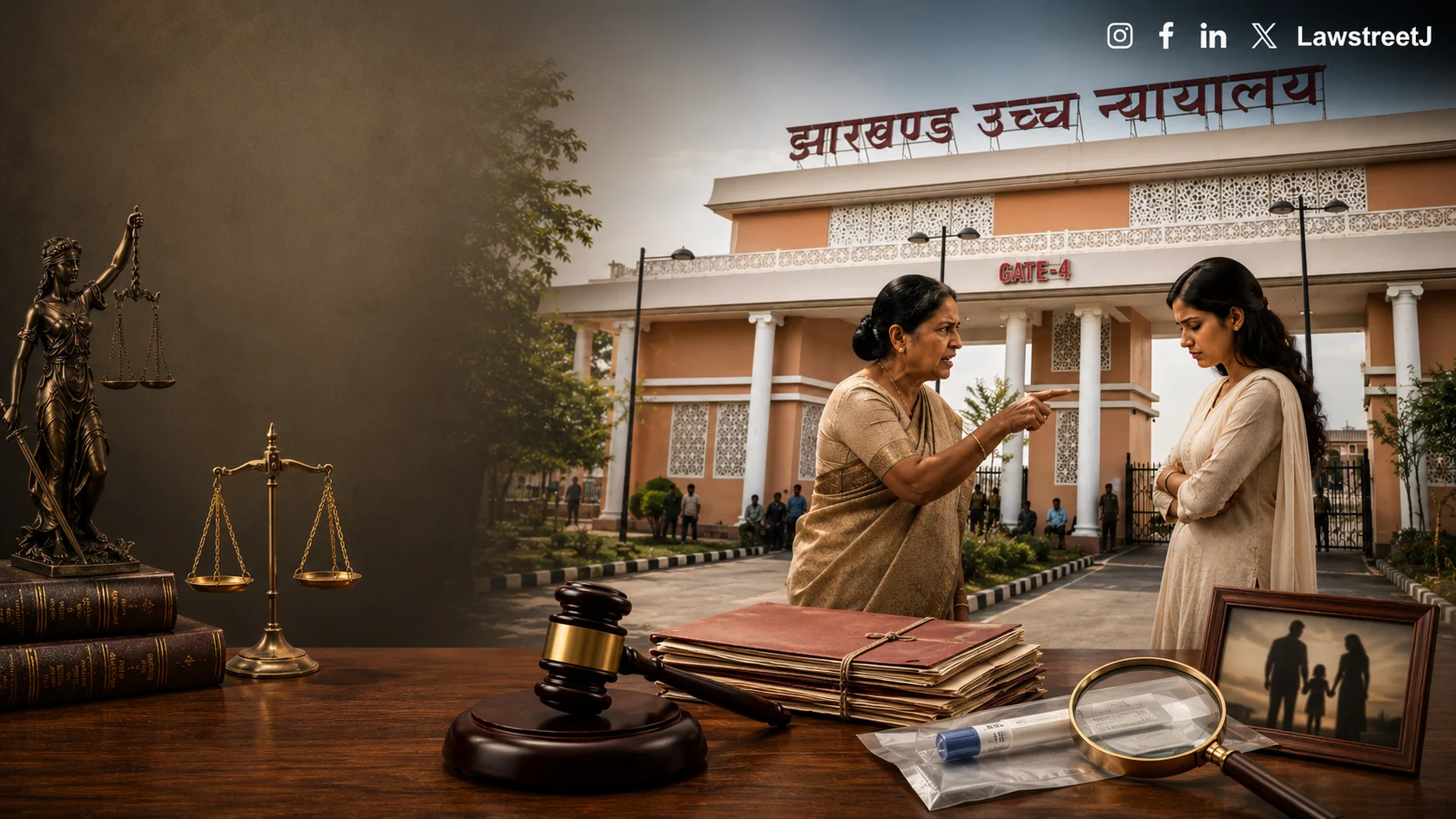
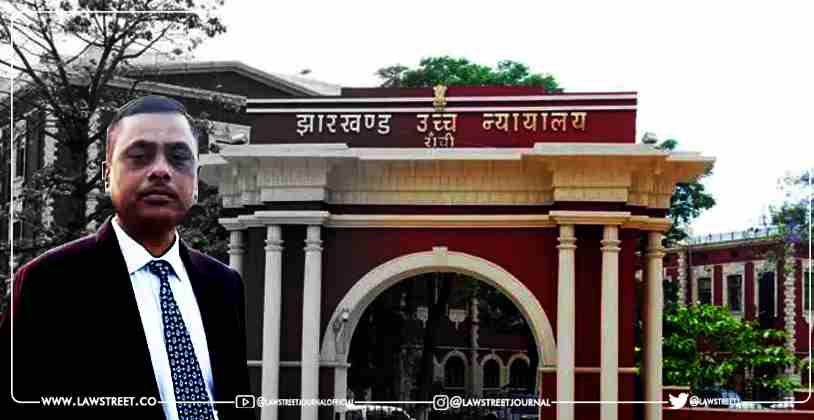
Ranchi: The Jharkhand High Court has set aside the conviction of a mother-in-law under Section 498A of the Indian Penal Code, holding that a solitary instance of scolding her daughter-in-law over a dispute involving a pot of treacle could not, by itself, establish the offence of cruelty, in the absence of any other proven instance of harassment during the seven years of the marriage.
Justice Pradeep Kumar Srivastava was hearing a criminal appeal filed against the judgment passed by the 4th Additional District and Sessions Judge (F.T.C.), Dumka, whereby the mother-in-law had been convicted under Section 498A of the IPC and sentenced to three years’ rigorous imprisonment with a fine of Rs.500, while being acquitted of the charge under Section 306 of the IPC.
According to the prosecution case, the appellant’s daughter-in-law, removed a pot of treacle that her mother-in-law had placed at a height on the wall and kept it on the ground, upon which the appellant began abusing her. Enraged by this, the deceased is alleged to have taken fire from a burning mud stove in the courtyard and set herself alight, sustaining severe burn injuries. She was admitted to Sadar Hospital, Dumka, where her fardbeyan was recorded by the police, leading to registration of an FIR under Section 498A of the IPC. The deceased succumbed to her injuries during treatment, following which the offence under Section 306 of the IPC was also added and a charge-sheet was submitted. On committal, the case was registered as Sessions Case No.80/2003 and 359/2003, and the appellant, denying the charges, claimed trial.
Mr. Om Prakash, counsel for the appellant, submitted that the only allegation against her was that she had scolded the deceased for scattering the treacle on the ground, and that such trivial friction was ordinary wear and tear of village life which did not warrant invoking Section 498A. He submitted that the deceased’s reaction of setting herself on fire over such a trivial issue reflected a person of a short temperament, and could not be attributed to any mental torture inflicted by the appellant. He further submitted that there was no allegation that the appellant had committed any overt act of physical torture, that the charge itself did not specify the date, time, place or any other conduct of cruelty apart from the occurrence of 20.01.2001, and that the trial court, having itself held that the appellant’s words did not amount to abetment of suicide, erred in convicting her under Section 498A on the same facts.
Mr. Tarun Kumar, the Additional Public Prosecutor, opposed the appeal, submitting that it was the appellant’s abusive conduct over the trivial matter that had incited the deceased to set herself on fire, and that the fardbeyan also referred to the deceased being frequently subjected to cruelty at the hands of the appellant.
Examining the evidence of the eleven prosecution witnesses, the court noted that a majority of them, including neighbours and relatives, had been declared hostile and expressed no knowledge of any ill-treatment of the deceased. Even the deceased’s husband and father-in-law, examined as witnesses, stated they had no knowledge of any cruelty or torture at the hands of the appellant. The doctor who conducted the autopsy found that the deceased had suffered 80% burns, with no smell of any accelerant such as petrol or kerosene detected, and that death occurred due to shock from septicemia. The investigating officer’s evidence traced the recording of the fardbeyan and the scene of occurrence, but did not point to any earlier instance of cruelty being reported or investigated.
The court noted that Section 498A of the IPC penalises cruelty by a husband or his relatives, defined to mean either wilful conduct likely to drive a woman to commit suicide or cause grave injury, or harassment connected to an unlawful demand for property or valuable security. It observed that no allegation attracting the second limb, relating to a dowry or property demand, existed in the case at all.
The ingredients for an offence to be made out under Section 498-A of I.P.C. require that there has to be cruelty inflicted against the victim, which either drives her to commit suicide or cause grave injury to herself or lead to such conduct that would cause grave injury or danger to life, limb or health. The second part of this Section refers to harassment with a view to satisfy an unlawful demand for any property or valuable security raised by the husband or his relatives. In the present case, no allegations which would fulfill the requirement of the second part are found.
The court held that except for the single act of abusing the deceased on the date of occurrence, no other overt act had been proved against the appellant, and there was no demonstration of any earlier instance of cruelty or harassment despite the deceased having stayed at her matrimonial home for over seven years. It observed that the prosecution had “miserably failed to prove the ingredients of Section 498A” against the appellant, and that the charge, as framed, did not disclose any allegation falling within Explanation (a) or (b) to the provision.
The court further observed that the trial court itself had found that the words spoken by the appellant did not amount to abetment of suicide, resulting in her acquittal under Section 306 of the IPC, yet had proceeded to convict her under Section 498A on the very same solitary allegation. Holding that the trial court had failed to properly appreciate the evidence on record regarding instances of cruelty, the High Court found the conviction unsustainable in law.
Allowing the appeal, the High Court set aside the judgment of conviction and sentence dated 31.05.2005, and discharged the appellant from the liability of her bail bond, along with her sureties.
Appearances: Mr. Om Prakash, Advocate, appeared for the Appellant; Mr. Tarun Kumar, A.P.P., appeared for the State.
Case Title: Lakhi Devi versus The State of Jharkhand, Cr. Appeal (SJ) No. 869 of 2005


![Supreme Court Collegium approves new Chief Justices for five key High Courts in India [Read Recommendations]](/secure/uploads/2023/12/lj_8000_380d1135-6f3a-4988-a00a-4d5cd5901815.jpg)
!['Arbitrary, impermissible,' SC quashes HC's resolution raising aggregate cut off marks on district judges appointment [Read Judgment]](/secure/uploads/2024/02/lj_3605_Rule-for-Judge-Selection.webp)