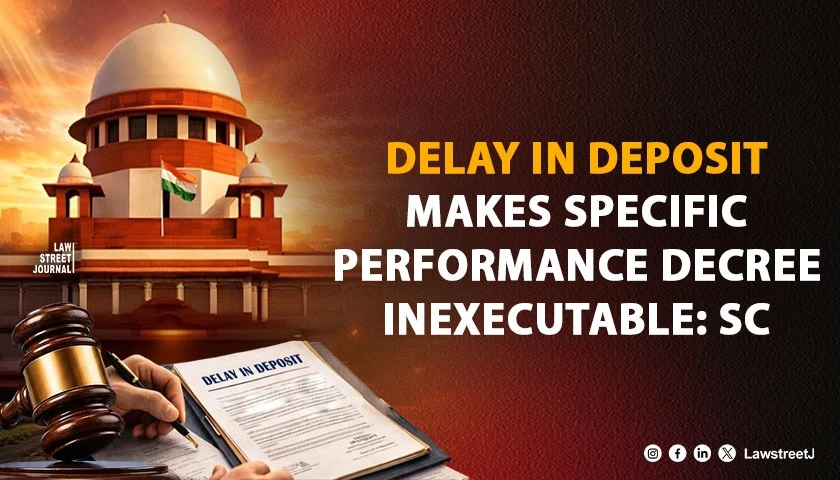
New Delhi: The Supreme Court has held that a decree holder’s failure to deposit the balance sale consideration within the time stipulated under a decree for specific performance results in automatic dismissal of the suit and renders the decree inexecutable. The Court further held that neither the mere permission granted by the executing court to deposit the amount beyond the stipulated period nor the actual deposit made pursuant to such permission amounts to condonation of delay or a deemed extension of time.
The Division Bench of Justice Pankaj Mithal and Justice S.V.N. Bhatti, while allowing the defendant’s appeal and setting aside the orders of the executing court and the Punjab and Haryana High Court, further held that it is not mandatory for the judgment debtor to move an application under Section 28 of the Specific Relief Act, 1963 for rescission of the contract. The Court observed that a court is not powerless to treat the contract as having been rescinded for non-compliance with the conditions under the decree even in the absence of such an application.
The dispute arose from an agreement to sell dated 19.10.2005, under which Habban Shah agreed to sell 12 kanals and 19 marlas of agricultural land in village Shikarpur, Tehsil Tauru, District Mewat, Haryana, to Sheruddin for a sale consideration of Rs. 5,00,000 per acre, after receiving Rs. 80,000 in advance. The sale deed was to be executed on or before 15.03.2006. Upon non-execution of the sale deed, Sheruddin instituted a suit for specific performance, which was decreed by the trial court on 31.10.2012. The court directed Habban Shah to execute the sale deed after receiving the balance sale consideration within three months, failing which Sheruddin would be at liberty to get it executed through the court.
Habban Shah challenged the decree in a first appeal, wherein an interim order restraining both parties from alienating the suit property was passed on 17.12.2012. The interim order lapsed on 25.01.2013 without extension. The first appeal was dismissed on 11.11.2014, and a second appeal filed before the High Court was also dismissed on 12.01.2017, with no interim order ever granted in the second appeal.
In the meantime, Sheruddin filed an execution petition on 04.03.2013, which was dismissed for want of prosecution on 01.08.2014. He thereafter filed a second execution petition on 08.01.2015. Habban Shah raised objections contending that the execution was barred by limitation and that the decree had become inexecutable due to Sheruddin’s failure to deposit the balance amount within three months. The executing court dismissed the objections, holding that Sheruddin had always been ready and willing to perform his part of the contract and that the pendency of the first appeal had prevented him from depositing the amount. The executing court subsequently permitted deposit of the balance amount, pursuant to which Rs. 6,92,410 was deposited. The Punjab and Haryana High Court, in revision, affirmed the executing court’s findings.
Before the Supreme Court, senior counsel appearing for Habban Shah argued that the decree unequivocally required execution of the sale deed within three months of the judgment upon receipt of the balance consideration. It was contended that Sheruddin had neither deposited the amount within the stipulated time nor filed any application seeking extension of time during that period, rendering the decree inexecutable and entitling the defendant to rescission under Section 28 of the Act.
On behalf of Sheruddin, it was argued that the executing court’s permission to deposit the amount, having been granted and acted upon, amounted to condonation of delay and an effective extension of time. It was further submitted that, in the absence of a formal application under Section 28, the defendant could not seek rescission of the contract.
The Court first addressed the preliminary objections concerning limitation and maintainability of the second execution petition. It held that the second petition filed on 08.01.2015 was well within the twelve-year limitation period prescribed under Article 136 of the Limitation Act, 1963, and was independently maintainable since the earlier petition had been dismissed for want of prosecution and not on merits, relying on Bhagyoday Cooperative Bank Limited v. Ravindra Balkrishna Patel, (2022) 14 SCC 417.
On the central issue, the Court held that the decree was a conditional one imposing reciprocal obligations on both parties, and that, by necessary implication, Sheruddin was required to deposit the balance sale consideration within three months. The Court observed that the interim order dated 17.12.2012 merely restrained alienation of the suit property and did not prohibit the plaintiff from depositing the balance consideration. Even assuming that the interim order created an obstacle, it had lapsed on 25.01.2013 — well within the three-month period prescribed under the decree — yet no deposit was made and no application for extension of time was filed during that period.
The Court further noted that the application filed by Sheruddin on 05.03.2013 seeking extension of time was filed after the interim order had already lapsed and was never adjudicated upon. It held that the subsequent permission granted by the executing court on 09.10.2015 could not, in law, amount to a deemed extension of time or condonation of delay.
Relying on P.R. Yelumalai v. N.M. Ravi, (2015) 9 SCC 52, the Court reaffirmed that a conditional decree for specific performance is self-operative and that non-compliance with any condition results in automatic dismissal of the suit, causing the decree to cease to exist in the eyes of law.
Applying Prem Jeevan v. K.S. Venkata Raman and Another, (2017) 11 SCC 57, the Court rejected the contention that a Section 28 application was a prerequisite for rescission. It held that failure of the judgment debtor to seek rescission does not revive a decree that has become inexecutable due to non-compliance with the stipulated conditions.
The Court also relied upon Balbir Singh and Another v. Baldev Singh (Dead) Through His Legal Representatives and Others, (2025) 3 SCC 543, wherein a decree was similarly held to be inexecutable for failure to deposit the amount within the stipulated period and for not seeking extension of time.
Distinguishing the plaintiff-respondent’s reliance on Dr. Amit Arya v. Kamlesh Kumari, 2025 SCC OnLine SC 2886, and Ram Lal v. Jarnail Singh (now Deceased) Through Its LRs and Others, 2025 SCC OnLine SC 584, the Court observed that the real test was whether the decree holder’s conduct amounted to a positive refusal to perform his obligations under the contract.
The Court held that Sheruddin’s conduct — namely, his failure to deposit the amount within three months, his failure to apply for extension within the stipulated period, and his apparent inaction after the interim order lapsed — demonstrated that he had been shying away from performing his obligations. The Court concluded that such conduct disentitled him from executing the decree, particularly in view of the equitable nature of the relief of specific performance under Sections 16(c) and 20 of the Act.
Summarising its conclusions, the Court held that:
- A decree for specific performance is in the nature of a preliminary decree;
- The court passing such decree does not become functus officio and retains jurisdiction until the sale deed is executed or the decree becomes inexecutable;
- Section 28(1) of the Specific Relief Act empowers the court to extend time on equitable considerations; and
- It is not mandatory to file an application under Section 28, as the court may treat the contract as rescinded for non-compliance with the decree even in the absence of such an application.
Exercising its equitable jurisdiction and balancing the equities between the parties, the Court directed Habban Shah to refund the earnest money of Rs. 80,000 received on 19.10.2005 along with simple interest at 8 percent per annum from the date of receipt until repayment. In the event of his inability to refund the amount, the Court permitted him to sell half an acre of the suit land to Sheruddin or, if Sheruddin refused, to any third party, and utilise the proceeds to make payment within three months.
For the Appellant: Shri Manoj Swarup, Senior Advocate
For the Respondent: Shri Divyesh Pratap Singh, Advocate
Case Title: Habban Shah v. Sheruddin [2026 INSC 451]