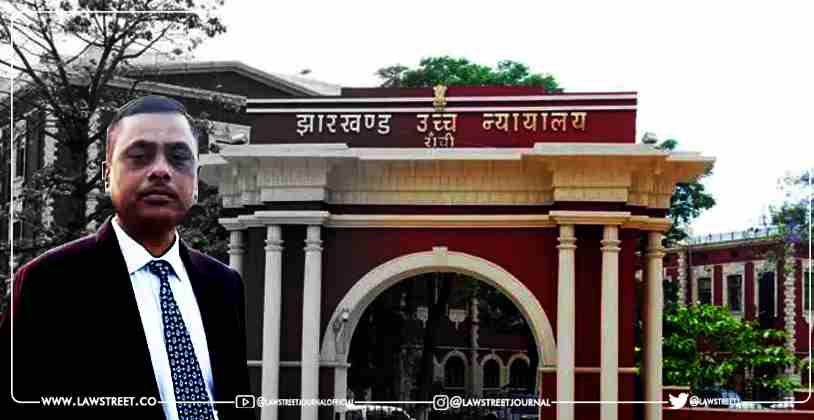
Ranchi: The High Court of Jharkhand at Ranchi has held that a party to a court-annexed mediation settlement cannot unilaterally retract from it after having voluntarily signed it and, more so, after having accepted or derived benefits under its terms.
A Division Bench of Justice Sujit Narayan Prasad and Justice Sanjay Prasad passed the ruling while disposing of a first appeal filed by a husband under Section 19(1) of the Family Courts Act against a judgment of the Family Court, Dumka, which had dismissed his suit for divorce on grounds of desertion and cruelty under Section 13(1)(i-a) and (i-b) of the Hindu Marriage Act, 1955.
The parties, who had married in 2011 and whose marriage was later registered in 2019 pursuant to earlier High Court orders, were parents to a minor son. After the Family Court dismissed the husband's divorce suit, the appeal was, on the joint request of both sides, referred to the Special Mediation Drive – Mediation ‘For the Nation’. During the mediation held on 19.08.2025, the parties arrived at a comprehensive settlement to dissolve their marriage by mutual consent under Section 13-B of the Hindu Marriage Act, under which the husband agreed to pay Rs. 35 lakh as permanent alimony, Rs. 40 lakh towards the child's education and other expenses, and Rs. 5 lakh towards the child's medical expenses, while the wife agreed to compromise a pending criminal appeal and withdraw a criminal revision seeking enhancement of maintenance.
In compliance with a joint compromise petition subsequently filed before the Court, the husband paid the first two instalments aggregating Rs. 35 lakh through NEFT transactions. The wife, however, did not withdraw the criminal revision or take steps towards the compromise of the criminal appeal as undertaken, and later informed the Court that, on reconsideration, she was no longer agreeable to the appeal being disposed of in terms of the settlement.
Before the Bench, counsel for the wife contended that even after signing a mediation document, a party who no longer wishes to honour its terms may resile from it, since there cannot be a petition for divorce by mutual consent once one party withdraws consent, and that the wife's intent while signing the settlement was material and had been coloured by the husband's conduct during mediation.
Rejecting this submission, the Court framed the pivotal question as “whether a settlement agreement, reached through court-annexed mediation and thereafter filed as a joint compromise petition before the High Court, upon which the parties have acted, can be unilaterally withdrawn by one of the parties from the settlement so arrived at through the mediator.”
Answering this in the negative, the Court held that a settlement reached through court-annexed mediation and filed as a joint compromise petition holds significant legal sanctity and, once voluntarily executed and signed by the parties and their counsel, becomes a contractually and legally binding document. It noted that the Mediation Act, 2023 further strengthens this position by making a mediated settlement agreement enforceable in the same manner as a judgment or decree of a court.
The Bench relied on Perry Kansagra v. Smriti Madan Kansagra, (2019) 20 SCC 753, to observe that the right to withdraw from mediation exists only during the pendency of the mediation process itself, and is extinguished once a final settlement agreement is signed. It also referred to Dhananjay Rathi v. Ruchika Rathi, where the Supreme Court held that the right to withdraw consent for mutual divorce before the final decree is not absolute where a comprehensive settlement has been partly acted upon, and to Trisha Singh v. Anurag Kumar, 2024 INSC 450, where a wife's attempt to resile after accepting part of the settlement amount was termed “recalcitrant” and the marriage was dissolved by invoking Article 142 of the Constitution.
Applying these principles, the Court held that once a party has accepted benefits under, or acted upon, a settlement, the doctrine of estoppel operates to preclude that party from subsequently denying or revoking it, and that a mere change of mind is not sufficient ground to withdraw from a signed and court-recorded mediation settlement. It observed that the husband's partial performance having already paid Rs. 35 lakh of the agreed alimony strengthened the application of estoppel against the wife, rendering her unilateral retraction legally unsustainable.
The Court accordingly directed both parties to adhere to the terms of the settlement dated 19.08.2025 and disposed of the appeal in terms thereof, directing strict compliance with all remaining terms within a period of six months, following which the parties are to file a joint petition for divorce by mutual consent before the jurisdictional Family Court, which shall pass appropriate orders in accordance with law. Liberty was granted to either party to move an appropriate forum in case of non-adherence to the settlement.
The appellant-husband was represented by counsel, while the respondent-wife was represented by her counsel before the Court.
Case Title: Appellant-Husband vs. Respondent-Wife


![Supreme Court Collegium approves new Chief Justices for five key High Courts in India [Read Recommendations]](/secure/uploads/2023/12/lj_8000_380d1135-6f3a-4988-a00a-4d5cd5901815.jpg)
!['Arbitrary, impermissible,' SC quashes HC's resolution raising aggregate cut off marks on district judges appointment [Read Judgment]](/secure/uploads/2024/02/lj_3605_Rule-for-Judge-Selection.webp)