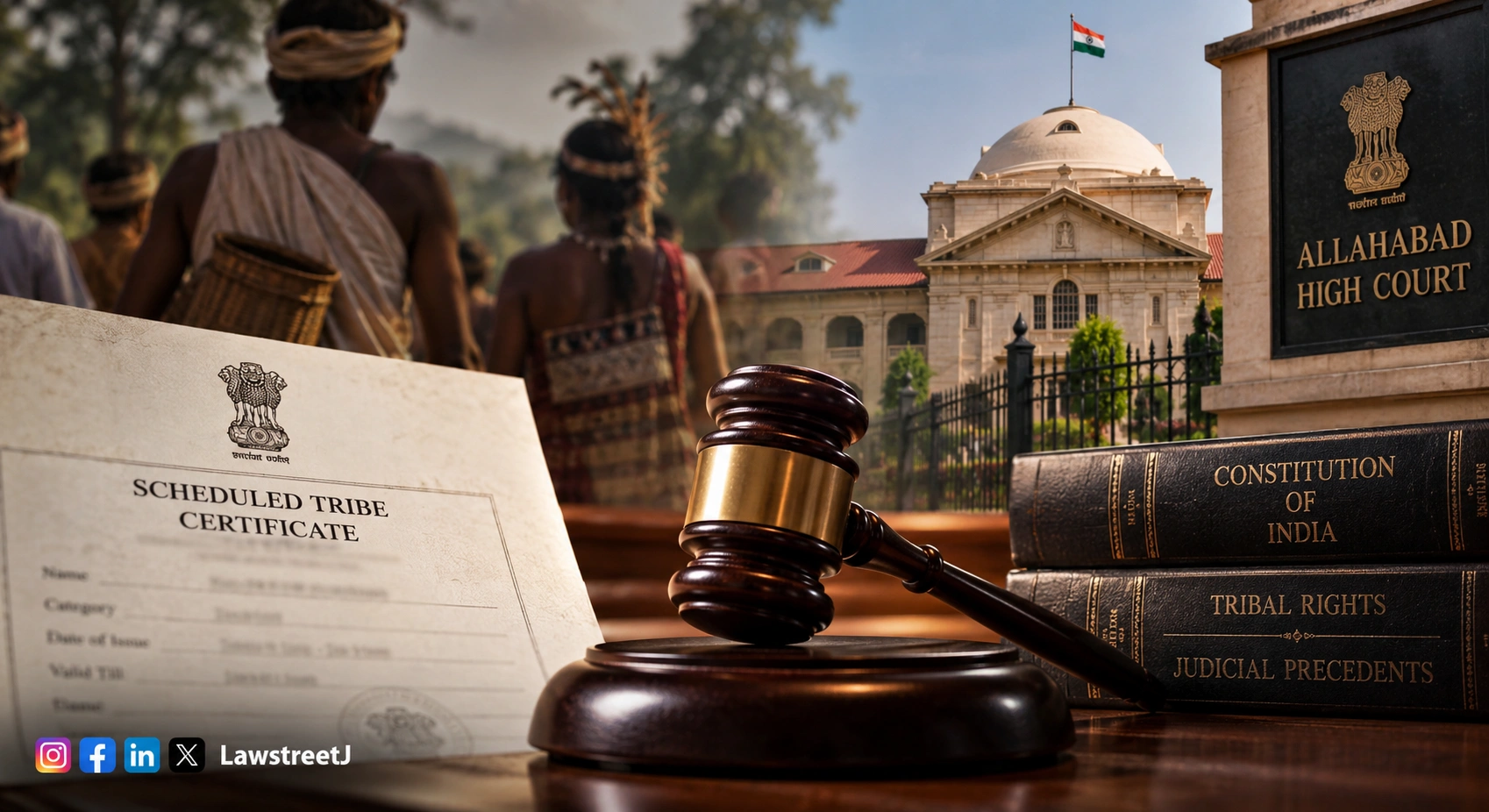
Allahabad: The Allahabad High Court has dismissed a set of connected writ petitions challenging orders of the Deputy Collector, Duddhi, District Sonbhadra, which had declared three registered sale deeds in her favour void under Section 157-B of the U.P. Zamindari Abolition and Land Reforms Act, 1950, and directed the land to vest in the State Government, holding that she had failed to establish continuing membership of the Bhuiyan Scheduled Tribe on the dates of the transactions.
Justice Arun Kumar was hearing three connected writ petitions under Article 226 of the Constitution assailing separate orders passed by the competent revenue authority in proceedings under Sections 104 and 105 of the Uttar Pradesh Revenue Code, 2006, by which agricultural land purchased by the petitioner between 2011 and 2018 at Village Bagharu, Tehsil Duddhi, was held to have been transferred in violation of the statutory restriction on transfer of tribal land and consequently void.
The petitioner claimed to belong to the Bhuiyan Scheduled Tribe by birth, being the daughter of Mahaveer, and to hold a Scheduled Tribe certificate issued by the Tehsildar, Duddhi. She had purchased the disputed lands from vendors stated to belong to the Gour Scheduled Tribe, with the sale deeds remaining unchallenged and unmutated in her favour for several years, until notice was issued to her in December 2025 in proceedings under the Code.
Learned counsel for the petitioner argued that she continued to belong to the Bhuiyan Scheduled Tribe by birth and had not lost that status merely because she had married Sirajuddin according to Islamic rites or was described as Muslim in certain documents, relying on the Supreme Court's decision in Rameshbhai Dabhai Naika v. State of Gujarat to contend that a status acquired by birth is not ordinarily displaced by marriage with a person of another community. It was further submitted that her Scheduled Tribe certificate had never been cancelled, that the caste status of the parties was disclosed in the sale deeds themselves, and that the proceedings, initiated more than a decade after the transactions, were vitiated by delay and non-consideration of material evidence.
The learned Senior Counsel and Additional Advocate General appearing for the State respondents raised a preliminary objection as to maintainability, contending that the petitioner ought to have availed the revisional remedy under Section 210 of the Code. On merits, it was submitted that the petitioner, originally known as Nanhki, had married Sirajuddin, adopted the name Naimunnisha, lived with him for decades, raised two children bearing Muslim names, and was recorded as Muslim in the family register, and that she had produced no material showing continued adherence to Bhuiyan customs or acceptance by the tribal community. Reliance was placed on State of Kerala v. Chandramohanan, Chinthada Anand v. State of Andhra Pradesh & Others and Additional Commissioner, Revenue v. Akhlaq Hussain, to submit that a person who has assimilated into another religion and abandoned tribal customs cannot claim continuing Scheduled Tribe status, and that a certificate obtained by suppression of material facts, such as the undisclosed marriage, cannot be treated as conclusive.
Rejecting the preliminary objection, the court held that the existence of an alternative remedy did not operate as an absolute bar where the proceedings raised questions as to the statutory regime governing pre-Code transactions and the legal test for continuing tribal status, and proceeded to examine the matter on merits.
On merits, the court accepted the principle, drawn from Chandramohanan and Chinthada Anand, that conversion to another religion does not by itself extinguish Scheduled Tribe status, and that the question is one of fact turning on continuing tribal traits, customs and community acceptance. However, the court found that, against the prolonged course of circumstances relied upon by the State the long marriage, the change of name, the children's names and the family register entry the petitioner had produced no credible material showing that she continued to follow Bhuiyan customs, participate in its community life, or remain accepted by the community.
The court observed that "the petitioner has failed to establish that she continued to possess the status of a member of the Bhuiyan Scheduled Tribe on the respective dates of execution of the disputed sale deeds."
The court further held that neither the Scheduled Tribe certificate nor the registered sale deeds could be treated as conclusive, since the certificate was alleged to have been obtained without disclosure of the petitioner's marriage and religious identity, and registration of a document cannot validate a transfer otherwise prohibited by Section 157-B of the U.P. Zamindari Abolition and Land Reforms Act, 1950, which governed the transactions as they predated the substantive provisions of the 2006 Code. The plea of delay was also rejected, the court holding that lapse of time, mutation or continued possession cannot cure a transfer that is void for contravention of a mandatory statutory prohibition.
Finding no jurisdictional error, perversity or violation of natural justice warranting interference under Article 226, the court dismissed the writ petitions, affirmed the impugned orders of the Deputy Collector, Duddhi, vacated any interim protection granted to the petitioner, and left the competent authority at liberty to give effect to the orders in accordance with law, with no order as to costs.
Appearances:
For the Petitioner(s): Sri P. R. Maurya and Sri Shashank Maurya, Advocates.
For the State Respondents: Sri Anoop Trivedi, Senior Advocate and Additional Advocate General, assisted by Sri Abhishek Shukla, Additional Chief Standing Counsel, and Sri Anubhav Chandra, Standing Counsel.
For the Respondent Gaon Sabha: Sri Pradeep Singh, Advocate.
Case Title: Nanhki @ Naimunnisha vs. State of U.P. and 3 others, along with connected Writ-C Nos. 17171 of 2026 and 17214 of 2026, Writ – C No. 17043 of 2026


!["No Loudspeakers For Azan, No Fundamental Right To Create Noise," Says Allahabad HC To Two Mosques [Read Judgment]](/secure/uploads/2020/01/lj_4995_Allahabad_HC_AZAN.jpg)