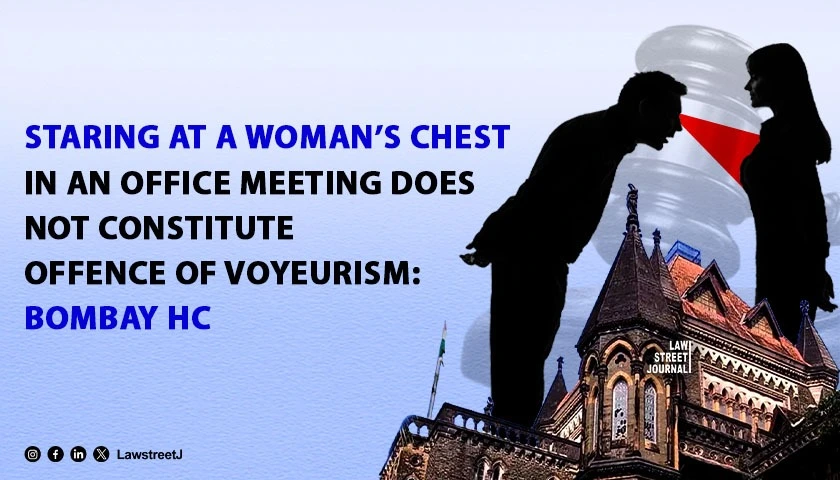
Mumbai: The Bombay High Court has held that unwanted staring at a female colleague’s chest during an office meeting, however indecent or morally wrong, does not constitute the offence of voyeurism under Section 354-C of the Indian Penal Code, 1860. This is because the said provision is confined to watching or recording a woman engaged in a ‘private act’ in circumstances where she has a reasonable expectation of not being observed, and cannot be stretched to cover every form of offensive gaze or improper workplace behaviour.
Justice Amit Borkar delivered the order on 8 April 2026 in Criminal Application No. 774 of 2015.
The applicant in the present case sought quashing of the FIR for the offence punishable under Section 354-C of the Indian Penal Code. The applicant and the complainant were colleagues at Max Life Insurance Co. Limited, where they were required to coordinate with one Seema Sharma and others, and attend client meetings at various offices. The complainant alleged that the applicant insisted she attend certain meetings alone, insulted her, avoided normal eye contact, and instead repeatedly stared at her chest while making inappropriate comments.
A specific incident on 14 November 2014, during a meeting at the Borivali office attended by the applicant, Seema Sharma, Prashant Jain, and the complainant, formed the core of the complaint. The complainant alleged that the applicant stared at her chest, leaving her disturbed. She conveyed the incident to Seema Sharma, who addressed an email to the Head of Department in Gurgaon. The matter was also brought to the notice of the HR Manager, who allegedly expressed disbelief.
On 21 November 2014, at another meeting at the Andheri office, the applicant allegedly began finding fault with the complainant’s work and publicly insulted her. The company initiated internal proceedings, constituted an Internal Complaints Committee (ICC) in accordance with the Sexual Harassment of Women at Workplace (Prevention, Prohibition and Redressal) Act, 2013, and conducted an inquiry. The Committee, chaired by Ms. Pramita Singh, submitted its report to the management exonerating the applicant. The company was nonetheless dissatisfied with the complainant’s explanations and threatened termination, which led to the filing of the criminal complaint.
The applicant’s counsel contended that a plain reading of the FIR disclosed no prima facie offence under Section 354-C of the IPC, and that the allegations, even if taken at face value, did not satisfy the essential ingredients of the said provision. Reliance was also placed on the ICC’s report exonerating the applicant.
The Additional Public Prosecutor and the advocate appearing for the complainant through the Legal Aid Committee opposed the application, contending that the applicant had deliberately insulted the victim, stared at her chest in a manner intended to outrage her modesty, and made objectionable remarks, thereby attracting the ingredients of Section 354-C.
The Court undertook a detailed textual analysis of Section 354-C of the IPC, which defines and penalises the offence of voyeurism. As per the analysis, this provision applies to any man who watches or captures the image of a woman engaging in a ‘private act’ in circumstances where she would reasonably expect not to be observed, or who disseminates such an image.
The Explanation to the section further defines a ‘private act’ as one carried out in a place reasonably expected to provide privacy, where the victim’s genitals, posterior, or breasts are exposed or covered only in underwear; or where the victim is using a lavatory; or engaging in a sexual act not ordinarily done in public. The section also covers situations where images of a private act are captured with consent but later disseminated without consent.
The Court held that the offence under Section 354-C is not attracted merely on account of improper behaviour or unwelcome staring. The emphasis, therefore, is on the nature of the act and the surrounding circumstances, and the offence is complete only when the watching or recording intrudes upon a sphere of privacy which the law seeks to protect.
The Court observed that the legislative intent is to penalise conduct involving invasion of bodily privacy in intimate or secluded settings, and not to punish every act that offends a woman’s modesty in a general sense.
Applying the statutory language to the facts of the case, the Court found the prosecution’s difficulty to be self-evident. The FIR did not allege that the applicant watched the complainant while she was engaged in any private act. It did not allege that any image of a private act was captured. It also did not allege that the complainant was in a setting where she could reasonably expect privacy. The sole allegation was that he stared at her chest during office meetings.
The Court held that unwanted staring, even if accepted as true, does not amount to voyeurism within the meaning of Section 354-C, and that the statute cannot be stretched beyond its plain wording.
The Court further observed that Section 354-C is not a general provision covering every form of offensive gaze or misconduct towards a woman. The act complained of must fall within the specific domain of watching or capturing a woman engaged in a private act. Hence, mere offensive conduct in an office environment, even if morally wrong, cannot be brought within this provision unless the statutory conditions are satisfied.
The Court also held that the substance of the accusation in the present case—namely, alleged staring, insulting behaviour, and workplace harassment—may, at best, amount to misconduct or indecency, depending on the facts established in appropriate proceedings, but does not fall within the narrow scope of Section 354-C.
The Court addressed the significance of the ICC’s report exonerating the applicant, observing that while it may have relevance in the context of service law, the criminal case would fail regardless due to the absence of essential statutory ingredients under Section 354-C.
The Court further noted that criminal law cannot be used to convert every workplace grievance into an offence of voyeurism, and that courts must assess the substance of allegations rather than the label attached.
It held that even if the complainant genuinely felt offended or humiliated, criminal prosecution under Section 354-C cannot be sustained in the absence of watching or recording a woman during a private act, or dissemination of such material—elements entirely absent in the present case.
Accordingly, the Court held that allowing the prosecution to continue would amount to an abuse of the process of law.
Allowing the Criminal Application, the Court quashed and set aside the FIR for the offence under Section 354-C of the IPC, and directed that all further proceedings arising therefrom, including the chargesheet, if any, shall stand terminated.
Mr. Amol Patankar, along with Mr. Neil Chandiwala, appeared for the applicant; Mr. Yogesh N. Nakhwa, Additional Public Prosecutor, appeared for the State; and Mr. Ajinkya Udane appeared for Respondent No. 2.
Case Title: Abhijit Baswant Nigudkar v. The State of Maharashtra & Ors. (Criminal Application No. 774 of 2015)



![Husband Can Also Claim Alimony/Maintenance From Wife: Bombay High Court Orders Woman To Pay Alimony To Ex-Husband [Read Order]](/secure/uploads/2022/04/lj_2823_Divorce.jpg)