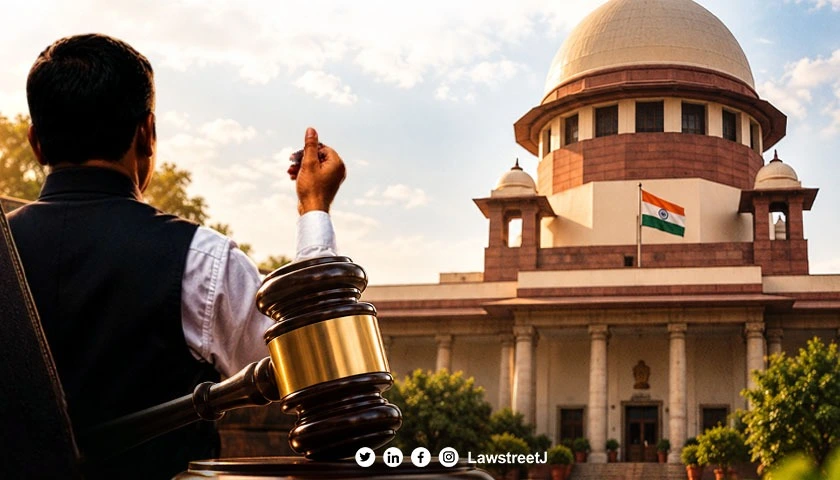
New Delhi: The Supreme Court has set aside the Karnataka High Court’s orders staying the conviction of MLA Vinay Rajashekharappa Kulkarni and suspending the sentences of other convicts in the 2016 murder of Zila Panchayat member Yogesh Goudar, holding that a stay of conviction requires a higher threshold than a good prima facie case, namely a palpable mistake in the judgment, and that possible disqualification of a legislator cannot be the primary ground. It directed the convicts to surrender within two weeks.
A Bench of Justice Prashant Kumar Mishra and Justice Shree Chandrashekhar, in a judgment by Justice Chandrashekhar, was hearing appeals by the State of Karnataka, the CBI and the deceased’s brother, Gurunatha Gouda, against the High Court’s orders of 31.07.2026. Special CC. No. 565 of 2021 ended in life imprisonment under Section 302 read with Section 120B IPC on 15.04.2026, for eight convicts, including Vinay Kulkarni (A-15), described as the mastermind, Chandrashekar Indi alias Chandu Mama (A-16), who allegedly provided country-made pistols, and six alleged assailants. A police Investigating Officer (A-19) was sentenced to seven years for fabricating evidence to shield the real culprits. The prosecution says that the deceased was attacked with thirty-five wounds on 15.06.2016, after a verbal altercation with A-15 at a Zila Panchayat meeting, and the approver deposed as PW10.
On the stay of conviction of A-15, the Court noted that the High Court had recorded the rival submissions and noted that the approver’s reliability and the delayed arraignment were matters for the final hearing, but stayed the conviction because he would incur disqualification under Section 8(3) of the Representation of the People Act, 1951 and suffer irreversible consequences. It held that the order did not say a word on how the conviction was unsustainable in law, and did not address the objections of the State and CBI or the higher threshold. Explaining that threshold, it stated:
“The test is not that the convict has shown a good prima facie case in his favour. Rather, the convict is required to bring his case very near to certainty and for doing so he must project a mistake which without any rigorous exercise leads to a conclusion that he has an eminently winnable case.”
The Court said that a palpable mistake is a fatal or irreconcilable error apparent on the face of the record, which does not admit two opinions, requires no long-drawn reasoning, and strikes at the foundation of the conviction, and that consequences are irreversible only if the conviction is liable to be set aside. Disqualification is a statutory consequence which one cannot avoid by showing an arguable case, since otherwise every convicted legislator would be entitled to a stay and could complete the term. Afjal Ansari v. State of U.P. was confined to its facts, a four-year sentence. The Court added that motive is a weak circumstance that the prosecution need not prove in a murder case, so that inconsistency in the motive attributed to A-15 was hardly a ground to interfere. It held the stay order perverse.
On suspension of sentence, the Court held that the High Court had not pinpointed any serious error in the conviction, and had merely catalogued submissions. It said that the testimony of an approver found truthful can be a basis for conviction, since corroboration is a rule of prudence, citing Rameshwar v. State of Rajasthan, and that PW10 was corroborated by witnesses on motive, the meetings and the false projection of a land dispute, besides documentary, medical and forensic evidence, and identification of A-16 by PW45. The conspiracy had been dealt with only piecemeal in the High Court order, direct evidence is not required, and the Dharwad trial material had prima facie been considered by the Special Judge, since the CBI inquiry was only further investigation.
The Court rejected pendency of the appeals as a ground to suspend a life sentence in grave offences such as murder, noting that pendency in the Karnataka High Court was 14,301 on 01.11.2026, comparatively lower than other High Courts, and that hundreds of other life convicts who had served a substantial part of the sentence were also waiting. It added that conviction substantially dilutes the presumption of innocence, that suspension of sentencerequires a fair chance of acquittal, that the parameters for it differ from a stay of conviction, and that for heinous crimes it cannot be given without a compelling reason shown by the judgment of conviction.
As regards the Investigating Officer, the Court held that the fixed term of sentence was not decisive, since an Investigating Officer who fabricates evidence to shield the real culprit commits a serious crime and the gravity of the offence affecting the administration of criminal justice may take precedence. The orders were set aside, the bail bonds were cancelled, and the convict-respondents were directed to surrender before the concerned court within two weeks.
Appearances:
For the Appellants: Mr. Suryaprakash V. Raju, Additional Solicitor General; Mr. Mahesh Jethmalani, Senior Advocate, for the brother of the deceased.
For the Respondents: Dr. Abhishek Manu Singhvi, Mr. Ardhendhumauli Kumar Prasad, Mr. S. Nagamuthu, Mr. Siddharth Dave and Mr. Rahul Kaushik, Senior Advocates.
Case Title: State of Karnataka vs. Vinay Rajashekharappa Kulkarni & Anr. (with connected appeals), Criminal Appeal arising out of SLP (Crl.) No. 18004 of 2026, 2026 INSC 1265