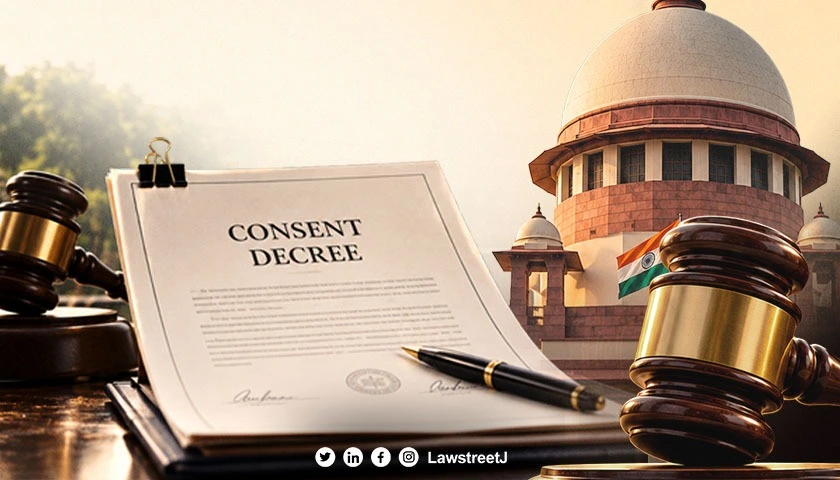
New Delhi: A seven-Judge Bench of the Supreme Court has answered as infructuous a reference pending for nearly three decades on whether a State Legislature can levy a surcharge computed as a percentage of the sales tax payable by a dealer, and has held that the question will be governed by the Constitution Bench ruling in S. Kodar v. State of Kerala, which continues to hold the field.
Chief Justice Surya Kant, writing for the Bench also comprising Justices S.V.N. Bhatti, Joymalya Bagchi, N.V. Anjaria, Arun Palli and V. Mohana, delivered the judgment on 4 November 2026 (2026 INSC 1192). Justice K.V. Viswanathan delivered a separate judgment which holds that Kodar was correctly decided and needs no reconsideration.
The reference arises out of Civil Appeal No. 8763 of 1994 (Arjun Flour Mills v. The State of Odisha Finance Department Secretary and Others), with connected matters. It concerned the 10% surcharge under Section 5-A of the Orissa Sales Tax Act, 1947 on dealers whose gross turnover exceeded ₹10 lakhs, the 10% surcharge under Sections 5(1-C) and 30-AA of the Punjab General Sales Tax Act, 1948, and a cess under the Punjab Social Security Act, 2000. The assessees argued that a levy measured by the tax already payable is a “tax on tax” that does not fall under Entry 54 of List II of the Seventh Schedule, while the States said it is merely an enhancement of the rate of sales tax.
The matter went from a Two-Judge Bench in 1998, which noted an apparent divergence between Hoechst Pharmaceuticals and the Seven-Judge Bench decision in India Cement, to a Five-Judge Bench in 1999, which found that Kodar would also need consideration, and on to a Seven-Judge Bench. The Court said that the legal landscape had “undergone a fundamental transformation” in the meantime, so the narrow question was whether the reference survives.
The Court identified the developments that bear on the reference. First, in State of West Bengal v. Kesoram Industries a Five-Judge Bench narrowed India Cement and held that royalty is not a tax, and a Nine-Judge Bench in Mineral Area Development Authority v. SAIL (2024) then held that royalty is not a tax and overruled India Cement to that extent, displacing the premise of the “tax on tax” observation. Second, the Constitution (One Hundred and First) Amendment Act, 2016 introduced the Goods and Services Tax, substituted Entry 54 of List II so that it now covers only a limited class of goods, and the surcharge laws had earlier been replaced by the Orissa VAT Act, 2004 and the Punjab VAT Act, 2005.
On the law, the Court held that the “tax on tax” argument conflates the subject of a tax with its measure, and that surcharges on income tax, for example, have never been treated as falling outside the entry under which the principal tax is levied. It held that Kodar upheld a Tamil Nadu additional tax computed as a percentage of the sales tax payable, even though dealers could not pass it on, as “in reality a tax on the aggregate of sales”, and that Hoechst Pharmaceuticals applied it. It noted that India Cement concerned a cess on royalty and did not hold that a levy computed as a percentage of another tax is beyond legislative competence.
The Court concluded that there is “no subsisting decision” in conflict with Kodar, that the constitutional entry and State enactments under which the levies were imposed have been replaced, and that the question referred is of no prospective significance. It therefore answered the reference as infructuous and directed that the question of State legislative competence to levy the surcharges will be governed by Kodar.
The Court left open the questions peculiar to the Punjab matters: the validity of Section 30-AA, which requires industrial units otherwise exempted from sales tax to pay the surcharge, and whether the proceeds of the Punjab Social Security Act cess could be credited directly to the Social Security Fund without first forming part of the Consolidated Fund under Article 266. It also left open all other contentions on assessments, periods of levy and consequential reliefs, and directed the Registry to list the lead and connected matters before the appropriate regular Benches after taking directions from the Chief Justice.
In his separate judgment, Justice Viswanathan traced the history of the reference and held that Kodar and Hoechst are consistent, that India Cement had “no bearing” since its dispute and the legislative entries were different, and that the pendency of a curative petition against the Nine-Judge Bench decision, and the 2026 amendment to the MMDR Act inserting Section 9-D, do not affect the findings in that decision.
He held that Kodar has been correctly decided and “continues to be a good law and needs no reconsideration”, and directed that the Orissa and Punjab sales tax appeals be placed before the Chief Justice for assignment to an appropriate Bench in accordance with Kodar, and that the Punjab Social Security Act appeals be segregated for assignment to an appropriate Division Bench.
The Court placed on record its appreciation of the assistance of counsel and of nodal counsel, Ms. Samapika Biswal.
Case Title: Arjun Flour Mills v. The State of Odisha Finance Department Secretary and Others, Civil Appeal No. 8763 of 1994, with connected matters