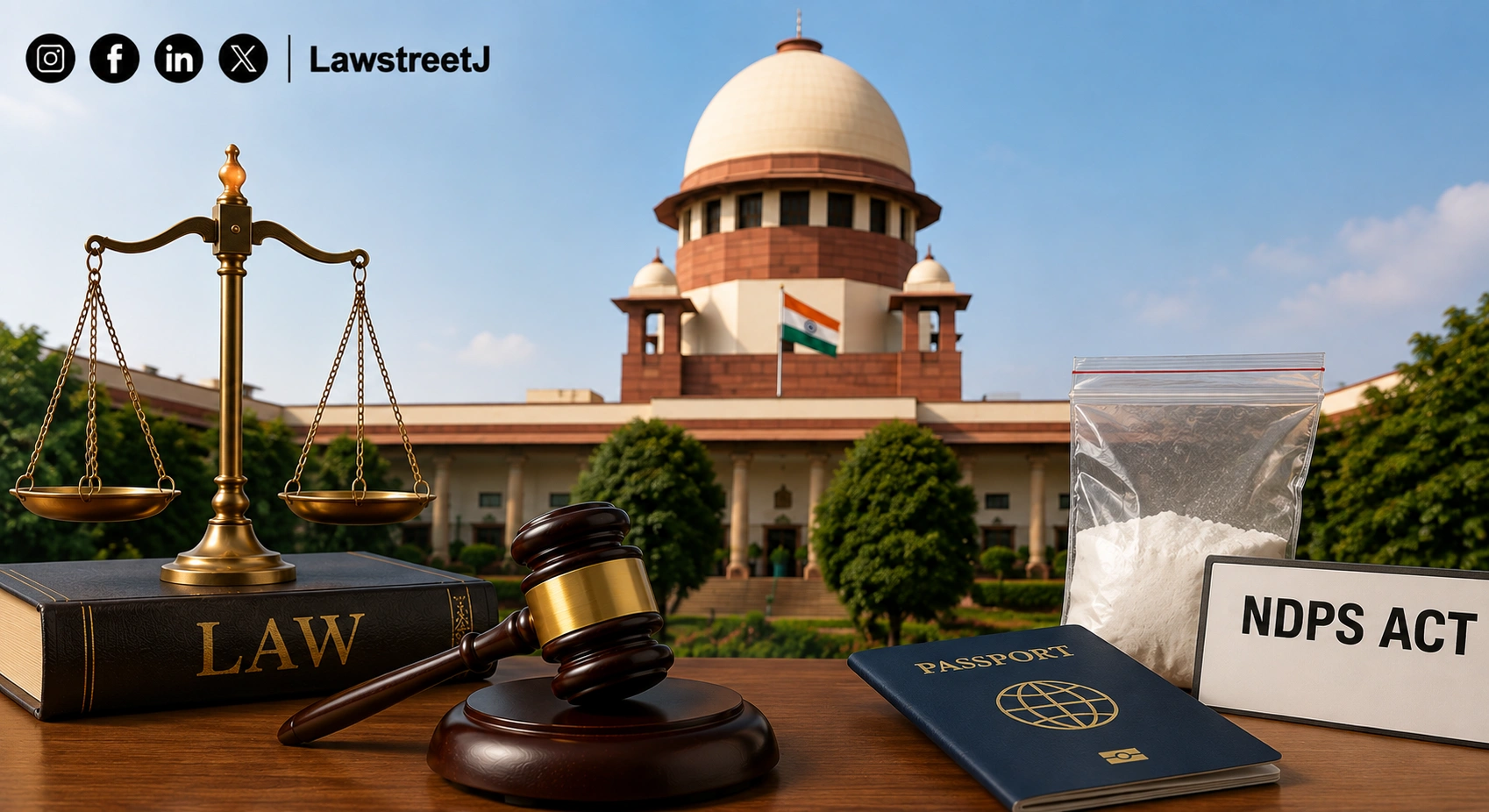
New Delhi: The Supreme Court has cancelled the bail granted to a Nigerian national accused in a heroin smuggling case after it was discovered that the surety furnished on his behalf was entirely fake, and went on to frame a detailed set of safeguards to prevent recurrence of such fraud in bail matters involving foreign nationals accused under the Narcotic Drugs and Psychotropic Substances Act, 1985.
A Bench of Justice Sanjay Karol and Justice Augustine George Masih was hearing an appeal filed by the Union of India against the grant of bail to the respondent, Chidiebere Kingsley Nawchara, arrested in March 2023 for his alleged role in smuggling 4935 grams of heroin into the country through Chhatrapati Shivaji Maharaj International Airport, Mumbai. What began as a routine appeal against a bail order, the Court noted, turned into something far more serious once it emerged that the accused had jumped bail and the surety produced on his behalf did not exist.
Surety Found to be Fabricated
During the pendency of the appeal, the Court had stayed the operation of the bail order and directed the police to arrest the respondent. Despite a Look Out Notice, the accused could not be traced. Verification revealed that the surety, one Sushil Balkrushna Jadhav, could not be found at the address furnished, his purported employer denied any association with him, the bank account details did not exist, and his PAN and Aadhaar cards were forged. The Court observed that the process of criminal justice grinds to a halt when the very persons meant to secure an accused's presence turn out to be fictitious.
Holding that the appeal had transformed from one against grant of bail into one for its cancellation on account of violation of bail conditions, the Court cancelled the bail granted to the respondent.
Exercise of Power under Article 142
Noting the absence of uniform statutory safeguards across jurisdictions for verifying sureties, particularly where the accused is a foreign national, the Court held that the exercise of its power under Article 142 of the Constitution was justified to fill this gap. It examined suggestions placed before it by the Union of India, the Directorate of Revenue Intelligence, and the learned amici curiae, Mr. Sidharth Luthra, Senior Advocate, and Ms. Sana Hashmi, Advocate-on-Record, before issuing directions confined to cases involving foreign nationals accused of offences involving commercial quantities under the NDPS Act.
"...if the very persons responsible for ensuring the accused's presence before the concerned Court are fictitious, the process of criminal justice grinds to a halt..."
Directions Issued
• The passport of the accused foreign national shall be deposited with the jurisdictional Court, with restrictions on travel abroad without its prior permission.
• The accused, upon release, shall register with the Foreigners Regional Registration Office (FRRO) within one week and inform the investigating officer and the Court in writing.
• The FRRO shall, in consultation with relevant departments, develop a portal to enable such registration.
• Two sureties of like amount must ordinarily be produced, though the Court may relax this requirement by a reasoned written order where it is demonstrated to be genuinely difficult.
• Verification of sureties must be completed within three days and the report placed before the Trial Court prior to release; delays must be recorded with reasons.
• The accused's residential address and contact details must be physically re-verified within three days of the bail order, prior to actual release.
• The accused must file an affidavit disclosing sources of income and details of any Indian bank accounts.
• The investigating officer shall inform the Embassy of the accused's country of origin about the case.
• The Ministry of Law and Justice, along with the National Informatics Centre, shall create a centralised database of accused persons and sureties in such cases.
• Where a surety is later found to be fake, the police, court and revenue officials involved in verification shall face departmental inquiry for dereliction of duty.
• A lien or charge equal to the surety amount shall be created on the surety's property, realisable upon violation of bail conditions.
• High Courts shall, through their IT Committees, implement digital portals for speedy verification of property and financial documents, on the lines already adopted by the Karnataka High Court.
• A new Form 47A is to be inserted after Form 47 of the Bharatiya Nagarik Suraksha Sanhita, 2023, for use in such cases.
Suggestions to the Executive
The Court also made several suggestions for consideration by the Executive, including framing rules for a regulated professional bail bondsperson system (draft rules for which are appended as Annexure I to the judgment), developing a Surety Information Management System across States, examining Aadhaar-based authentication and geo-fencing technologies for surety and accused verification, considering whether the NDPS Act should be brought within the ambit of Section 129 of the BNSS, and training judicial officers on the socio-economic realities underlying surety-based bail.
The Court directed that copies of the judgment be sent to the Union Law Secretary, the Chief Secretaries of all States and Union Territories, and the Registrars General of all High Courts for onward circulation to Trial Courts. A copy was also directed to be sent to the Chief Justice of the Bombay High Court and the Mumbai Police Commissioner to examine action against the officials involved in verifying the fabricated surety in the present case.
Case Title : Union of India v. Chidiebere Kingsley Nawchara & Ors. |SLP (Crl.) No(s). 14185 of 2025