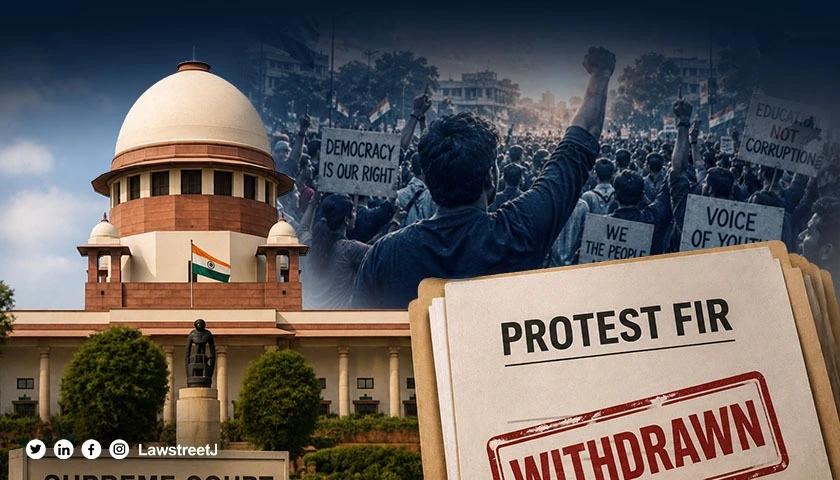
New Delhi: The Supreme Court of India has provided a significant legal clarification regarding the withdrawal of criminal cases registered against students who participated in nationwide protests over the NEET-UG paper leak.
A bench led by Chief Justice of India Surya Kant, along with Justices Joymalya Bagchi and V. Mohana, held on Monday that state governments are at liberty to close or withdraw these FIRs in accordance with the prescribed legal framework.
A pivotal aspect of the Court's clarification involves the interpretation of "criminal antecedents," a term used in its earlier July 28 order to determine eligibility for protection from arrest. The bench clarified that this expression refers strictly to "grave and heinous offences" rather than petty violations. Counsels appearing for the students had argued that a broad interpretation of the term was being used as a "catch-all category" to justify continued arrests and harassment, potentially trapping students with minor records, such as driving violations, in the criminal justice system.
Legal experts and state authorities have emphasized that despite executive promises, FIRs cannot be closed overnight through a simple government order. Once an FIR is registered, it becomes the property of the court, and its closure must follow statutory procedures regulated by the judiciary. Under Section 360 of the Bharatiya Nagarik Suraksha Sanhita (BNSS), a Public Prosecutor may move to withdraw from a prosecution, but this remains subject to the consent and satisfaction of the court. Alternatively, investigating agencies may file closure reports, which the jurisdictional magistrate is free to accept or reject after considering the nature of the case and the interests of any private victims.
In the National Capital Territory of Delhi, the Home Department has already initiated the legal process to review and drop actions in 13 registered FIRs related to the protests. The Delhi government’s order explicitly reiterates the Supreme Court's mandate, providing relief only to peaceful demonstrators without records of grave offences. Similarly, the Bihar government has issued directives to district magistrates and public prosecutors to expedite the withdrawal of 64 FIRs involving more than 350 students across 20 districts.
The legal proceedings are occurring against a backdrop of serious allegations regarding police conduct during the July 20 ‘Sansad Chalo’ march. Petitioners have submitted approximately 300 videos to the court, which allegedly depict security personnel using excessive force, including the deployment of pellet guns, shock batons, and lathis fitted with nails. Senior counsel highlighted specific instances of brutality, such as the alleged assault of an advocate at a police station and the use of facial recognition technology to identify protesters without their consent.
The Chief Justice stated that police officers involved in such excesses would not be unduly protected, and the Court is considering the formation of a judge-led panel to investigate the conduct of both authorities and protesters.
The Cockroach Janta Party (CJP), which organized the demonstrations, has maintained pressure on the government to honour its July 25 assurance that all FIRs against peaceful protesters would be scrapped. The outfit argued that it only called off its nationwide agitation based on this solemn guarantee and warned that students were still being "witch-hunted" despite the interim relief provided by the judiciary. CJP spokespersons have called for the immediate implementation of the agreement's "letter and spirit," asserting that the streets of India would resume their protest if these guarantees are dishonoured.
The Supreme Court has now directed the Union government to file an affidavit regarding the use of pellet guns and the current status of the FIRs across different states. The bench indicated it intends to lay down a formal protocol to regulate when such force may be used or avoided in civilian demonstrations.
The proceedings have been listed for further hearing on August 18.
Case title: Shailendra Mani Tripathi v. Union of India & Ors. (and connected matters).