New Delhi: The Supreme Court, while acknowledging progress made by the Food Safety and Standards Authority of India (FSSAI) towards implementing Front-of-Package Labelling (FoPL) on packaged foods, has flagged several unresolved ambiguities in its proposal and directed it to file a further affidavit clarifying its approach on thresholds, phasing, design and placement of the proposed warning label.
A Bench of Justice J.B. Pardiwala and Justice K. Vinod Chandran was hearing a miscellaneous application in a pending writ petition concerning the regulation of High in Fat, Sugar or Salt (HFSS) and Ultra-Processed Foods (UPF).
By its earlier order dated 13.08.2026, the Court had underscored the urgent need for FoPL, drawing a link between HFSS/UPF consumption and health conditions such as obesity, diabetes, heart disease and hypertension, and had called upon the Union and FSSAI to take prompt action, observing that the right to health under Article 21 and the State's duty under Article 47 required affirmative steps.
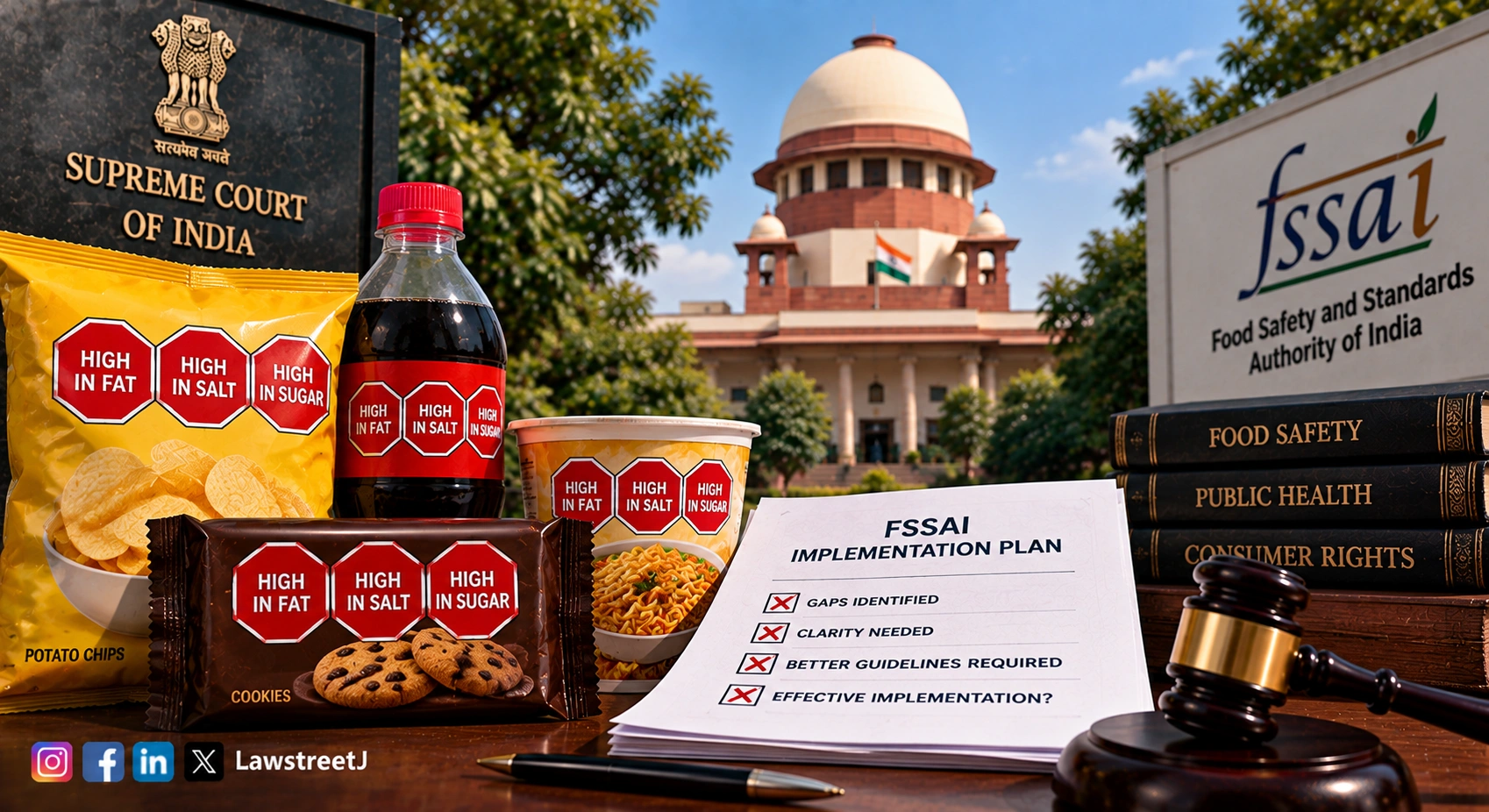
In response, FSSAI filed an affidavit stating that it had prepared a proposal for a red hexagonal Front-of-Pack warning label bearing declarations such as “HIGH FAT”, “HIGH SUGAR”, “HIGH SALT” or “HIGHLY SWEETENED BEVERAGE”, to be displayed in a font size one point larger than the nutrition information table, with single-ingredient foods and inherently HFSS items such as ghee, oil and sugar proposed to be exempted. FSSAI proposed a phased rollout, with Phase I covering products high in two or more nutrients-of-concern and specified sweetened beverages, and Phase II extending the warning to products high in any single nutrient.
The Court found several aspects of this proposal in need of clarification. On the phased strategy, it noted that the petitioner had objected to the ‘two or more’ threshold as unscientific, since excess sugar, salt and saturated fat are independently harmful through different pathways, and pointed out an unresolved inconsistency between the disjunctive language of the Dietary Guidelines for Indians, 2024 and the conjunctive language of the 2022 Draft Labelling Regulations in defining HFSS foods. The Court also noted the absence of any fixed timeline separating Phase I from Phase II, cautioning that this could indefinitely postpone the second phase, and considered an alternative model, illustrated by Israel’s approach of moving from higher to progressively lower thresholds as one FSSAI should examine.
On threshold levels, the Court examined Table 15.1 and Table 15.2 of the 2024 Guidelines, which classify foods by degree of processing (Groups A, B and C) and by calorific sub-category (1, 2 and 3), with sub-categories 2 and 3 treated as HFSS. It observed that while sub-category 1 specifies exact permissible levels of fat, sugar and salt, no clear numerical differentiation exists between sub-categories 2 and 3, and asked FSSAI to clarify whether this distinction, as well as the difference between moderately processed (Group B) and ultra-processed (Group C) foods, would be reflected in the design of the warning label.
On font size, the Court noted that FSSAI's proposal to use a font one point larger than the nutrition table, prescribed under Regulation 6(3) of the 2020 Labelling Regulations, could not be meaningfully assessed without knowing the dimensions of the hexagonal label itself, and asked whether the label's size would be standardised or proportionate to package area, noting the petitioner's submission that other countries use labels covering 15-20% of the principal display area.
The Court raised several further concerns: whether the label should be based on ‘total’ sugar and ‘saturated’ fat, consistent with a 2021 stakeholders' consensus, rather than ‘added’ sugar and fat as presently proposed, and how trans-fat would be accounted for; the absence of clarity on where the label would be placed on the package; the proposal's reliance on word-based warnings without pictorial representations, which may not be accessible across India's varying levels of literacy; why a single composite hexagon was proposed for multiple nutrients-of-concern rather than separate hexagons for each; whether the colour red was apt given its common association with non-vegetarian labelling; the risk that discouraging sugar, salt and fat could drive increased use of artificial preservatives and emulsifiers; and whether compliance with the final regulations would be mandatory from inception or subject to a voluntary transition period, as was proposed under the Draft 2022 Regulations.
The Court also referred to its earlier observations, citing UNICEF's Child Nutrition Report 2025, on the sharp rise in childhood overweight prevalence and children's disproportionate exposure to packaged snacks near schools, and directed the Union to indicate how nutritional literacy on interpreting FoPL and nutrition information would be incorporated into school curricula.
Accordingly, the Court framed a set of thirteen specific questions for the Union and FSSAI covering the timeline for the two phases, the scientific basis for the phasing criteria, identification of covered sweetened beverages, treatment of food sub-categories and processing groups, the total-versus-added nutrient basis, the colour and dimensions of the label, accessibility for diverse literacy levels, the rationale for composite versus individual hexagons, regulation of substitute additives, the timeline for mandatory compliance, and the incorporation of nutritional literacy in schools.
FSSAI was directed to file its response by affidavit within ten days, to be shared with the petitioner for a further response before the next hearing, which was fixed for 28.09.2026.
Case Title: 3S and Our Health Society vs. Union of India & Anr., Miscellaneous Application No. 1177 of 2025 in Writ Petition (Civil) No. 437 of 2024