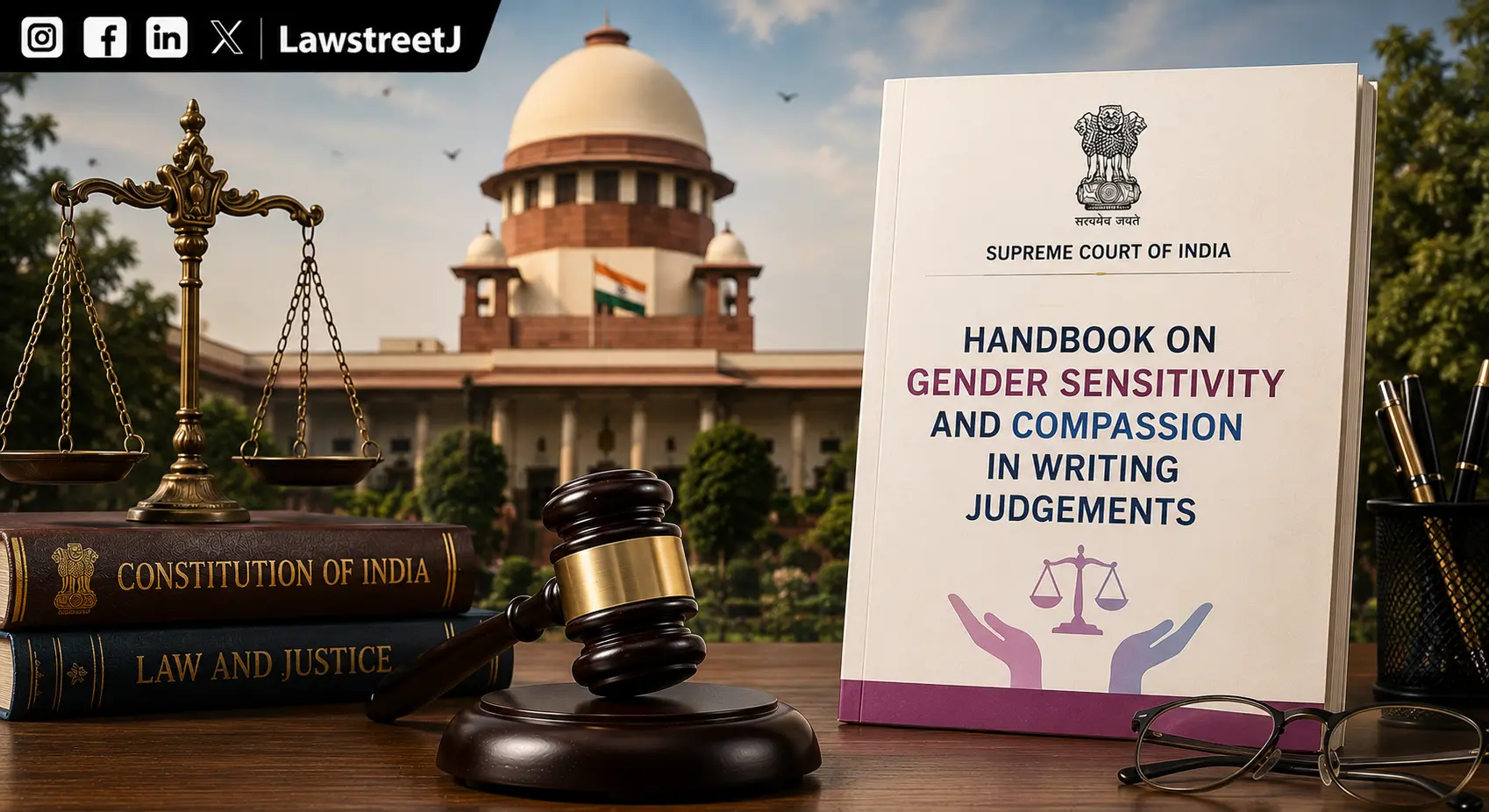
New Delhi: The Supreme Court of India has released a comprehensive handbook titled “Judgements and Gender - Sensitivity and Compassion in Writing Judgements,” directing all courts across the country to strictly adhere to the expressions, terminology and guidance contained in the approved report.
The release marks the culmination of a process set in motion by the Court itself earlier this year, when it directed the constitution of a Committee of Experts to examine the persistent use of insensitive and stereotypical language in judicial writing, particularly in cases involving sexual offences, women, children and other vulnerable persons. The Court has underscored that legal training alone cannot equip judges to handle such matters with the requisite sensitivity, and that emotional intelligence must function as an essential complement to legal competence in the effective administration of justice.
The handbook traces its origins to an order dated 10th February 2026, passed by a Bench comprising the Chief Justice of India, Surya Kant, and Justices Joymalya Bagchi and N.V. Anjaria, in Suo Moto Writ Petition (Criminal) No. 1/2025. The Bench had taken cognisance of an order passed by a High Court in a matter involving allegations under Section 376 of the Indian Penal Code, 1860, and Section 18 of the Protection of Children from Sexual Offences Act, 2012 (POCSO).
The High Court, while examining a summons order, had modified it to substitute the charges with lesser offences under Section 354B of the Indian Penal Code and Sections 9 and 10 of the POCSO Act. Senior counsel appearing before the Supreme Court, apart from pointing out legal infirmities in the impugned order, drew the Court's attention to what they described as an insensitivity reflected in the manner in which the matter, involving a minor victim of an alleged sexual offence, had been dealt with.
The Supreme Court, while examining these submissions, observed that it found “some strength in the issues raised.” The Bench noted that the judicial system, being a cohesive framework designed to deliver justice, cannot function on the sound application of constitutional and legal principles alone, but must also foster an environment of compassion and empathy. The Court remarked that “the absence of either of these cornerstones would prevent judicial institutions from properly performing their critical duties,” and went on to observe that no judge or judgment can be expected to do complete justice while remaining inconsiderate towards the factual realities and vulnerabilities faced by a litigant.
Rather than laying down guidelines on its own without the benefit of a comprehensive understanding of past efforts in this direction, the Court chose to request the National Judicial Academy, Bhopal, through its Director, Justice Aniruddha Bose, a former Judge of the Supreme Court, to constitute a Committee of Experts. The Committee, presided over by Justice Bose as Chairperson and comprising four other domain experts drawn from among practitioners, academicians and social workers, was tasked with preparing a comprehensive report on “Developing Guidelines to Inculcate Sensitivity and Compassion into Judges and Judicial Processes in the Context of Sexual Offences and other Vulnerable Cases.” The Court specifically directed that the Committee bear in mind the linguistic diversity of the country and, where possible, identify offensive words and expressions across regional languages that may otherwise go unnoticed by the judiciary. It further directed that the guidelines be prepared, as far as possible, in simple language comprehensible to laypersons, given that the primary beneficiaries of such guidelines would be children, women of tender age and members of vulnerable communities.
In compliance with these directions, a committee was constituted comprising Justice (Retd.) Sonia G. Gokani, former Chief Justice of the High Court of Gujarat; Ms. Anuradha Shankar, former Director General of Police, Madhya Pradesh; Dr. Surat Singh, Advocate, Supreme Court of India; and Prof. Lucy T.V. Zehol, Professor, Department of Anthropology, North-Eastern Hill University, Shillong, with the committee being assisted by Dr. Sonam Jain of the National Judicial Academy. As part of its exercise, the committee analysed 125 trial court judgments from across the country, with the assistance of State Judicial Academies, and also circulated a questionnaire to gauge stakeholder understanding of court language and proceedings.
The findings, as reflected in the handbook, present a mixed picture of judicial attitudes. While the study found several instances of sensitised judicial approaches, particularly citing State of Punjab v. Gurmit Singh, where the Supreme Court had directed trial judges to actively protect victims during testimony and not remain “silent spectators” while a victim is subjected to embarrassing or intimidating questioning, the committee also documented the continued prevalence of victim-blaming language across the justice delivery system. The handbook records commonly used phrases such as questions about a survivor's clothing, her reasons for being at a particular place, or why a complaint was made late, and notes that similar attitudes persist not merely in courtrooms but also at police stations, hospitals and one-stop crisis centres.
A significant portion of the handbook is devoted to tracing the evolution of gender jurisprudence in India through a curated table of landmark decisions, beginning with Yusuf Abdul Aziz v. State of Bombay (1954) and extending to recent pronouncements including Joseph Shine v. Union of India, which struck down the offence of adultery; Aparna Bhat v. State of Madhya Pradesh, which directed judges to avoid gender stereotypes and barred suggestions of marriage or compromise in rape cases; and State of Jharkhand v. Shailendra Kumar Rai, which condemned the use of the “two-finger test” in rape investigations. The handbook notes that in the latter judgment, the Court had held that a woman's “sexual history is wholly immaterial” to allegations of rape, and that treating a sexually active woman as inherently less credible reflects attitudes that are “patriarchal and sexist.”
The handbook also reiterates the existing statutory rape-shield protections available under Indian law, including Sections 154 and 155 of the Bharatiya Sakshya Adhiniyam, 2023, which empower courts to disallow indecent, scandalous or insulting questions during cross-examination, and Section 53A of the same enactment, which renders a victim's prior sexual history irrelevant to the question of consent. Reference is also made to a recent Allahabad High Court decision condemning a lawyer's attempt to characterise a survivor as “a woman of easy virtue,” holding such characterisation to be “wholly irrelevant” and legally impermissible.
Perhaps the most widely discussed component of the handbook is its glossary of gendered and stereotypical expressions commonly found in judgments, along with suggested neutral alternatives. Terms such as “prosecutrix,” “helpless woman,” “ouraging the modesty,” and references to a victim's “chastity” or “honour” have been flagged as reflective of patriarchal notions embedded in judicial language, with the handbook recommending their substitution with terms such as “survivor,” “complainant,” and expressions centred on “bodily autonomy” and “dignity.” The handbook also addresses terminology relating to sex work, live-in relationships, and persons of diverse sexual orientation and gender identity, recommending the use of terms such as “partner” in place of “concubine” or “mistress,” and “sex worker” in place of derogatory alternatives, while cautioning that even the term “prostitute” ought to be used only where a statute specifically requires it.
| Traditional / Problematic Phrase | Neutral, Legally Appropriate Alternative |
|---|---|
The body of women as play ground | Violated bodily autonomy of complainant(s)/victim(s) |
Helpless woman; helpless female | Survivor / Complainant |
Where women are honoured, there the gods rejoice | Avoid religious/cultural references; focus on legal rights |
It destroys the very soul of a helpless woman | Crime caused severe trauma to the survivor |
Victimization, soul destroyed | Survivor experienced harm/trauma |
Female members/persons (for victims) | Victim / Survivor / Complainant |
Gold digger (economic motive) | Avoid speculation; focus on evidence |
Suffering from psychological neurosis | Survivor may be experiencing trauma/distress |
Woman in non-permissive society | Person in a conservative society |
Allow women to walk freely | All individuals have the right to move freely and safely |
Self-respecting woman | “Woman” may be used without any adjective |
Poor helpless minor girl | Minor victim / Child survivor |
Hormonal changes, desire, temptation | Avoid physiological explanations unless absolutely necessary |
She was enticed away (good faith) | Accused lured/abducted victim by gaining trust |
Honour, shame | Avoid “honour”/“shame”; focus on survivor’s rights |
Victim of another person’s lust | Victim/survivor of sexual assault/violence |
Stigma as inevitable consequence | Focus on justice/rehabilitation |
Outraged the modesty | Sexual assault / violation of bodily autonomy |
Serious health consequences as a female | Serious health consequences for the victim/survivor |
Permanent impact on girl’s life | Survivor may need ongoing support; focus on recovery |
Lost her chastity | Survivor’s bodily autonomy was violated |
No hue and cry, travelled calmly (post-occurrence behaviour) | Avoid victim-blaming; focus on facts |
Gullible or obedient daughter | Minor / Child victim |
She was a consenting party | Consent is not legally valid for minors |
Tutored child | Child witness; avoid assumptions about influence |
Bid to defile chastity | Act of sexual assault / violation of autonomy |
Fueled by lust | Sexual violence; avoid attributing crime to “lust” |
Prosecutrix | Victim / Survivor / Complainant |
Degrades the soul of the helpless female | Causes severe harm to survivor |
Spoiled her childhood / ruined life | The crime had serious consequences; focus on support |
Minor girl/child | Child victim / Survivor |
Satisfy his illicit lust | Committed sexual assault / violated the law |
Haunt throughout her life | Survivor may face ongoing challenges |
Physical relationship (for rape/assault) | Sexual assault / rape (where the act is non-consensual and/or victim is a minor) |
Disrobing (unless provided in the statute) | Forced removal of clothing (part of sexual assault) |
Status and prestige of family is at stake | Focus on harm to victim/survivor; avoid “honour” shaming |
Scars left remain lifelong | Survivor may need ongoing support; focus on recovery |
Helpless female | Survivor |
Her private part/chest/vagina, victim girl | Use neutral medical/legal terms; refer to child/survivor |
Accused acted as with his granddaughter | Focus on age difference & power dynamics, not family framing |
Destroyed life, betrayal, shameful conduct | Survivor experienced severe harm |
Modesty | Bodily autonomy |
Offends esteem/dignity | Violation of survivor’s bodily autonomy and rights |
Girl child is vulnerable | All children are entitled to protection under the law |
Sex slave | Survivor subjected to repeated sexual violence/exploitation while under control |
Brothel keeper | Perpetrator of trafficking/sexual exploitation (“brothel” only if statutorily necessary) |
Sterling character (victim’s character) | Character evidence is irrelevant in sexual offences |
Lust satisfaction | Act of sexual violence/assault; avoid trivialising the crime |
Illiterate/rustic witness | Witness (mention education only if legally relevant) |
Whore (derogatory term) | Survivor / Victim |
Inability to control emotions, male-dominated society | Avoid rationalising crime; focus on accountability/law |
Concubine, Kept/Keep, Mistress | Partner (extends to same-sex relationships); or “girlfriend” where relevant |
Prostitute, call girl, fallen woman, escort | Sex worker (“prostitute” only where statutorily necessary) |
Homosexual | Gay (Lesbian remains an acceptable term for women) |
Hijra / Thirunangai / Thirunambi / Jogappa (used pejoratively) | Intersex; or SOGIESC-based terminology as appropriate |
The handbook goes beyond vocabulary to address courtroom practice more broadly, describing what it terms “compassionate court practices.” These include a recommendation that presiding officers not wait for victims to make specific requests before ensuring protective measures are in place, given that such protection is a legal obligation of the court itself. The handbook draws on the Supreme Court's earlier judgment in Mahender Chawla v. Union of India, approving the Witness Protection Scheme, 2018, and on Sakshi v. Union of India, which had endorsed child-friendly procedures for recording evidence in cases involving sexual offences. It also revives the Court's earlier observations in State of U.P. v. Shambhunath Singh, describing witnesses as deserving to be treated as “guests invited” by the court, and cautioning against the prolonged and undignified waiting that witnesses are frequently subjected to.
On the question of in-camera proceedings, the handbook notes the statutory position under Section 366 of the Bharatiya Nagarik Suraksha Sanhita, 2023, which mandates that trials for offences of rape and related offences under the Bharatiya Nyaya Sanhita, as well as offences under the POCSO Act, be conducted in camera, with strict prohibitions on the publication of material that could reveal the identity of a victim, as had earlier been directed by the Supreme Court in Nipun Saxena v. Union of India.
The handbook enumerates a set of “points for consideration” intended to guide judges in gender-related matters, including the use of fact-based reasoning rather than assumptions rooted in a victim's conduct or character, caution in the use of statutory expressions such as “ouraging modesty,” recognition that the absence of resistance or a delay in reporting does not imply consent, and the consistent use of terms such as “child” or “minor” for victims below the age of eighteen, in keeping with the POCSO Act. It correspondingly lists terms to be avoided altogether, including expressions suggestive of victim-blaming, references to “bashfulness,” “honour” or “sanctity,” generalisations about how complainants are expected to behave, and language attributing sexual offences to “lust” rather than characterising them in legally precise terms as acts of sexual violence.
The handbook is accompanied by two annexures. The first sets out the results of a feedback exercise conducted through District Legal Service Authorities, in which litigants and witnesses were asked about their experience of court proceedings. The results indicate that a majority of respondents over eighty-six percent reported understanding the legal proceedings and language used in their matters, and that a similar majority felt they had been heard by the presiding judge.
However, the same exercise revealed that over eighty percent of respondents remained unaware of the Witness Protection Scheme, and a significant number reported facing repeated adjournments, poor communication and a lack of separate waiting areas for victims and witnesses. The second annexure reproduces the National Legal Services Authority's Compensation Scheme for Women Victims/Survivors of Sexual Assault and Other Crimes, 2018, framed pursuant to the Supreme Court's directions in Nipun Saxena v. Union of India, setting out the eligibility criteria, procedure and quantum of compensation payable to women victims of offences ranging from rape and acid attacks to grievous injury requiring rehabilitation.
In its preface to the handbook, Justice Aniruddha Bose acknowledged that the exercise undertaken by the Committee was without precedent, and cautioned that a publication of this nature “cannot permanently act as guideline as language evolve continuously.” He observed that the responsibility of weeding out offensive or undesirable language ultimately rests with the legal community as a whole, and that the use of appropriate expressions can play a meaningful role in “eradicating deep-seated gender-based prejudices.”
The handbook, while directing strict compliance across courts, has therefore been framed less as a static rulebook than as a living reference intended to sensitise judges, lawyers and court staff to the lived realities of victims and survivors who appear before the justice system, with the stated objective of ensuring that courts remain, in the Committee's words, spaces where survivors feel comforted rather than places where they risk reliving their trauma.
Source: Supreme Court of India, Suo Moto Writ Petition (Criminal) No. 1/2025, order dated 10 February 2026 (CJI Surya Kant, Bagchi and Anjaria, JJ.); Handbook on “Judgements and Gender – Sensitivity and Compassion in Writing Judgements”, prepared by a Committee of Experts constituted by the National Judicial Academy, Bhopal, chaired by Justice Aniruddha Bose.