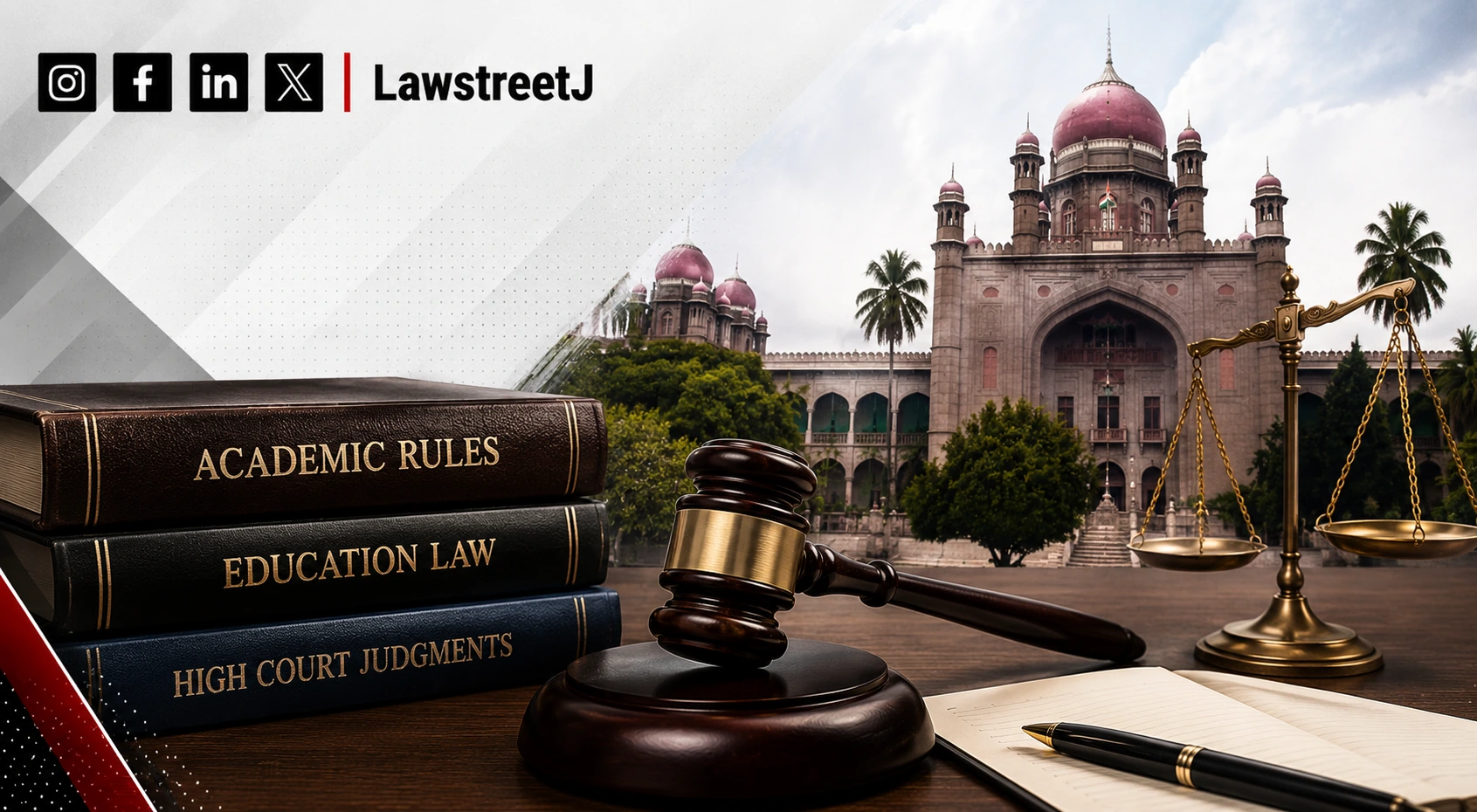
Hyderabad: The Telangana High Court has refused to direct NALSAR University of Law to permit an MBA student to appear in supplementary examinations after she was detained for shortage of attendance due to prolonged illness.
Justice Juvvadi Sridevi was hearing a writ petition filed by S. Nandini, a first-year MBA student who had completed her first semester with a CGPA of 7.60 but, during February and March 2026, suffered from viral pneumonia, a Lower Respiratory Tract Infection, severe dehydration and persistent fever, for which she was advised nearly twenty days of complete bed rest. As a result, she could not maintain the prescribed attendance and was not permitted to appear for the Second Semester End-Term Examinations held in April 2026.
On a representation by her parents seeking condonation of the attendance shortage and tendering an apology for not having obtained prior permission for medical leave, the Head of the Department of Management Studies initially assured the petitioner that she would be allowed to appear for the supplementary examinations scheduled for July 2026. However, on 04.07.2026, she was informed that since her backlogs exceeded four subjects, she would have to repeat the entire first year. After the supplementary examinations commenced on 06.07.2026, the University declined to issue her a hall ticket, citing her detention for shortage of attendance and directing her to re-register for the first year under the Manual of Policies for the MBA Programme.
Counsel for the petitioner argued that the University's Rules recognise medical leave and relaxation in genuine cases of personal physical exigency, that Rule 4.6 permits a student granted medical leave to appear for examinations with a minimum of 67% attendance rather than the ordinary 75%, and that Rule 4.8.7's restriction on post facto medical certificates could not be read in isolation so as to override the provisions recognising medical leave. It was further submitted that the University had neither passed a reasoned order nor granted a personal hearing before refusing her the hall ticket, rendering the action arbitrary and violative of natural justice.
The University's Standing Counsel submitted that the petitioner had secured only around 52% attendance, well short of even the relaxed 67% threshold applicable to students on medical leave, that she had never obtained prior permission for medical leave in accordance with the prescribed procedure, and that Rule 5.3.5 mandatorily barred a student detained for shortage of attendance from appearing in the repeat or supplementary examination, requiring re-registration instead. It was also pointed out that the petitioner neither objected to her detention at the relevant time nor approached the Court until after the supplementary examinations had already begun, doing so by way of a lunch motion.
Examining Rules 4.6, 4.7.2 and 5.3.5 of the University's Rules, the Court held that even the relaxed attendance requirement for students on medical leave was a mandatory floor of 67%, and that the petitioner, on either party's figures, fell short of it. It found that Rule 5.3.5 left no room for discretion once a student stood detained for shortage of attendance.
“Rule 5.3.5 stipulates that a student, who is not permitted to take End-Term Examinations on account of shortage of attendance, shall not be eligible to appear for the repeat examination and shall be required to re-register for the course. The Rule is couched in mandatory terms and leaves no discretion either to the respondent-University or to this Court to permit a student detained on account of shortage of attendance to appear in the supplementary examinations.”
The Court also noted that the petitioner had not challenged her detention from the End-Term Examinations when it occurred, and had approached the Court only after the supplementary examinations were already underway, with her parents' representation itself dated 06.07.2026, the day the examinations commenced.
“Sympathy or equitable considerations cannot override the mandatory academic Rules, which are uniformly applicable to all the students. It is well settled that in matters relating to academic standards, eligibility and examination regulations, the scope of judicial review under Article 226 of the Constitution of India is extremely limited.”
Holding that the University's action could not be interfered with absent arbitrariness, mala fides, discrimination, or violation of its own Rules, the Court dismissed the writ petition, with no order as to costs.
Appearances: For the Petitioner: Dr. Lakshmi Narasimha, Advocate. For the Respondent: Mr. A. Kranti Kumar Reddy, Standing Counsel for NALSAR University.
Case Title: S. Nandini v. NALSAR University of Law, W.P. No.21904 of 2026


!['No common intention to kill,' SC alters conviction from murder to culpable homicide not amounting to murder [Read Judgment]](/secure/uploads/2024/02/lj_7197_f77c706e-b667-41fe-9c36-9e633e880b85.jpg)
![Remaining silent during an investigation is a fundamental right: Telangana HC [Read Judgment]](/secure/uploads/2024/04/lj_3728_c8f7ecd3-a0e9-44f7-85aa-f77b9dae3a49.webp)