.webp)
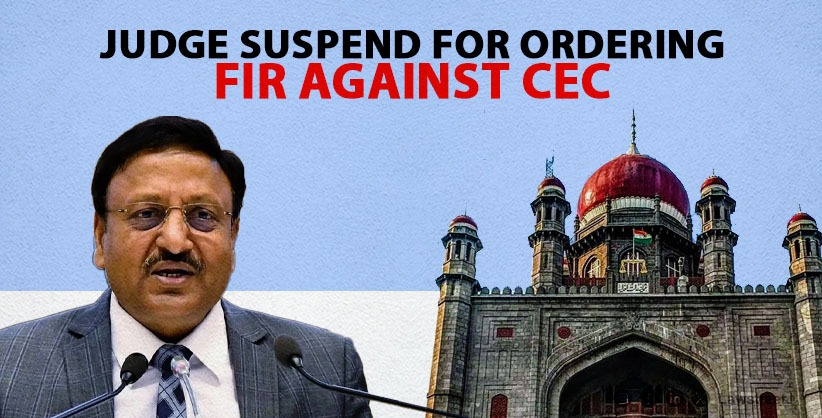
Hyderabad: The Telangana High Court has rejected two election petitions challenging the 2023 Assembly election victory of Bharat Rashtra Samithi leader Kalvakuntla Taraka Rama Rao (KTR) from the 29-Sircilla Assembly Constituency, allowing his applications for rejection of the petitions for want of a valid cause of action.
Justice Namavarapu Rajeshwar Rao was hearing applications filed under Order VII Rule 11 of the Code of Civil Procedure, 1908 read with Section 86 of the Representation of the People Act, 1951, seeking dismissal of Election Petition Nos. 27 and 28 of 2024, filed by Kondam Karuna Mahender Reddy and Lagisetti Srinivas respectively, both of whom had contested the same constituency and lost.
The election petitioners had alleged that KTR committed a corrupt practice under Section 123 of the R.P. Act by suppressing, in his Form 26 nomination affidavit, the movable and immovable assets of his son, Kalvakuntla Himanshu Rao, who had turned 18 shortly before the notification of elections and had, within a week of attaining majority, allegedly purchased agricultural land worth over Rs. 98 lakh from a private company. It was contended that this suppression amounted to undue influence over the electorate.
Appearing for KTR, Senior Counsel Sri G. Vidyasagar submitted that the election petitions nowhere specified which clause of Section 123 was invoked, and merely stated that there was “every possibility” of undue influence, without pleading any concrete material facts. It was argued that KTR's son had attained majority on 12.07.2023 and had his own independent source of livelihood, and was therefore not a “dependent child” whose assets required disclosure under the relevant clause of Form 26.
It was further submitted that Section 75(A)(5)(v) of the R.P. Act, which defines “dependent children,” applies only to post-election declarations by sitting legislators and has no bearing on a nomination affidavit, and that the petitioners had not placed any material to show that the funds for the land purchase originated from KTR himself.
Opposing the applications, Senior Counsel Sri D. Prakash Reddy for the election petitioners argued that non-disclosure of a dependent's assets amounts to corrupt practice under Section 123(2), and that KTR had failed to reveal the actual source of his son's funds despite the son being a student in the United States, which the Court ought to treat as an adverse inference.
Rejecting this contention, the Court held that the mere non-disclosure of information relating to assets does not, by itself, warrant setting aside an election, unless the concealment is shown to be of a substantial nature capable of materially affecting the result, relying on the Supreme Court's recent ruling in Ajmera Shyam v. Kova Lakshmi (2026) 3 SCC 373. The Court observed:
“Merely because a returned candidate has not disclosed certain information related to the assets, courts should not rush to invalidate the election by adopting a highly pedantic and fastidious approach, unless it is shown that such concealment or non-disclosure was of such magnitude and substantial nature that it could have influenced the election result.”
The Court further noted that the election petitioners had not raised any objection at the stage of scrutiny of nominations, had not disclosed which sub-clause of Section 123 was attracted, and had failed to plead how the alleged non-disclosure materially affected the election result defects the Court held were fatal to the maintainability of the petitions under Section 83 of the R.P. Act read with Order VII Rule 11 CPC.
Holding that vague and unsubstantiated allegations “based on mere possibility and not on definite material facts” could not sustain a trial, the Court allowed both applications and dismissed Election Petition Nos. 27 and 28 of 2024, with no order as to costs.
Appearances:
For the Petitioner (KTR): Sri G. Vidyasagar, Senior Counsel, representing Sri T.V. Ramana Rao, Advocate.
For the Respondents/Election Petitioners: Sri D. Prakash Reddy, Senior Counsel, representing Sri Peri Prabhakar, Advocate.
For Respondent No. 21: Sri Mohammed Omer Farooq, Advocate.
Case Title: Kalvakuntla Taraka Rama Rao vs. Kondam Karuna Mahender Reddy and others; Kalvakuntla Taraka Rama Rao vs. Lagisetti Srinivas and others, I.A. No. 02 of 2024 in Election Petition Nos. 27 & 28 of 2024


!['No common intention to kill,' SC alters conviction from murder to culpable homicide not amounting to murder [Read Judgment]](/secure/uploads/2024/02/lj_7197_f77c706e-b667-41fe-9c36-9e633e880b85.jpg)
![Remaining silent during an investigation is a fundamental right: Telangana HC [Read Judgment]](/secure/uploads/2024/04/lj_3728_c8f7ecd3-a0e9-44f7-85aa-f77b9dae3a49.webp)