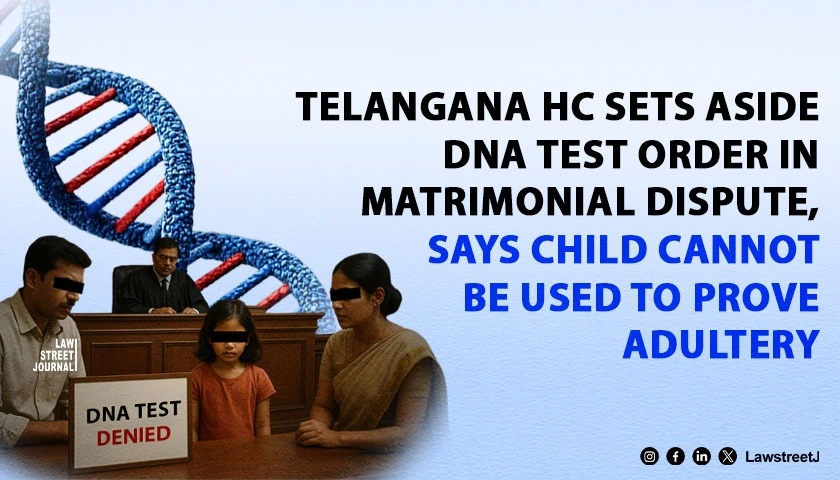
Telangana: The High Court for the State of Telangana at Hyderabad has set aside a trial court order directing a DNA test of a minor girl child in the course of matrimonial proceedings, holding that a child cannot be used as a means to establish allegations of adultery against the mother and that the right to identity of a child cannot be sacrificed for the purpose of proving one party’s case in a matrimonial dispute.
The order was passed by Justice Renuka Yara in a revision petition challenging the order passed by the Senior Civil Judge, whereby the application for DNA testing of the minor child had been allowed.
The background of the case is that the husband filed an application seeking dissolution of his marriage on the grounds of adultery and cruelty. The divorce petition alleged that the wife was having an extramarital relationship with a third person, that she was quarrelsome and continuously demanded to live separately from the husband’s parents, and that she had never shown interest in living with the husband. It was further alleged that she was regularly having conversations over the phone with the said third person and concealing the same.
The central allegation that gave rise to the DNA test application was that on May 26, 2022, the wife declared that the minor child was not the daughter of the husband but was the daughter of the third person, and that the husband was a father only for social purposes. Following this declaration, the husband filed an application under Section 45 of the Indian Evidence Act, 1872, seeking a direction for DNA testing of himself and the minor child to determine the paternity of the child. The trial court allowed the application and directed both the husband and the minor child to appear before the Director, Forensic Science Laboratory, for a DNA test within two weeks, with a further direction to submit the report to the court.
Before the High Court, the revision petitioner contended that the husband had the capacity to manage the DNA laboratory and obtain a report in his favour. It was further alleged that the husband had already collected DNA samples privately, obtained a report in his favour, and on the basis of that private report, had evicted the wife and the minor child from his house. The revision petitioner therefore opposed the court-directed collection of DNA samples.
The counsel for the revision petitioner placed reliance on Section 112 of the Indian Evidence Act, 1872, and the Supreme Court’s judgment in Aparna Ajinkya Firodia v. Ajinkya Arun Firodia, reported in (2024) 7 SCC 773. Section 112 provides that birth during the continuance of a valid marriage shall be conclusive proof of legitimacy unless it can be shown that the parties to the marriage had no access to each other at the relevant time. It was argued that the husband had not pleaded the absence of access to the wife during the period relevant to the conception of the child, and therefore the statutory presumption of legitimacy under Section 112 remained fully operative.
The High Court noted that the Indian Evidence Act was enacted in 1872 during the British era, at a time when the science of DNA testing was not available and the only mechanism available to courts to determine paternity was to draw presumptions based on access between the parties during a valid marriage. It observed that with the subsequent development of DNA testing, courts have in appropriate cases directed such tests to establish paternity, but while doing so, courts are required to be extremely cautious about invading the privacy of a minor child, with the welfare of the child to be placed above all other considerations.
The High Court relied extensively on the guidelines laid down by the Supreme Court in Aparna Ajinkya Firodia (supra), wherein it was held that DNA tests of children born during the subsistence of a valid marriage may be directed only when there is sufficient prima facie material to dislodge the presumption under Section 112 of the Evidence Act, and that if no plea has been raised regarding non-access, a DNA test may not be directed to rebut the presumption of legitimacy.
The High Court also placed reliance on the observation in Aparna Ajinkya Firodia (supra) that the question of whether a DNA test should be permitted on a child must be analysed through the prism of the child and not through the prism of the parents. It was held in that case that a child cannot be used as a pawn to show that the mother was living in adultery, and that the husband is always at liberty to prove the adulterous conduct of the wife by other evidence, but the child’s right to identity should not be sacrificed for that purpose.
The contention raised on behalf of the husband that denying a DNA test would infringe his right to a fair trial and his entitlement to produce the best available evidence was also addressed and rejected by the Supreme Court in Aparna Ajinkya Firodia (supra), which held that the dispute in matrimonial proceedings is between the parties to the marriage and not between one of the parties and the child whose paternity is questioned. It was held that to enable one party to benefit from a fair trial, the court cannot sacrifice the rights and best interests of a third party to the dispute, namely the child.
Applying these principles to the facts before it, the High Court held that the divorce petition between the parties did not include the minor child as a party to the proceedings, and therefore the child could not be made a means to prove the adultery alleged against the revision petitioner. The court noted that the husband had not raised any plea of non-access to rebut the statutory presumption of legitimacy under Section 112, and that in the absence of such a plea, the presumption remained intact and a DNA test could not be directed.
While setting aside the trial court’s order, the High Court made it clear that the husband is at liberty to adduce any other evidence available to him to prove his allegations of adultery against the wife in the ongoing matrimonial proceedings. The court clarified that setting aside the DNA test direction does not bar the husband from establishing his case through other permissible means.
The Civil Revision Petition was accordingly allowed and the order dated September 17, 2024, passed by the Senior Civil Judge at Jagtial in I.A. No. 173 of 2024 in H.M.O.P. No. 39 of 2024, was set aside. There was no order as to costs, and all miscellaneous applications, if any pending, were directed to stand closed.
Appearances:
For the Petitioner: M/s. Alluri Divakar Reddy, Advocate
For the Respondents: Mr. Y. Bala Murali, Advocate (for Respondent No. 1)
Case Title: [Revision Petitioner] v. [Respondent No. 1 & Respondent No. 2]


!['No common intention to kill,' SC alters conviction from murder to culpable homicide not amounting to murder [Read Judgment]](/secure/uploads/2024/02/lj_7197_f77c706e-b667-41fe-9c36-9e633e880b85.jpg)
![Remaining silent during an investigation is a fundamental right: Telangana HC [Read Judgment]](/secure/uploads/2024/04/lj_3728_c8f7ecd3-a0e9-44f7-85aa-f77b9dae3a49.webp)