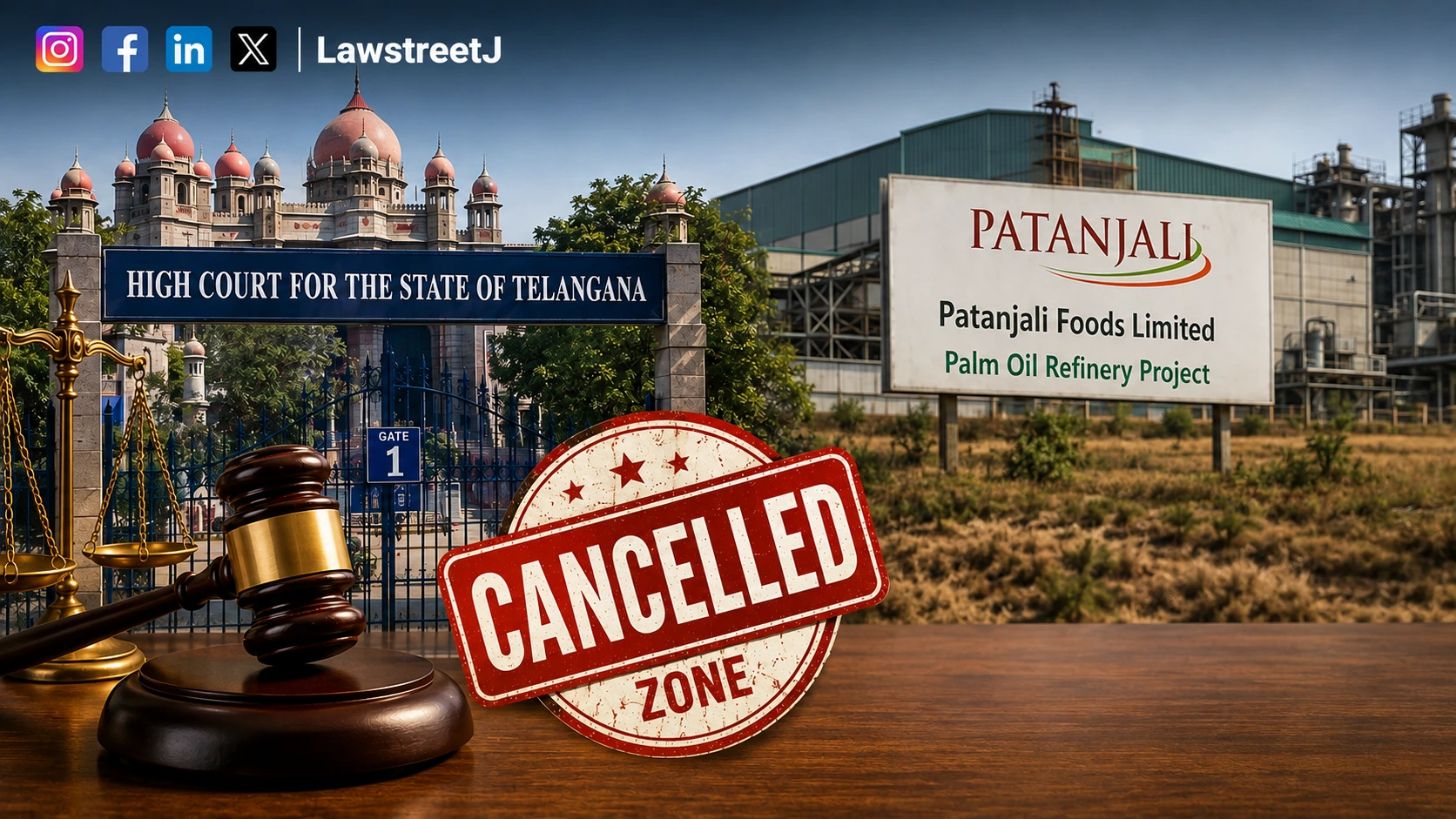
Hyderabad: The Telangana High Court has dismissed a writ appeal filed by Patanjali Foods Limited against the cancellation of its oil palm factory zone in Suryapet District, holding that the company failed to establish a processing unit within the stipulated period despite repeated opportunities and that the State's decision to cancel the allotment and re-allot it to another company was neither arbitrary nor disproportionate.
The Division Bench of Chief Justice Aparesh Kumar Singh and Justice G.M. Mohiuddin was hearing a Writ Appeal filed under Clause 15 of the Letters Patent against an order of the learned Single Judge dismissing the company's challenge to G.O.Ms.No.13 and G.O.Ms.No.14, both dated 15.03.2025, by which the Suryapet factory zone allotted to it under the Telangana Oil Palm (Regulation of Production and Processing) Act, 1993, was cancelled and re-allotted to a rival company.
The appellant, engaged in oil palm cultivation in Telangana since 2009, had been allotted factory zones in Nalgonda and Suryapet Districts over the years, most recently under G.O.Ms.No.60 dated 16.12.2020 and G.O.Ms.No.24 dated 10.06.2021. A Memorandum of Agreement dated 15.03.2017 executed between the appellant and the State required it to establish an oil palm processing unit within twenty-four months, identify a site for the unit, and furnish periodic information on its progress. Despite three show cause notices issued between December 2022 and October 2024 citing failure to meet plantation targets and non-establishment of the processing mill, and a personal hearing afforded in December 2024, the appellant did not commission the unit. The State subsequently cancelled the Suryapet allotment and re-allotted it to respondent No.4, prompting the appellant to approach the High Court, which upheld the cancellation, leading to the present appeal.
Senior Counsel for the appellant argued that Clause 13 of the Agreement, which provided for forfeiture and cancellation, was confined to a failure to furnish information and documents, and did not independently mandate establishment of the processing mill; that Clause 15 alone governed the consequence of delay in commissioning the unit, requiring only continued procurement of Fresh Fruit Bunches from farmers, without contemplating cancellation; that time was never of the essence of the Agreement given the absence of any express stipulation to that effect and the State's own conduct in granting repeated extensions; that the cancellation was disproportionate given the appellant's investment of about Rs.49.53 crores and its ranking among the top performers under the Central Scheme; and that subsequent steps taken toward establishing the mill, including purchase of land and conversion approvals, showed continuing bona fides.
The State and the respondent company opposed the appeal, submitting that the appellant had also failed to execute the Memorandum of Agreement in the format prescribed under G.O.Ms.No.60 and had furnished an affidavit in June 2021 acknowledging that non-compliance would entail forfeiture and cancellation; that the appellant's performance in the Suryapet zone stood at only about fourteen per cent of the targeted plantation area; that farmers in the zone were reverting to paddy cultivation for want of adequate planting material, as reported by the District Collector; and that the steps relied upon by the appellant, including the land purchase and regulatory approvals, were belated and post-dated the impugned Government Orders.
The Court held that Clauses 5(b) and 6 of the Agreement imposed a clear and unambiguous obligation to establish the processing unit within twenty-four months, and that Clause 13 could not be read in isolation from this obligation, since the information required to be furnished under it existed only to satisfy the Commissioner that effective steps were being taken toward, among other things, setting up the mill. Reading Clause 13 as confined to a bare furnishing of documents, the Court observed, would render the regulatory mechanism largely ineffective. It further held that Clause 15 operated in a distinct field, meant only to protect farmers pending commissioning of the unit, and did not exclude the cancellation consequence under Clause 13.
On the question of time being of the essence, the Court found it unnecessary to decide the issue conclusively, holding that even assuming time was not of the essence, the underlying obligation to establish the mill remained binding, and the appellant's admitted, prolonged default justified invocation of Clause 13. The Court also rejected the plea of disproportionality, noting that cancellation followed multiple show cause notices, consideration of replies and a personal hearing over more than two years, that the appellant's plantation performance in the Suryapet zone was only about fourteen per cent of target, and that the appellant continued to retain its Nalgonda factory zone where it remained free to establish the processing facility. The plea of contra proferentem was also rejected on the ground that the relevant clauses were clear and admitted of no ambiguity, and the subsequent steps toward establishing the mill were held to be developments that post-dated the impugned orders and could not cure the pre-existing default.
Holding that the cancellation of the Suryapet factory zone was neither arbitrary nor disproportionate but was founded on the appellant's continued non-compliance with its contractual obligations, the Court found no ground to interfere with the order of the learned Single Judge and dismissed the Writ Appeal, affirming the order dated 08.01.2026 passed in W.P.No.9604 of 2025, with no order as to costs.
Appearances:
For the Appellant: Mr. S. Sriram, Senior Counsel, instructed by M/s. TLH Advocates and Solicitors.
For Respondent Nos.1 to 3: Mrs. B. Mohana Reddy, Government Pleader for Agriculture and Cooperation Department.
For Respondent No.4: Mr. Sannapaneni Lohith, Advocate.
Case Title: Patanjali Foods Limited vs. Department of Horticulture and 3 others, Writ Appeal No.102 of 2026



!['No common intention to kill,' SC alters conviction from murder to culpable homicide not amounting to murder [Read Judgment]](/secure/uploads/2024/02/lj_7197_f77c706e-b667-41fe-9c36-9e633e880b85.jpg)
![Remaining silent during an investigation is a fundamental right: Telangana HC [Read Judgment]](/secure/uploads/2024/04/lj_3728_c8f7ecd3-a0e9-44f7-85aa-f77b9dae3a49.webp)