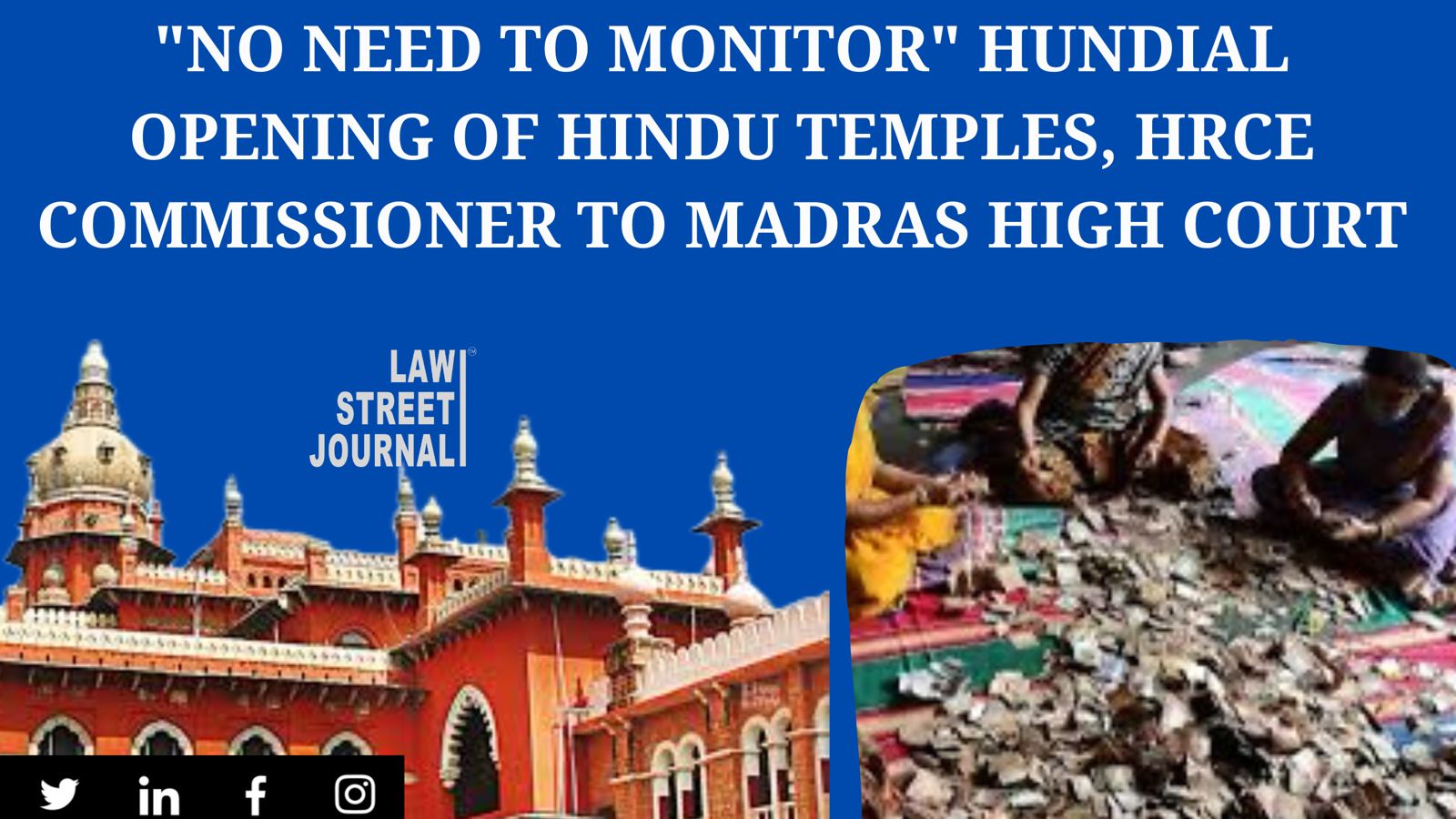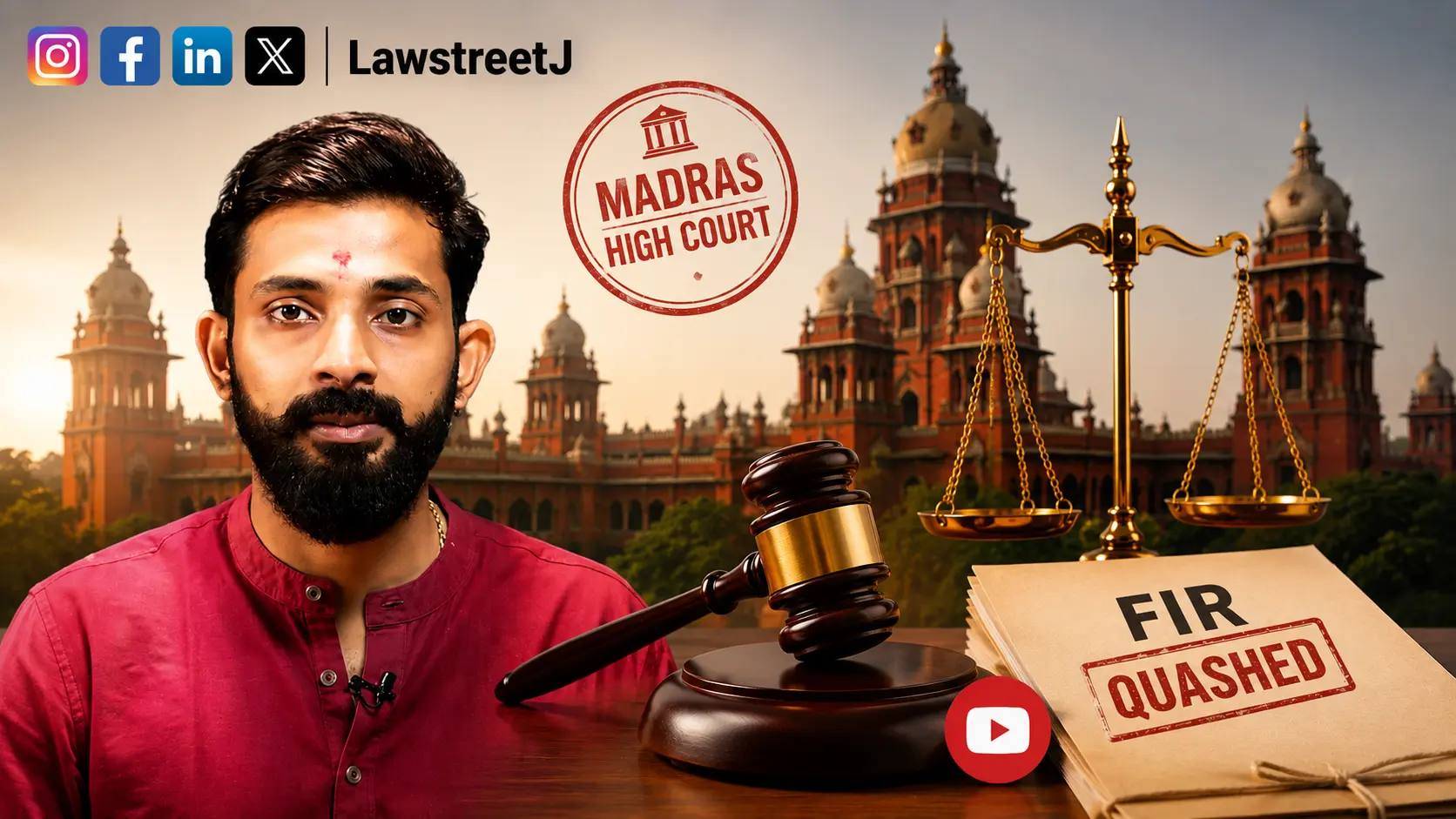
Madras: The Madras High Court has held that collecting donations online for a public cause without prior government approval may invite administrative objections, but it does not automatically amount to cheating or criminal breach of trust, while quashing an FIR against YouTuber S. Karthik Gopinath over a crowdfunding campaign that raised more than Rs.33 lakh for the restoration of damaged temple idols.
Justice D. Bharatha Chakravarthy was hearing a petition filed under Section 482 of the Cr.P.C. by the petitioner, seeking to quash the FIR in Crime No.4 of 2022 registered on the file of the Inspector of Police, City Crime Branch, Avadi, for offences under Sections 406 and 420 of the IPC and Section 66D of the Information Technology Act, 2000.
The allegation against the petitioner was that he had posted messages on various social media platforms and other digital resources projecting himself as undertaking the thirupani work of restoring idols belonging to the Arulmigu Mathurakaaliamman Thirukoil, Siruvachur, and had collected money for the purpose without authorisation from the Hindu Religious & Charitable Endowments Department or the temple, and had misappropriated the same.
The facts, as recorded by the court, show that after the idols of two subsidiary shrines of the temple were damaged in October 2021, the petitioner uploaded a YouTube video and launched a crowdfunding campaign through MILAAP, a web portal for crowdfunding, collecting a total sum of Rs.33,28,924/-. On 14.10.2021, he issued stop instructions to the portal, and thereafter obtained quotations from craftsmen and sculptors for the restoration work. On 29.12.2021, he wrote to the HR & CE Department seeking permission for renovation of the idols using the funds, and the then Executive Officer issued a letter of consent for obtaining sanction from the Commissioner, HR & CE Department. Amounts were subsequently paid as advance to a Sthapathi, but after a new Executive Officer took charge of the temple, a legal notice was issued to the petitioner alleging that he was not permitted to collect and spend money on his own, to which the petitioner replied that the funds had been collected only for the specific purpose and would be spent accordingly. A complaint was lodged on 27.05.2022, pursuant to which the case was registered, and the petitioner was arrested and later released on bail.
Counsel for the petitioner submitted that there was no intention to misappropriate the funds, and that the only allegation that could be made was the failure to obtain prior approval of the authorities, which by itself was not a criminal offence sufficient to attract Section 406 IPC. It was argued that the factum of criminal misappropriation had to be proved, that there was no dishonest intention, and hence the offence under Section 420 IPC was also not made out; and that once the other offences failed, the offence under Section 66D of the IT Act, based merely on posting notices on an electronic channel, could not survive as a standalone offence.
The learned Government Advocate (Crl. Side), relying on the counter affidavit, submitted that the funds had been collected through MILAAP, a private application, without permission from the HR & CE authorities, and that whether there was dishonest intention could not be determined merely on the petitioner's own assertion. On the court enquiring from both sides whether any amount had actually been misappropriated, it emerged that the entire sum collected through the web portal had since been withdrawn and was lying to the credit of the case on the file of the Judicial Magistrate, Thiruvottiyur, invested in a fixed deposit.
The court noted that neither the Government Advocate nor counsel appearing for the temple could point to any money having been misappropriated or spent otherwise by the petitioner, the only expenditure having been an amount paid to the Sthapathi.
"I find no criminal intention of misappropriating the amount by the petitioner... there is no allegation of wrongful gain or wrongful loss inasmuch as the amount is duly and faithfully handed over to the Court account. From the inception and upto the end, there is no any dishonest intention."
Recording that the petitioner and the other parties were in consensus that the entire amount could now be handed over to the temple for carrying out the renovation of the idols and other temple works, the court quashed the case in Crime No.4 of 2022 as against the petitioner and directed that the sum lying to its credit, along with accrued interest, be paid out to the Arulmigu Mathurakaaliamman Thirukoil, Siruvachur. The Executive Officer was permitted to file a formal application before the trial court for direct transfer of the amount to the temple account, to be utilised for renovation of the idols or other temple purposes.
The Criminal Original Petition was accordingly allowed, the connected miscellaneous petitions were closed, and the petitioner's bank accounts, which had been frozen in connection with the case, were ordered to be defreezed.
Appearances:
For the Petitioner: Mr. Abhinav Parthasarathy, Advocate.
For the Respondents: Mr. R. Rajasekaran, Counsel for Government of Tamil Nadu (Crl. Side), for R1; Mr. S. Surya, Government Advocate, for R2.
Case Title: S. Karthik Gopinath vs. State rep. by the Inspector of Police, City Crime Branch, Avadi & Anr., Crl. O.P. No. 13166 of 2022


![Madras High Court Directs Tamil Nadu Government to Ensure Quota for Transgenders in Local Body Elections [Read Order]](/secure/uploads/2023/08/lj_2507_7a03d113-08b1-4670-b6fb-9058aee481d0.jpg)