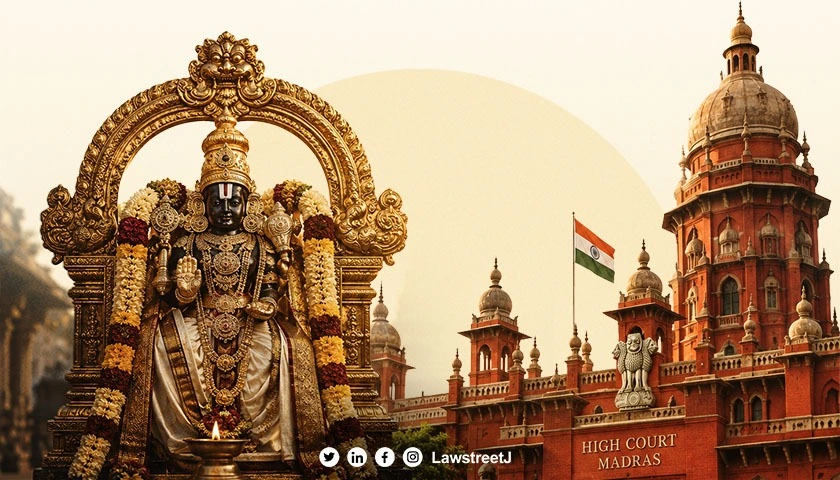
Madurai: The Madurai Bench of the Madras High Court has held that revenue records must record the name of the Deity alone, and not that of the Deity “represented by its Hereditary Trustee”, in line with a Supreme Court judgment in Civil Appeal No. 4850 of 2021. The Court also directed the Tamil Nadu Revenue Department to issue the executive instructions that the Supreme Court had envisaged.
Justice K. Kumaresh Babu disposed of W.P. (MD) No. 25244 of 2026, filed by the Executive Officer of Arulmighu Mutharamman Thirukovil, Palayamkottai Town, Tirunelveli District. The petition challenged the proceedings of 22.07.2026 of the Commissioner of Land Administration, which directed that the revenue records be mutated in the name of Sree Narguna Sundara Vinayakar Temple represented by its Hereditary Trustee, the fifth respondent. The petitioner sought a direction to mutate the records as “Nathan-Punjai-Sree Narguna Sundara Vinayagar Balasubramaniar Kovil” and to issue patta in the name of the temple or deity.
The fifth respondent’s counsel, Mr. S. Kumar, raised a primary objection that the petition was filed by the Executive Officer of one temple against an order concerning another. The petitioner, represented by Mr. V.R. Shanmuganathan, contended that it is under the control and management of the said Sree Narguna Sundara Vinayagar Balasubramaniar Kovil, and relied on a circular of the HR&CE Commissioner based on the Supreme Court judgment. The Revenue authorities were represented by Special Government Pleader Mr. S. Siva Thilakar, and the Assistant Commissioner, HR&CE by Government Advocate Mr. M.S. Parthiban.
The Court noted that the Supreme Court had categorically held that in revenue records the name of the Deity alone is to be entered, not that of the manager or the priest, with the exception that Poojaris who perform their functions and cultivate the land may have their names entered in the remarks column. The Supreme Court had also contemplated executive instructions to supplement the statute and rules.
Rejecting the maintainability objection, the Court said the petitioner was representing a Deity named Sree Narguna Sundara Vinayagar, and that the Court would in any case have to exercise parens patriae jurisdiction in respect of a Deity, “which is always considered to be a minor”. It also rejected the objection that the impugned order was issued without executive instructions from the Revenue Department, holding that the Supreme Court judgment is the law of the land and applies equally even in the absence of an executive instruction or statute.
“The direction issued by the first respondent to mutate the revenue records in the name of the Deity being represented by its Hereditary Trustee goes contrary to the dictum laid down by the Hon’ble Apex Court.”
The Court directed that the name of the deity, Sree Narguna Sundara Vinayagar Balasubramaniar, alone shall be recorded in the revenue records. It also held that the classification of the land as “Natham Private” is not recognised under the Revenue Standing Order, and directed that the land be classified only as natham, standing in the deity’s name. There was no order as to costs.
Before parting with the case, the Court noted that the Supreme Court had expressly permitted executive instructions to supplement the statute and rules, but the Tamil Nadu Revenue Department had issued none. It directed the Secretary, Revenue and Disaster Management Department, to issue the necessary instructions and the revenue authorities to carry out corrections in the records as directed in paragraph 27 of the Supreme Court judgment.
Appearances:
For the Petitioner: Mr. V.R. Shanmuganathan, Advocate.
For Respondent Nos. 1, 2 and 4: Mr. S. Siva Thilakar, Special Government Pleader. For Respondent No. 3: Mr. M.S. Parthiban, Government Advocate.
For Respondent No. 5: Mr. S. Kumar, Advocate.
Case Title: The Executive Officer, Arulmighu Mutharamman Thirukovil vs. The Commissioner of Land Administration & Ors., W.P. (MD) No. 25244 of 2026