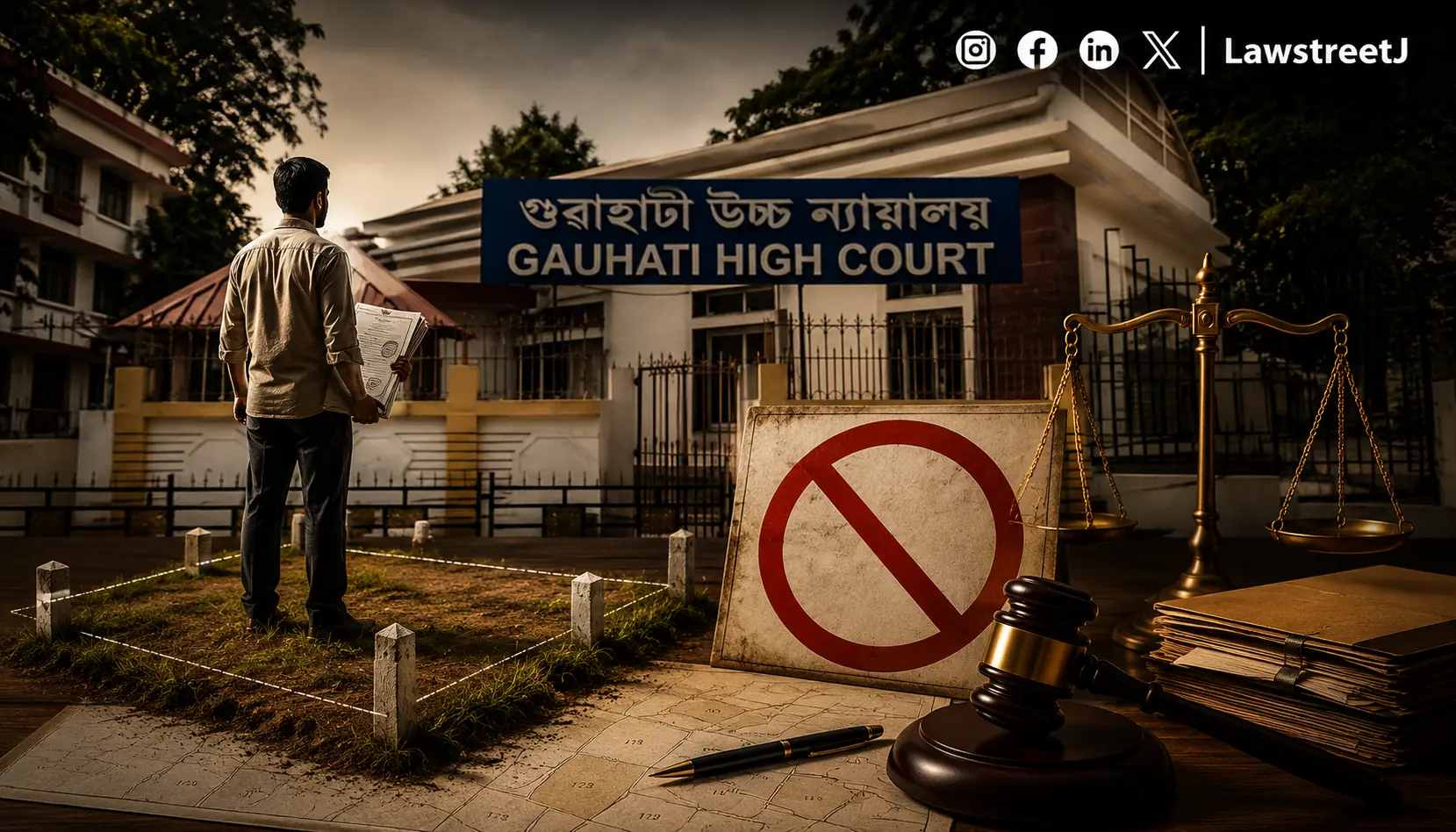
Guwahati: The Gauhati High Court has quashed proceedings initiated under Sections 144, 145 and 146 of the Code of Criminal Procedure, 1973 over a disputed piece of land at Hailakandi, holding that a Magistrate cannot assume jurisdiction under Section 145 CrPC once the fact of actual possession stands admitted in the very pleadings of the party seeking eviction.
Justice Sanjeev Kumar Sharma was hearing a petition filed under Section 482 CrPC by Zahirul Haque Laskar, seeking to quash the order dated 27.04.2022 passed by the Additional District Magistrate, Hailakandi, in Case No. 148M/2021, along with the proceedings under Section 145/146(1) CrPC arising therefrom.
The dispute arose when Chandu Miya Laskar, arrayed as respondent No. 2, filed a complaint before the Additional District Magistrate claiming to be the lawful owner and possessor of the suit land by inheritance. He alleged that the petitioner and his brothers had orally agreed to take a portion of the land on rent for running shops and a godown, initially paying monthly rent, but later stopped payments and began asserting ownership over the land. When the respondent attempted to extend construction of shop houses and earth-fill the western part of the land on 28.03.2022, the petitioner and his brothers objected, allegedly attempting to dispossess him, giving rise to an apprehension of breach of peace.
On the basis of a police report recommending that both parties be restrained from working on the land to preserve peace, the Additional District Magistrate attached the suit land by an ex parte order dated 27.04.2022 under Section 146 CrPC. The petitioner's subsequent application to vacate the ex parte order remained undecided, while the Magistrate directed the Circle Officer to enquire into the status of the land.
During the pendency of these proceedings, the respondent also instituted a civil suit, T.S. No. 69/2022, before the Court of Munsiff, Hailakandi, seeking a declaration of title and recovery of khas possession, which was later withdrawn on 10.03.2023. The petitioner's Criminal Revision No. 42/2022 against the attachment order succeeded before the Sessions Judge, Hailakandi, who set aside the attachment and remanded the matter. The respondent's challenge to that order before the High Court resulted in an interim stay of the Sessions Judge's judgment.
Assailing the proceedings before the High Court, counsel for the petitioner submitted that the respondent's own complaint acknowledged that the petitioner was a tenant in possession of the land, paying rent until he defaulted. It was argued that once possession stood admitted, there remained no dispute of fact for the Magistrate to adjudicate under Section 145 CrPC, and the invocation of that provision, along with the attachment under Section 146, was without jurisdiction.
The Court examined Section 145 CrPC, which empowers an Executive Magistrate to intervene only where a dispute likely to cause breach of peace exists concerning the fact of actual possession of land, and to decide, upon the parties' written statements and evidence, which party was in possession on the date of the initial order.
The Court held:
The fact that the petitioner is in possession of the disputed land must be regarded as an admitted fact in view of the pleadings of the respondent herein in his application before the learned Magistrate.
Explaining the scheme of Section 145, the Court observed that the provision requires the parties to file written statements only to enable the Magistrate to decide the question of actual possession, and where that question is not itself in dispute, no issue survives for adjudication. It further held that a Magistrate cannot draw a proceeding under Section 145 CrPC where the record clearly shows that the person sought to be evicted has been in possession of the land for a period longer than two months prior to the police report or information triggering the proceeding.
Applying this principle, the Court held that the vital jurisdictional condition for invoking Section 145 CrPC was absent in the present case, rendering the impugned proceedings without jurisdiction, and that allowing them to continue would amount to an abuse of the process of law.
Accordingly, the Court quashed the proceedings in Case No. 148M/2021 under Sections 144, 145 and 146 CrPC pending before the Additional District Magistrate, Hailakandi, and allowed the petition.
Appearances: Mr. M.J. Quadir, Advocate, appeared for the petitioner. Ms. B. Devi, learned counsel, appeared for respondent No. 2. The learned Public Prosecutor, Assam, appeared for the State.
Case Title: Zahirul Haque Laskar versus State of Assam and Another


![Justice Nongmeikapam Kotiswar Singh appointed as acting Chief Justice of Gauhati High Court [Read Press Release]](/secure/uploads/2023/01/lj_9707_5c969d0f-570f-400a-ba8b-3b65cf825540.jpg)
![Collegium Recommends Chief Justices of Delhi, Rajasthan, and Gauhati High Courts for Elevation to Supreme Court [Read Order]](/secure/uploads/2023/11/lj_9736_933a94de-bdaf-43de-944b-b0e58e17edb5.jpg)
![Supreme Court Mandates Strict Scrutiny in Sexual Harassment Allegations at Work [Read Judgment]](/secure/uploads/2023/11/lj_3478_eef290f2-6acf-4296-9ee0-adf54f275609.jpg)