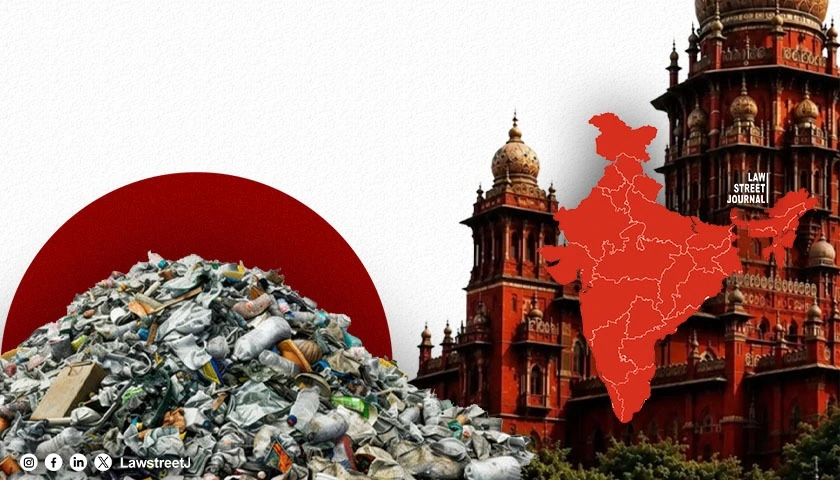
Madurai: The Madurai Bench of the Madras High Court, presided over by Justice D. Bharatha Chakravarthy, has held that importers who bring municipal solid waste into India under the guise of waste-paper consignments cannot seek to re-export the offending cargo to a third country of their choice, and must instead send it back to the country from which it was originally exported, in terms of the Hazardous and Other Wastes (Management and Transboundary Movement) Rules, 2016 and India's obligations under the Basel Convention.
The batch of writ petitions arose from consignments imported by M/s. Sripathi Paper and Boards Private Limited, Sivakasi, and M/s. Rajarajeswari Krafts Private Limited, also of Sivakasi, both of which import waste paper for use as raw material in their manufacturing operations. Sripathi had imported a consignment declared as “Waste Paper – News & Pams” from a Canadian supplier, while Rajarajeswari had imported similar consignments from Canada, the United States and Singapore. On examination at the Container Freight Station in Tuticorin, the Directorate of Revenue Intelligence and the Tamil Nadu Pollution Control Board found that the containers in fact held a mixture of municipal solid waste, including used PET bottles, street sweepings, broken glass, plastic carry bags and soft-drink cans, rather than waste paper alone. Show-cause notices were issued under Section 124 of the Customs Act, 1962, and the adjudicating authority ultimately confiscated the goods, imposed penalties, which the importers paid, and directed re-export of the consignments at the importers' cost.
Rather than complying promptly, the importers sought permission to re-export the goods to Dubai instead of Canada, the United States or Singapore, citing lower freight costs and the exporters' willingness to accept delivery there. When the request went unanswered and detention and demurrage charges mounted at the port, the two companies approached the High Court, seeking either permission to re-export to Dubai or, alternatively, permission to dispose of the waste within India through cement kilns or waste-to-energy plants, along with directions to the Customs Department, the shipping line and the Container Freight Stations to waive the accumulated charges.
Rejecting the challenge to the underlying adjudication orders, the Court noted that the importers had, throughout the proceedings, accepted the finding of misdeclaration and sought only leniency in punishment, and had never appealed the orders under Section 128 of the Customs Act. Turning to the plea for re-export to Dubai, the Court held that Rule 15(2) of the Hazardous and Other Wastes Rules, 2016 uses the expression “re-export,” which necessarily connotes return of the waste to the country from which it was exported, and cannot be read to permit diversion to any third country of the importer's choosing. The Court drew on Article 9(2) of the Basel Convention, which requires that illegally trafficked waste be taken back by the exporter into the State of export, and observed that the practice of developed nations shifting the burden of waste disposal onto developing countries amounts to what is internationally described as “waste colonialism.” The alternative prayer to dispose of the waste within India was also rejected, the Court holding that permitting local disposal would defeat the very object of the statutory scheme prohibiting the import of hazardous and municipal waste, and would be inconsistent with the Office Memorandum dated 10.01.2023, which excludes municipal solid waste from any relaxation for contaminants.
The Court was severe in its remarks on the conduct of the importers, observing:
If any person knowingly designs, imports, or aids in importing and throws trash on Bharath Matha, it is not just an offence under the Environment Protection Act, 1985 alone, but it is a direct challenge to her sovereignty. There cannot be a more aggravated form of deshdroh.
The Court held that such conduct could, depending on the findings of the investigating authorities, attract prosecution under Section 152 of the Bharatiya Nyaya Sanhita, 2023, apart from Section 15 of the Environment (Protection) Act, 1986.
On the question of charges, the Court applied the Division Bench ruling in M/s. K. Steamship Agencies Pvt. Ltd. v. M/s. Balaji Dekors to hold that detention and demurrage waiver certificates are valid only where adjudication concludes in the importer's favour without penalty; since the importers here were found guilty of misdeclaration, they remained liable to pay the Container Freight Stations and the shipping line, M/s. Maersk Line India Private Limited, notwithstanding the waivers earlier granted. The shipping line, however, agreed before the Court to accept a consolidated sum of Rs.4,00,00,000/- from both importers in full and final settlement, waiving the balance of over Rs.38 crore otherwise due, and to carry the consignments back to the ports of origin on payment of freight charges.
Directing the importers to re-export the goods within 60 days, the Court ordered that any dispute over pending charges could not stall the process, given the environmental risk of the waste continuing to lie at the port, and that failure to re-export within that period would attract environmental compensation of Rs.50,000/- per day per importer, recoverable by the Tamil Nadu Pollution Control Board applying the Polluter Pays Principle. The Court further directed that if re-export was not effected within 60 days, the competent authority must prosecute the importers and the persons responsible under Section 19 of the Environment (Protection) Act, 1986. The Union Government was asked to take up the matter of repeat-offending exporters with the authorities of the exporting countries through diplomatic channels, and the Ministry of Environment, Forest and Climate Change was called upon to reconsider its 2023 Office Memorandum and to improve domestic segregation of waste paper so as to reduce reliance on such imports. The petitioners were directed to pay costs of Rs.10,000/- each to the Commissioner of Customs.
Appearances:
For Petitioners in all W.Ps.: Mr. Hari Radhakrishnan; For Customs Department & Directorate of Revenue Intelligence: Mr. R. Gowri Shankar, Senior Standing Counsel; For Tamil Nadu Pollution Control Board: Ms. Madhuri Donti Reddy; For the shipping liner, M/s. Maersk Line India Pvt. Ltd.: Mr. P. Giridharan; For Union of India: Mr. K. Govindarajan, Deputy Solicitor General.
Case Title: M/s. Sripathi Paper and Boards Private Limited v. The Commissioner of Customs & Ors., and connected matters



![Madras High Court Directs Tamil Nadu Government to Ensure Quota for Transgenders in Local Body Elections [Read Order]](/secure/uploads/2023/08/lj_2507_7a03d113-08b1-4670-b6fb-9058aee481d0.jpg)