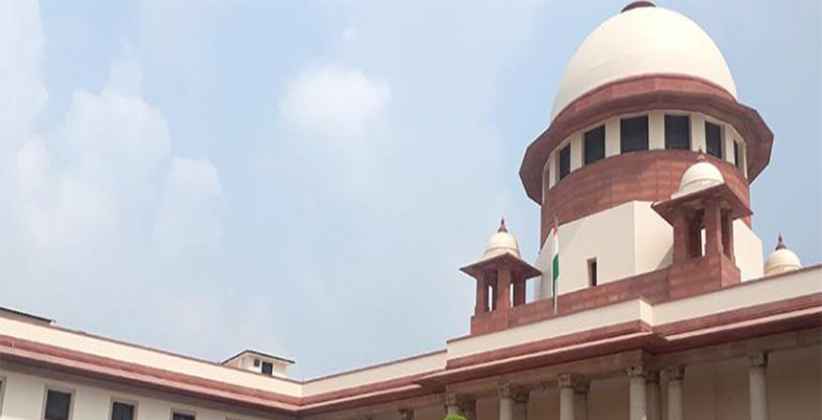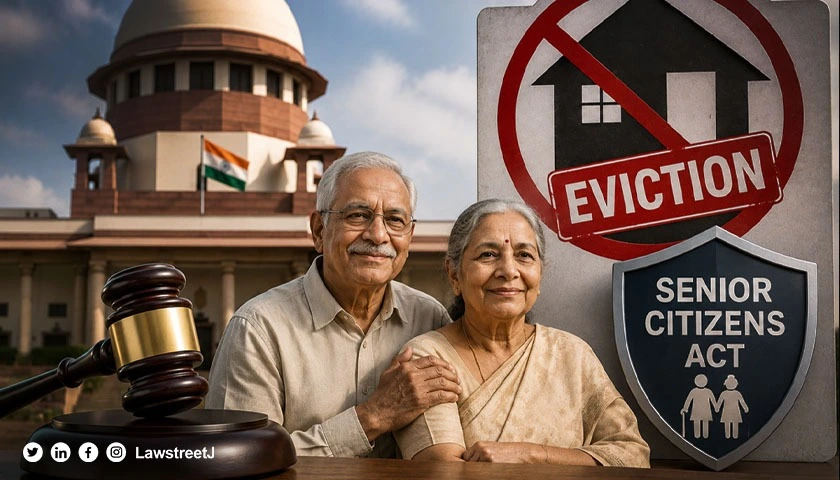
New Delhi: The Supreme Court has held that tribunals constituted under the Maintenance and Welfare of Parents and Senior Citizens Act, 2007 have the power to order eviction of a son or daughter-in-law from a senior citizen's property, where such eviction is necessary and expedient to ensure the maintenance and protection of the senior citizen.
A Bench of Justice Pamidighantam Sri Narasimha and Justice Alok Aradhe was hearing an appeal filed by an elderly man against orders of the Allahabad High Court, Lucknow Bench, which had held that the Act did not empower authorities to pass an order of eviction, and had accordingly quashed eviction orders passed against his son by the Sub-Divisional Magistrate and the District Magistrate.
The appellant, owner of a residential house in Vikas Nagar, Lucknow, had approached the District Magistrate under the Act seeking eviction of his son after his own 81-year-old mother was allegedly forced to leave the premises and reside at an old-age facility because the son did not permit her to stay and created nuisance. The Sub-Divisional Magistrate directed the son's eviction, and the District Magistrate affirmed the order on appeal. The son and his wife then challenged these orders before the High Court, which quashed them, holding that the Act did not confer power to order eviction. The appellant's review application against this view was also dismissed, leading to the present appeal.
The Court held that Section 7 of the Act constitutes tribunals with power under Section 8 to conduct inquiries following a summary procedure with the powers of a Civil Court, while Section 27 explicitly bars the jurisdiction of Civil Courts. Applying the well-settled principle that a grant of jurisdiction impliedly carries with it the power to do all acts necessary for its exercise, as laid down in Income Tax Officer, Cannanore v. M.K. Mohammed Kunhi, the Court held that the tribunal under the Act has the power to order eviction to ensure the maintenance or protection of a senior citizen.
The Court referred to the decision of a three-Judge Bench in S. Vanitha v. Deputy Commissioner, Bengaluru Urban District & Ors., which held that the tribunal may order eviction where necessary and expedient for the maintenance and protection of a senior citizen or parent, and that such eviction would be an incident of enforcement of the right to maintenance. It noted that this view was subsequently followed by two-Judge Benches in Samtola Devi v. State of U.P. & Ors. and Kamalakant Mishra v. Additional Collector & Ors. The Court expressed respectful agreement with this consistent line of authority and held that the High Court's reliance on its own earlier decision in Abhishek Tiwari and Another v. State of U.P. was misconceived.
Emphasising the constitutional underpinnings of the Act, the Court observed:
“The measure of a civilized society is often reflected in the dignity, respect and security it affords to its elderly. Across cultures, religions, and civilizations, senior citizens have been regarded not merely as dependents requiring care, but as repositories of wisdom, experience, and collective memory whose guidance enriches families and society alike.”
The Court further observed that Article 21 as interpreted by the Court, along with Article 41 of the Constitution, envisage a social order that protects the vulnerable and enables every individual to live with dignity, and that the Act gives statutory expression to this constitutional mandate so that advancing age does not become synonymous with neglect, insecurity, or indignity.
Setting aside the judgment dated 06.10.2023 and the review order dated 29.01.2024 passed by the High Court, the Court restored the eviction orders passed by the authorities under the Act. The appeals were accordingly allowed, with no order as to costs.
Appearances:
For the Petitioner: Mr. R. Anand Padmanabhan, Senior Advocate with Mr. Romil Pathak, Advocate and Ms. Jagrati Singh, AOR.
For the Respondent(s): Mr. Tanmaya Agarwal, AOR; Mr. Devendra Kumar Shukla, AOR.
Case Title: Ravi Kant Gupta vs. State of Uttar Pradesh & Ors., Civil Appeal (@ SLP(C) Diary No. 22768 of 2024)