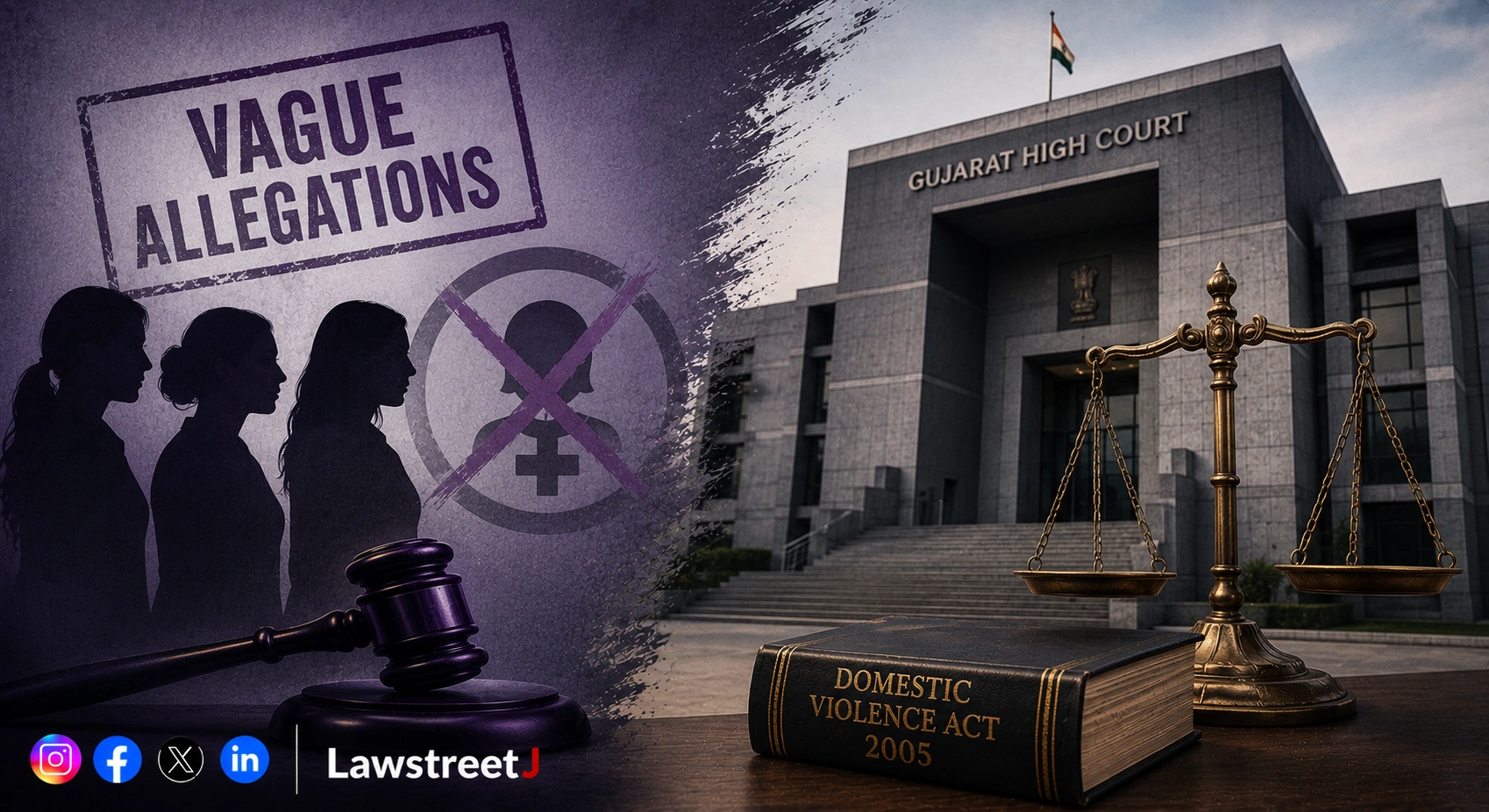
Ahmedabad: The Gujarat High Court has quashed a complaint under the Domestic Violence Act against a married couple's sisters-in-law, holding that general and vague allegations, unsupported by any specific role attributed to them, cannot sustain criminal proceedings, particularly where the relatives concerned were shown to have been married and residing separately well before the complainant's own marriage.
Justice A.Y. Kogje was hearing plea filed by the husband's family members seeking quashment of a complaint pending before the 10th Additional Chief Judicial Magistrate, Bhavnagar, under Sections 18, 19, 20, 22 and 23 of the Protection of Women from Domestic Violence Act, 2005.
The petition was not pressed on behalf of petitioner nos.1 and 2, the complainant's father-in-law and mother-in-law, and Rule was accordingly discharged as against them. The surviving contest concerned petitioner nos.3 and 4, the complainant's sisters-in-law, who submitted that they had never lived with the complainant and had been married and residing separately well before the complainant's own marriage to their brother in 2013, and that the complaint contained no specific allegation against them beyond vague and general assertions made to harass the entire family.
It was further pointed out that the complainant had earlier filed similar proceedings, including under the Domestic Violence Act, in 2017 against the same family members, which were withdrawn in 2018 following a settlement facilitated by elders and community leaders, before the present complaint was filed afresh in 2022 alongside a maintenance application under Section 125 of the Code of Criminal Procedure.
Opposing the petition, counsel for the complainant contended that she had been subjected to mental and physical torture by her in-laws, that she was kept as domestic help and prevented from contacting her parents, and that her in-laws had instigated her husband to demand items such as a laptop, watch and mobile phone, besides expressing displeasure over the birth of a daughter.
Examining the complaint as a whole, the court found that the specific allegations were directed almost entirely at the complainant's husband, who was not even a party to the proceedings, while the only allegation against the sisters-in-law was that they used to instigate him to demand dowry a bare assertion unaccompanied by particulars. The court further noted that the sisters-in-law, having been married prior to the complainant's own marriage and residing separately, could not plausibly have subjected her to the mental and physical torture alleged.
Relying on the Supreme Court's observations in Arnesh Kumar v. State of Bihar & Anr., (2014) 8 SCC 273, on the tendency to rope in distant relatives under matrimonial penal provisions, and in Preeti Gupta & Anr. v. State of Jharkhand & Anr., (2010) 7 SCC 667, on complaints filed in the heat of the moment without proper deliberation and the resulting social harm, the court observed:
“The allegations of harassment of husband's close relations who had been living in different cities and never visited or rarely visited the place where the complainant resided would have an entirely different complexion. The allegations of the complaint are required to be scrutinized with great care and circumspection.”
Holding that no ingredients of an offence under Sections 18, 19, 20, 22 and 23 of the Domestic Violence Act were made out against the sisters-in-law, the court allowed the petition to that extent, quashing and setting aside the complaint and all proceedings arising therefrom qua petitioner nos.3 and 4. Rule was made absolute accordingly, with the petition having already been disposed of as not pressed against petitioner nos.1 and 2.
Appearances:
For the Applicants: Mr. Kuldeep D. Vaidya, Advocate.
For Respondent Nos.1 to 3: Mr. Aditya J. Pandya, Advocate.
For Respondent No.4: Mr. Rohan Shah, Additional Public Prosecutor.
Case Title: Salimbhai Abubakarbhai Lakhani & Ors. vs. Aksanabanu Samirbhai Lakhani D/o Abdul Rasidbhai Dholiya & Ors., R/Special Criminal Application (Quashing) No. 12673 of 2023


![Supreme Court Affirms Women's Right to Reproductive Choices as Central to Human Dignity [Read Order]](/secure/uploads/2023/08/lj_5007_Right_to_Reproductive.jpg)