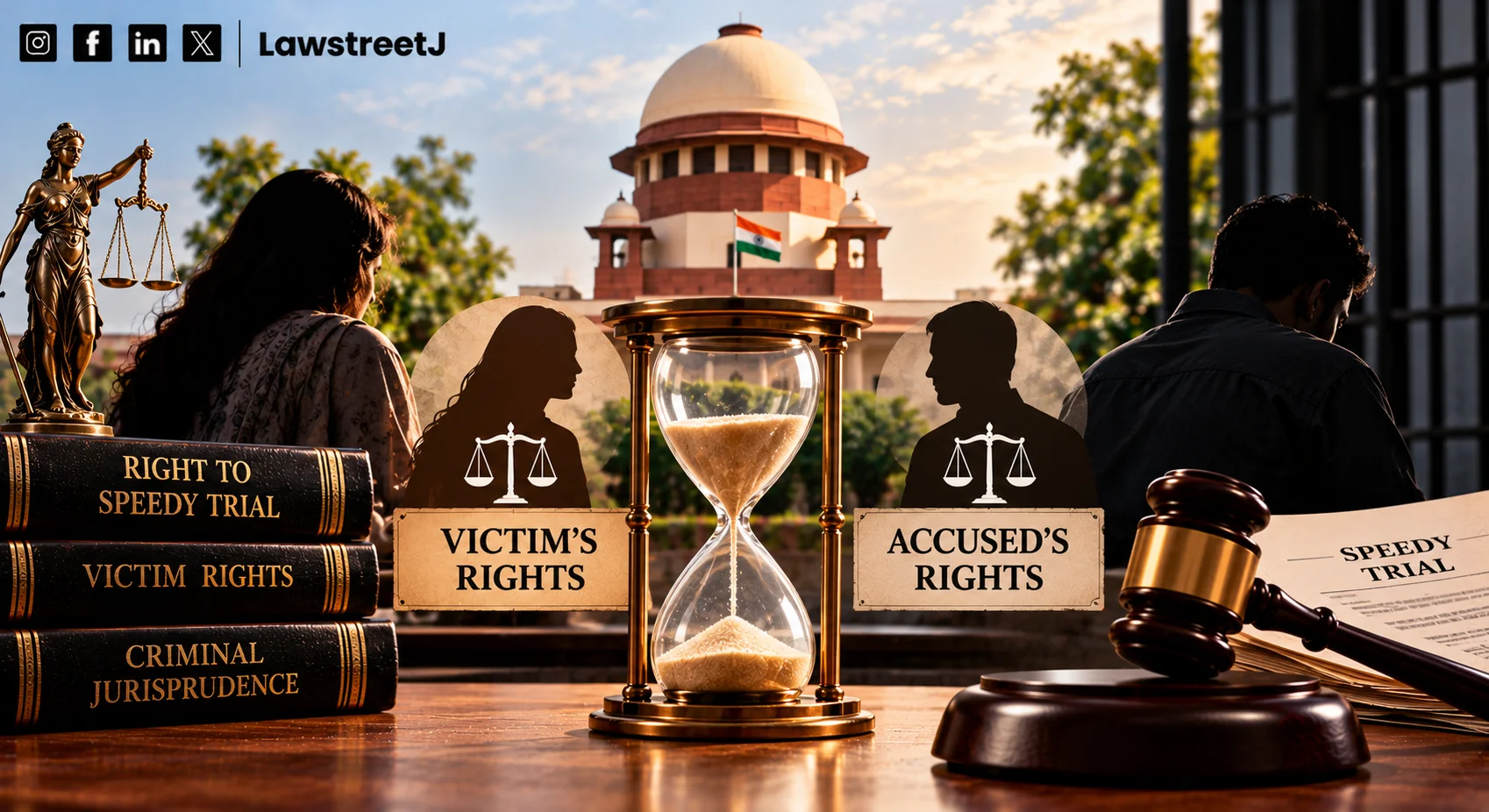
New Delhi: The Supreme Court has held that a victim is not a stranger to a criminal proceeding and has locus standi to approach the High Court under Section 528 of the Bharatiya Nagarik Suraksha Sanhita, 2023 (BNSS) seeking a direction to the trial court to expedite the trial, setting aside a Delhi High Court order that had held the role of a de facto complainant to be limited to that of a witness and had dismissed her petition as frivolous with costs of Rs. 10,000.
A Bench of Justice Ujjal Bhuyan and Justice Atul S. Chandurkar delivered the order on 24 September 2026 in an appeal by Renuka Jain, arising out of Special Leave Petition (Criminal) No. 13468/2026, and directed the trial court to conclude the trial within one year.
The appellant had lodged FIR No. 211/2017 at the Farsh Bazar Police Station under Section 420 of the Indian Penal Code, 1860. After a charge sheet was filed, the case was registered as C.R. No. 7850/2019 before the Judicial Magistrate First Class, Shahdara District Courts, Karkardooma. Aggrieved by the delay, she had earlier obtained an order dated 7 February 2023 from the Delhi High Court in W.P. (Crl.) No. 2090/2018, directing the trial court to conclude the trial within two years after framing of charges. As the trial did not progress substantially, she filed a fresh petition under Section 528 of the BNSS, to which the prosecution objected on the ground of her locus standi.
The Single Judge, by order dated 6 January 2026, agreed with the prosecution that, as the case was a State case, the role of the de facto complainant was limited to being a witness and that only the State or the accused could bring such a petition. The High Court dismissed the petition as frivolous and a drain on the court's overflowing dockets, imposing costs of Rs. 10,000. The Supreme Court had issued notice on 24 July 2026 and stayed the imposition of costs. The standing counsel informed the Court that the prosecution had cited 22 witnesses, one of whom had been deleted, leaving 21, and that PW-1 was under cross-examination.
Examining Sections 301, 302 and 24(8) of the Code of Criminal Procedure, 1973, and the corresponding provisions of the BNSS, including Sections 338 and 339 and the definition of “victim” under Section 2(y), the Court observed that these provisions permit a victim to instruct a pleader, assist the prosecution with the court's permission, and engage an advocate of choice to assist the prosecution. It held that it is the loss or injury suffered by the victim at the hands of the accused that triggers the criminal process, and that the proposition that a victim's role is limited to being a witness is incorrect.
The Court held that a victim or her legal guardian is “a definite stakeholder in the criminal justice system” who, like the accused, has a vested right to insist on a speedy as well as a fair trial and can therefore file a petition under Section 528 of the BNSS seeking expedition of the trial.
In support of its conclusions, the Court relied on Mangal Singh v. Kishan Singh, Rattiram v. State of Madhya Pradesh, Amir Hamza Shaikh v. State of Maharashtra, J.K. International v. State (NCT of Delhi) and its recent decision in Keshvendra Singh v. Shankar Singh. These decisions recognise that the right to a speedy trial is not merely the prerogative of the accused but also a valuable right of the victim, and that delay can cause the victim acute suffering and anguish, sometimes more than the accused.
The Court stated that it was unable to agree with the High Court's decision to characterise the victim's plea for a speedy trial as frivolous. It held that the High Court's view was based on a complete misreading of the legal and constitutional provisions and could not be sustained. Accordingly, the Supreme Court set aside the Delhi High Court's order dated 6 January 2026 and directed the trial court to conclude the trial in C.R. Case No. 7850/2019 expeditiously and within an outer limit of one year from the date of the order.
It clarified that it had expressed no opinion on the merits of the case and that all contentions remained open. The criminal appeal was allowed, and pending applications were disposed of.
Appearances:
For the Appellant: Ms. Fauzia Shakil, Advocate-on-Record, with other advocates.
For the State of NCT of Delhi: Mr. Davinder Pal Singh, Additional Solicitor General, assisted by Mr. Akshat Aggarwal and Ms. Vidhi Gupta, Advocates.
For Respondent No. 2: Mr. Vikas Sharma, Advocate.
Case Title: Renuka Jain v. The State of NCT of Delhi & Ors.