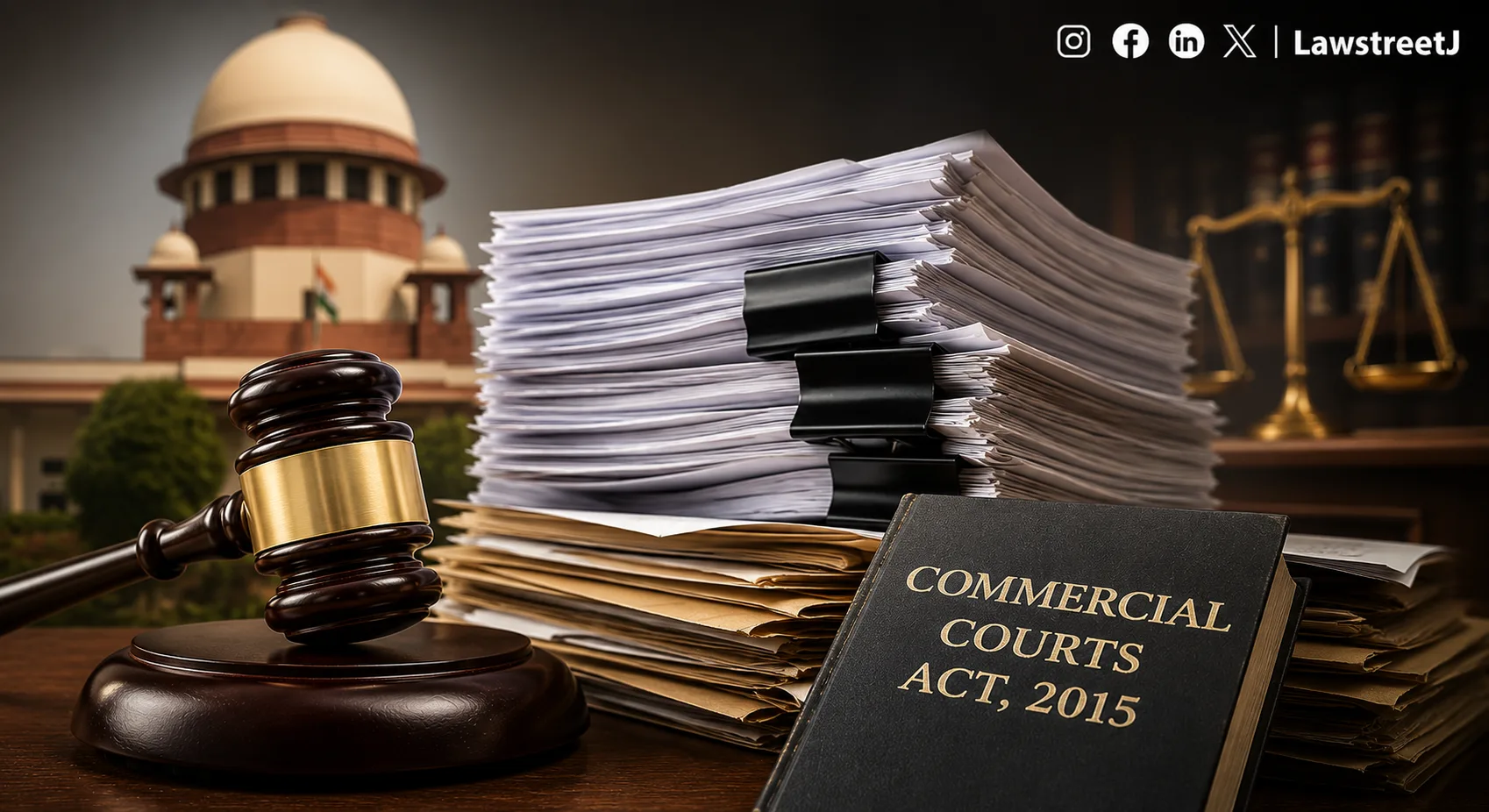
New Delhi: The Supreme Court has held that the mere volume of evidence does not by itself amount to a ‘reasonable cause’ justifying the belated production of documents in a suit governed by the Commercial Courts Act, 2015.
A Bench of Justice Sanjay Karol and Justice Nongmeikapam Kotiswar Singh was hearing an appeal filed by M/s. Levitate Mobile Technologies Pvt. Ltd. against a Delhi High Court order that had refused to allow it to place additional documents on record and recall its own witness at a late stage of a long-pending commercial suit against M/s. Standard Chartered Bank.
The dispute traced back to an IT Professional Services Agreement of February 2013, under which the appellant had developed and managed a mobile application for the respondent-bank. After the app was launched, the bank directed that it be taken down, prompting the appellant to claim revenue-sharing losses of over Rs. 4.46 crore. When the claim was denied, the appellant filed a civil suit before the Delhi High Court in 2015, which was later renumbered as a commercial suit in 2018 upon an earlier application for additional documents being allowed.
Evidence of the appellant’s witness was completed only in May 2023, more than seven years after the suit was filed. The appellant then sought to bring on record emails, vendor agreements, and backend server data, and to recall its witness, citing the volume of records, difficulty tracking voluminous correspondence, and averments that had allegedly surfaced for the first time during cross-examination. The Single Judge rejected the application in February 2025, applying the ‘reasonable cause’ standard under Order XI Rule 1 of the CPC as amended for commercial suits, and holding that the appellant had slept over the documents without explanation.
Before the Supreme Court, senior counsel for the appellant argued that the High Court had wrongly applied a ‘sufficient cause’ standard instead of the correct, lower threshold of ‘reasonable cause’, and that the relevance of the documents ought to have been weighed before rejecting the application outright.
The Court traced the legislative history of the Commercial Courts Act to the Law Commission’s 188th and 253rd Reports, and reiterated that the statute’s timelines, including those governing disclosure and production of documents, exist to ensure the expeditious resolution of commercial disputes. While agreeing that ‘reasonable cause’, not ‘sufficient cause’, was the applicable standard, the Bench found that the appellant’s case failed even on that lower threshold.
“It is well established that the plaintiff when leading evidence, is expected to not only produce all documents but also properly anticipate the questions that may be put to its witnesses by the other side. What cannot be countenanced is a stop and go or a piecemeal approach. Voluminous evidence too, is entirely an uninspiring ground,”
the Bench observed, declining to interfere with the High Court’s rejection of the application.
The Court noted that all the documents sought to be produced were already in the appellant’s possession both when the plaint was filed and when an earlier application for additional documents had been allowed in 2017 on substantially similar grounds. It rejected the appellant’s contention that applying the stricter standard would amount to a piecemeal application of the Act, holding that Section 15 of the Commercial Courts Act expressly makes its procedure applicable to suits transferred to the Commercial Division, including those pending before its enactment.
Observing that the suit, filed in 2015, was still at the stage of plaintiff’s evidence more than a decade later, the Bench remarked that even a snail might question the pace of the trial, a delay starkly at odds with the Act’s underlying objective of expediting commercial litigation. Finding no ground for interference, the Court dismissed the appeal, while directing that the suit be decided as expeditiously as possible. No costs were awarded.
Case Title: M/s. Levitate Mobile Technologies Pvt. Ltd. vs. M/s. Standard Chartered Bank & Anr.