Bengaluru: The Karnataka High Court has quashed an FIR registered against the mother-in-law and three other relatives of a man accused of dowry harassment and cruelty, holding that the allegations levelled against them were vague, omnibus and unsupported by any specific instance of wrongdoing.
Justice M. Nagaprasanna, disposing of a criminal petition filed under Section 528 of the Bharatiya Nagarik Suraksha Sanhita, was considering a plea to quash a First Information Report registered at the East Women Police Station, Pulakeshinagar Sub-Division, Bengaluru, for offences under Sections 85 and 352 of the Bharatiya Nyaya Sanhita and Sections 3 and 4 of the Dowry Prohibition Act, 1961. The petitioners were the mother-in-law, an uncle, a cousin and another relative of the complainant's husband, who was not before the Court and continues to face investigation.
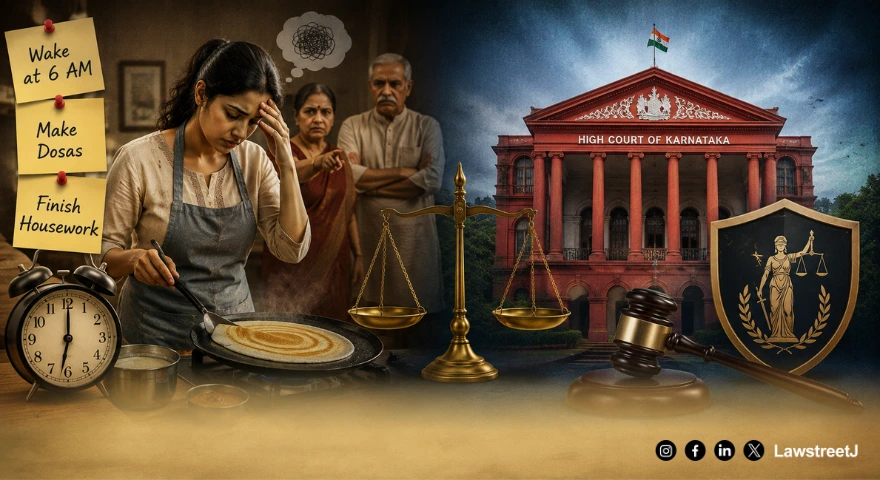
The complainant had married the first accused in May 2024, and within a year the relationship had soured, leading to several proceedings, including the complaint that gave rise to the present FIR. In her complaint, she had listed extensive grievances against her husband and his family, ranging from disputes over gold jewellery and household expenses to allegations of physical assault, verbal abuse and emotional cruelty. Among the household allegations was a detailed account of her daily routine at her marital home, including that she was expected to wake at 6 a.m., that specific quantities of ingredients such as chilli and turmeric powder were measured out for her cooking, and that she was required to prepare dosas for her husband and serve him before she herself could eat.
Appearing for the petitioners, counsel submitted that the allegations against them were bald and unconnected to any specific act, and that permitting investigation to continue would amount to an abuse of the process of law. The complainant, appearing in person, opposed the plea, taking the Court through an extensive set of objections and WhatsApp messages to argue that the family had subjected her to sustained dowry-related torture. The State, represented by the High Court Government Pleader, supported continuation of the investigation.
Examining the complaint, the Court noted that while there were specific and detailed allegations against the husband, the allegations against the mother-in-law and the other relatives remained generalised. The Court observed that the household routine described by the complainant, though it may reflect an unhappy domestic arrangement, did not by itself disclose the ingredients of an offence.
The Court held that “Bald and vague allegations are made against the mother-in-law or even the other three accused,” and that such allegations did not form the ingredients of the offence under Section 85 of the BNS or Section 498A of the IPC, the earlier corresponding provision.
The Court relied on a recent line of Supreme Court decisions cautioning against the indiscriminate implication of relatives in matrimonial disputes, including Rajesh Chaddha v. State of Uttar Pradesh, Ghanshyam Soni v. State (Government of NCT of Delhi), Maram Nirmala v. State of Telangana, Dr. Sushil Kumar Purbey v. State of Bihar, and Arti Mehta v. State of Madhya Pradesh, all of which draw upon the Court's earlier ruling in Dara Lakshmi Narayana v. State of Telangana. Extracting from that line of authority, the Court reiterated that
“A mere reference to the names of family members in a criminal case arising out of a matrimonial dispute, without specific allegations indicating their active involvement should be nipped in the bud,” and that generalised, sweeping accusations unsupported by concrete evidence cannot form the basis for criminal prosecution.
Applying this reasoning, the Court found that continuing the investigation against the petitioners would result in a miscarriage of justice. It accordingly allowed the petition and quashed the FIR qua accused Nos. 2 to 5, while clarifying that the observations were confined to the case of the petitioners and would not affect the proceedings pending against the husband, who remains under investigation.
Appearances:
For the Petitioners: Sri Ankith S. Reddy, Advocate.
For the State (Respondent No.1): Smt. Deepthi Alva, High Court Government Pleader.
Respondent No.2: Party-in-person.
Case Title: In-laws vs. State of Karnataka & Anr., Criminal Petition No.8190 of 2025


![Karnataka High Court: Cabinet Rank Status Not Equivalent to Ministerial Position [Read Order]](/secure/uploads/2023/09/lj_2318_fc1b99b7-aeed-472b-836e-33750bedb394.jpg)


![Woman living in adultery cannot claim maintenance: Karnataka High Court [Read Order]](/secure/uploads/2023/10/lj_3083_Women_living.jpg)