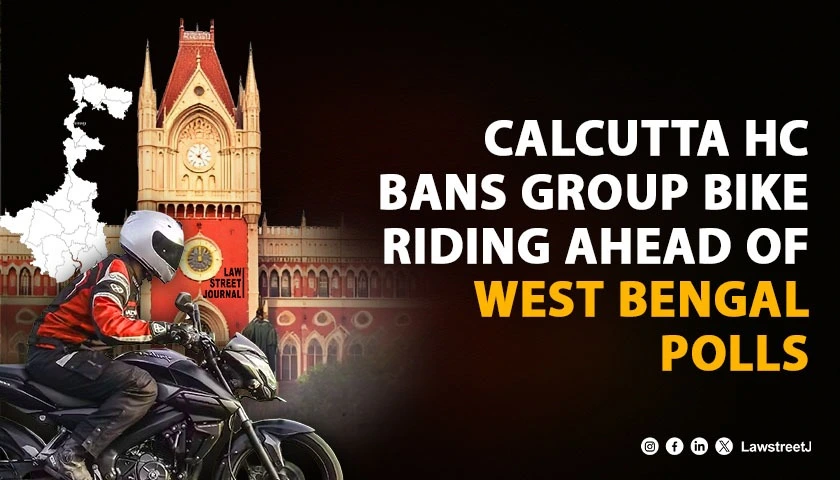
Kolkatta: The Calcutta High Court has expanded restrictions on motorcycle use during the ongoing West Bengal elections, directing that not only motorbike rallies but also group riding on two-wheelers shall be barred from two days prior to polling day onwards. This effectively prohibits group motorcycle riding from April 27 to April 29. The second phase of the West Bengal elections is scheduled to be held on April 29.
A Division Bench of Justice Shampa Sarkar and Justice Ajay Kumar Gupta passed the order on April 27, 2026, in MAT No. 771 of 2026 with CAN No. 1 of 2026, on an appeal filed by the Chief Electoral Officer of West Bengal against an order dated April 20, 2026, passed by a learned Single Judge.
The Division Bench, after hearing the submissions of the Chief Electoral Officer on the need to ensure security and the peaceful casting of votes during the second phase of elections, held that the Single Judge’s order required a limited modification. It directed that Clause (a) of the Single Judge’s order be modified to read as follows: “No motorbike rally or biking in groups shall be allowed from two days prior to polling day onwards.” The rest of the Single Judge’s order was left unchanged.
The learned Single Judge had, on April 20, 2026, held that the Election Commission of India could not impose a blanket restriction on motorcycle riding in the name of conducting free and fair elections and had set aside a notification issued by the Chief Electoral Officer that effectively barred motorcycle use between 6 PM and 6 AM in the days leading up to polling, except in limited circumstances.
The Single Judge had observed that while the Election Commission was justified in prohibiting motorbike rallies to prevent violence, a complete restriction on motorcycle movement lacked a legal basis and disproportionately affected citizens, including professionals dependent on two-wheelers for daily commuting. At the same time, the Single Judge had permitted calibrated restrictions, including a ban on motorbike rallies from two days before polling, limits on pillion riding in the 12 hours preceding polling (with exceptions for emergencies and essential activities), and regulated use of motorcycles on polling day for voting and other necessities, with exemptions for delivery personnel and office-goers with valid identification.
Before the Division Bench, Senior Advocate Jishnu Chowdhury, appearing for the Chief Electoral Officer, emphasised the need for stricter controls to ensure security and the peaceful casting of votes during the second phase of elections, particularly in view of concerns surrounding group mobilisation on motorcycles.
Accepting this concern in part, the Division Bench expanded the scope of the restriction under Clause (a) to include biking in groups, in addition to formal motorbike rallies, noting that group motorcycle movement could potentially undermine law and order even where it did not formally constitute a rally.
The court clarified that its order would be confined to the writ petition pertaining to the 2026 West Bengal elections and that broader questions of law, including those relating to the extent of the Election Commission’s powers, were not being decided and were kept open for consideration in appropriate proceedings.
The court directed that all parties, including persons required to use motorcycles during this period and the concerned authorities, act on the basis of the server copy of the order, which was directed to be uploaded on the Election Commission’s website along with the Single Judge’s order to ensure immediate implementation ahead of polling.
With this limited modification, the appeal and the connected application were disposed of.
Case Details:
- Case Title: Chief Electoral Officer, West Bengal v. Ritankar Das and Others
- Case Number: MAT No. 771 of 2026 with CAN No. 1 of 2026
- Court: Calcutta High Court
- Bench: Justice Shampa Sarkar and Justice Ajay Kumar Gupta
- Date of Order: April 27, 2026
- Appellant’s Advocates: Mr. Jishnu Chowdhury, Senior Advocate, with Ms. Sanskriti Agarwal
- State’s Advocates: Mr. Kishore Datta, Advocate General; Mr. Swapan Banerjee, Additional Government Pleader; Ms. Sunita Shaw; Mr. Soumen Chatterjee
- Respondent No. 1’s Advocates: Mr. Bikash Ranjan Bhattacharyya, Senior Advocate, with Mr. Soumya Dasgupta, Mr. Siddhartha Sankar Mandal, Mr. Sattwik Majumder and Ms. Tanuta Guray
- Respondents’ Advocates: Ms. Sanchari Chakraborty and Ms. Sayari Barman
- Union of India’s Advocate: Mr. Subit Majumdar

![Calcutta High Court conducts late-evening hearing, orders release of lawyer arrested inside court [Read Order]](/secure/uploads/2023/12/lj_4146_Court_lawyers_arrest.jpg)
![Indian Courts this Week: Law Street Journal's Weekly Round-Up of SC & HCs [Jan 1 - Jan 6]](/secure/uploads/2024/01/lj_9050_WhatsApp_Image_2024-01-06_at_12.07.10_PM.jpeg)