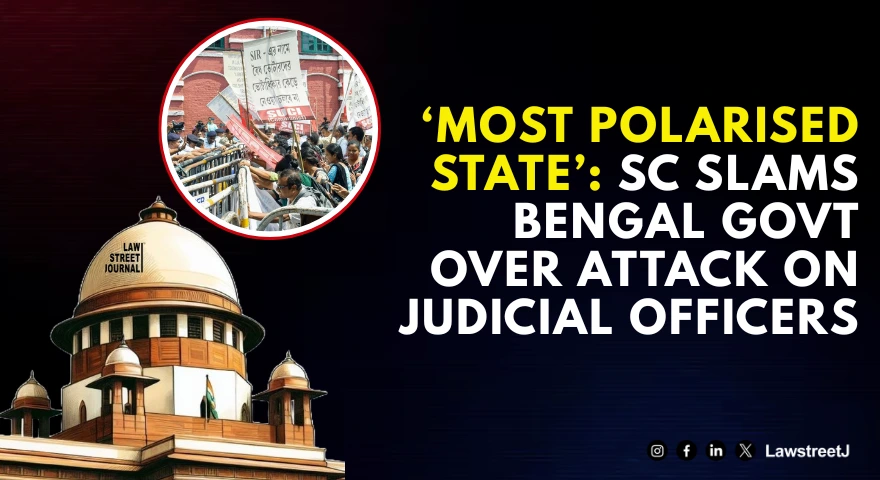
New Delhi: The Supreme Court of India on Thursday took a serious view of the threats and violence faced by judicial officers engaged in electoral roll duties in West Bengal and ordered the immediate deployment of Central Armed Police Forces (CAPF) for their protection.
A Bench comprising Chief Justice of India Surya Kant, Justice Joymalya Bagchi, and Justice Vipul Pancholi convened an urgent hearing to address a grave security lapse in the Malda district. The Court expressed “extreme concern” and “disappointment” over an incident in which seven judicial officers, including three women, were held hostage and gheraoed by a mob for several hours.
The Bench characterised the situation as a “brazen attempt” to browbeat the judiciary and a direct challenge to the authority of the apex court. CJI Surya Kant revealed that the Court had been receiving reports since the early hours of the morning and that he personally monitored the situation until 2 AM. It was brought to the Court’s attention that during the ordeal at a block development office in Kaliachak, the officers were left without protection, and in one instance, a five-year-old child accompanying an officer was denied food and water.
In a significant step to ensure the safety of judicial officers, the Court directed the Election Commission of India (ECI) to requisition and deploy adequate CAPF personnel at all locations where officers are adjudicating objections. The Court emphasised that it was imperative for the State government to have already informed the ECI to facilitate such deployment and ensure the safety of both the officers and their families. This direction was issued as an interim measure requiring immediate compliance to assure judicial officers that their lives and liberty would be protected.
The incident reportedly began around 3:30 PM on Wednesday, when demonstrators surrounded the office where the officers were conducting Special Intensive Revision (SIR) work. Despite the Registrar General of the Calcutta High Court requesting intervention from the state administration, the Court noted that “no tangible action was taken” for several hours. The situation escalated to the extent that the Chief Justice of the Calcutta High Court had to personally contact the Home Secretary and the Director General of Police to secure evacuation. Although the officers were eventually released after midnight, their vehicles were attacked with stones, bamboo sticks, and bricks during evacuation.
During the hearing, the Supreme Court strongly criticised the “criminal failure” and “complete abdication of duty” of the West Bengal administration. The Bench observed that the response of the Chief Secretary, DGP, Home Secretary, and district officials was “highly deplorable.” It further noted that the Chief Secretary could not be contacted and had not shared a mobile number with the High Court, terming it a serious failure of civil and police administration. Emphasising institutional integrity, the Court stated that the judicial officers were acting as the “extended hands” of the Supreme Court, and any assault on them amounted to a challenge to the authority of the Court itself.
To ensure an impartial probe, the Supreme Court handed over the investigation of the Malda incident to central agencies. The ECI was directed to entrust the inquiry to either the Central Bureau of Investigation (CBI) or the National Investigation Agency (NIA), with a preliminary report to be submitted directly before the Court. The Bench further directed that a criminal case be registered against the miscreants to ensure they are “brought to book.”
In addition, show-cause notices were issued to the Chief Secretary, the DGP, the Home Secretary, and the local District Magistrate and Senior Superintendent of Police. These officials have been directed to explain their inaction and the delay in securing safe evacuation. The Court also mandated their personal online presence at the next hearing scheduled for April 6 at 4 PM.
The background of the matter reflects a “trust deficit” between the West Bengal government and the Election Commission, which had earlier prompted the Supreme Court to pass an “extraordinary order” in February directing the appointment of serving and former judicial officers to oversee the SIR process. Prior to the incident, judicial officers had achieved an unprecedented disposal rate, clearing approximately 47.40 lakh objections out of 65 lakh as of March 31. The Court expressed concern that such violence could have a “chilling effect” on officers who had been working tirelessly, including on weekends and holidays, to meet electoral deadlines.
Addressing the prevailing political climate, the CJI remarked that West Bengal appeared to be the “most polarised state,” noting that even court orders were being viewed through a political lens. When the Advocate General suggested that the ECI was acting as an adversary, the Court observed that everyone in the state seemed to be speaking a “political language.” The Bench further noted that the gherao was not spontaneous but appeared to be a “calculated and deliberate move” aimed at demoralising judicial officers and obstructing the adjudication process.
Further directions were issued to regulate proceedings at adjudication centres. The Court mandated that no more than three to five persons be allowed to enter the premises at a time for filing or hearing objections. It also directed that the security of the residences and family members of judicial officers expressing apprehension must be immediately assessed and ensured.
During the hearing, counsel for the parties engaged in a sharp exchange regarding responsibility for the lapse. Senior Advocates Menaka Guruswamy and Kalyan Bandopadhyay argued that the current officials had been appointed by the Election Commission after earlier transfers, suggesting that the responsibility lay with the Commission.
In contrast, Solicitor General Tushar Mehta contended that the state administration could no longer be entrusted with safeguarding the judiciary, describing the incident as an “unacceptable” assault and an “affront to the majesty of the rule of law.” Senior Advocate Dama Seshadri Naidu, appearing for the Election Commission, cautioned that the rule of law cannot survive in an environment of “mobocracy.”
Case Title: Mamata Banerjee v. Election Commission of India (W.P.(C) No. 129 of 2026) (and other connected matters)