New Delhi: A 48-year-old definition, a docket-explosion, and three days of argument: the Supreme Court has reserved judgment on a question that decides which workplaces get labour protection at all.
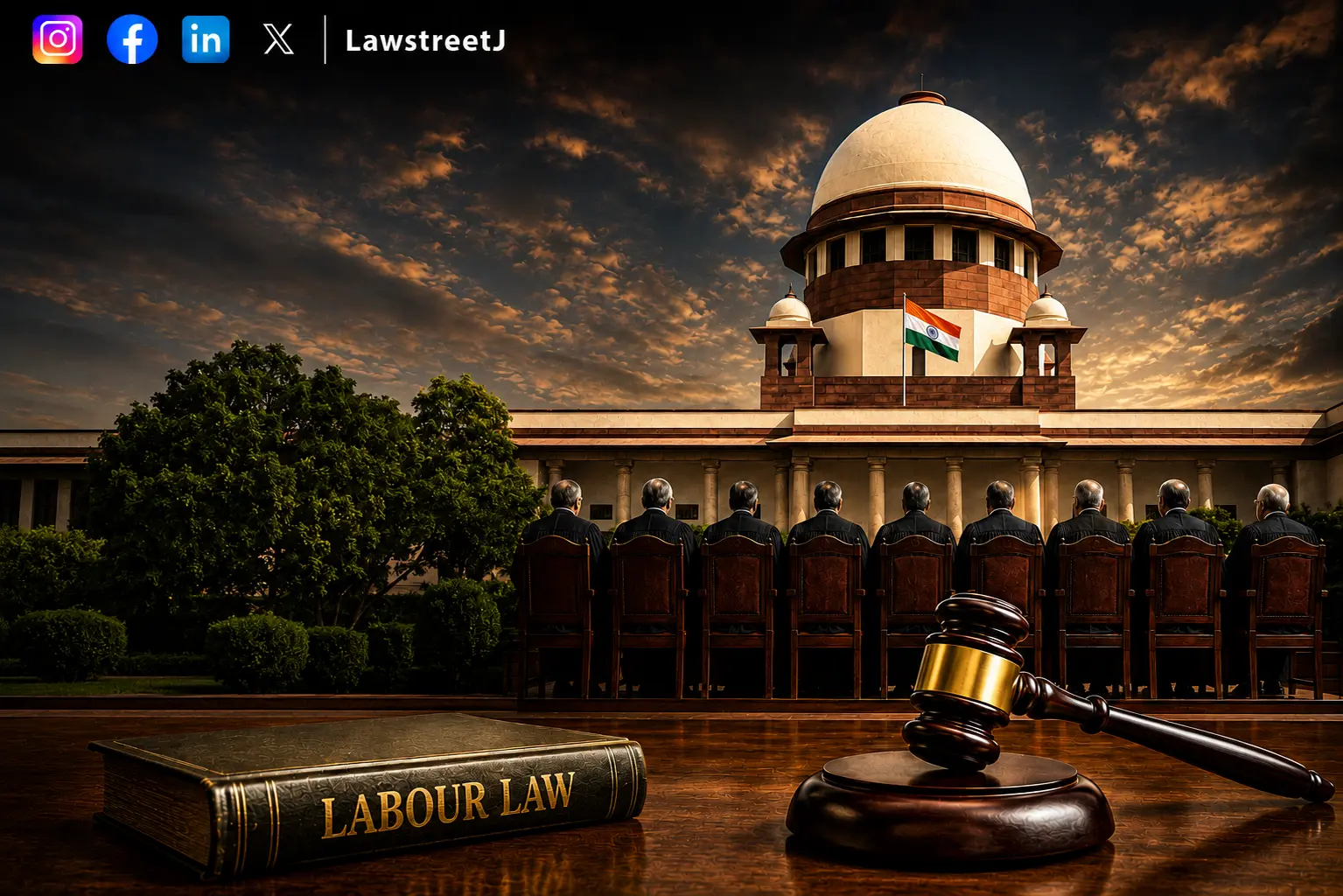
On 19 March 2026, a nine-judge Bench of the Supreme Court led by Chief Justice Surya Kant reserved judgment on one of Indian labour law's longest-running questions: what, exactly, is an "industry"?
The answer determines whether the Industrial Disputes Act, 1947, its protections on wages, dismissal, unionising, and dispute resolution, applies to a given workplace at all. For nearly five decades, that answer has rested on a sweeping 1978 ruling that the Court is now being asked to revisit, and possibly undo.
The 1978 verdict that swept almost everything in
In Bangalore Water Supply & Sewerage Board v. R. Rajappa, a seven-judge Bench led by Justice V.R. Krishna Iyer read Section 2(j) of the Industrial Disputes Act as broadly as the words would allow. The Court devised a "triple test": an undertaking qualifies as an industry if there is systematic activity, cooperation between employer and employee, and production or distribution of goods or services to satisfy human wants or wishes. A "dominant nature" test was layered on top, so that where an establishment carried on several activities, its primary function would decide whether the whole fell within the Act.
Justice Krishna Iyer was explicit about the philosophy behind this: the definition, he wrote, had to be read with "dictionary in hand, decisions in head and Constitution at heart," rejecting narrow, legalistic readings that would let employers escape scrutiny through semantic technicalities. The practical effect was enormous. Hospitals, universities, clubs, charities, research institutions, and even government welfare departments were pulled within the sweep of the Act. Profit motive was declared irrelevant. Only a narrow category of "sovereign functions," things Justice Krishna Iyer suggested like defence and core statutory employment, stood outside the definition.
Cracks that were never fully sealed
The judgment did not end the debate; it merely won it for a generation. Two fault lines in particular kept resurfacing. The first was profit motive's inconsistent treatment: although the triple test explicitly excluded profit motive as a criterion, Justice Krishna Iyer's opinion nonetheless treated it as the deciding factor for whether research institutions counted as industries, an internal tension legal commentators have flagged in the years since.
The second was the sovereign-functions exception. The judges could not agree on where this line sat. Justice Y.V. Chandrachud questioned whether the IDA contained any statutory basis for a sovereign-functions carve-out at all. Chief Justice M.H. Beg, by contrast, wanted a firmer, narrower reading that kept government activity outside the Act's reach wherever true "regal" functions were involved. Justice Krishna Iyer settled on a middle path, a narrow exception for functions like defence, while treating most State-run welfare and economic activity as industry. The result was an accepted exception with almost no guidance on its boundaries.
That ambiguity is precisely what surfaced in State of U.P. v. Jai Bir Singh, the case now before the nine-judge Bench, which originated from a "cleavage of opinion" over whether a State Social Forestry Department was welfare work or industrial activity.
The long road to reconsideration
Bangalore Water Supply was challenged in Jai Bir Singh in 2002. In May 2005, a five-judge Constitution Bench, in an opinion by Justice D.M. Dharmadhikari, referred the matter to a larger Bench, describing the 1978 definition as over-expansive and too "worker-oriented," and warning that interpretation had stretched the statute to the point of harming employers as well as workers. The Bench also flagged that "liberal professions," law, medicine, accountancy, raised questions perhaps better suited to separate legislation than judicial interpretation. In January 2017, a seven-judge Bench directed that the reference be heard by nine judges. It was only in February 2026 that a Bench led by CJI Surya Kant finally listed the matter for final arguments, 21 years after the original reference.
In the 2005 reference itself, the five-judge Bench had described the litigation generated by Bangalore Water Supply as a "docket explosion," a phrase that captures why the stakes of reconsideration are so high. Whatever the nine judges decide, the ruling is expected either to ease decades of accumulated litigation, or, if it upholds the 1978 position, to formally close a controversy that already appeared largely settled in practice.
The legislative shadow over the courtroom
Parliament has hovered at the edges of this dispute for over 40 years without resolving it. The Industrial Disputes (Amendment) Act, 1982, attempted to narrow the definition of "industry" and exclude several categories of activity, but the relevant provision was never notified by the executive, so it never came into force.
The legislative landscape has shifted more decisively since. Between 2019 and 2020, Parliament consolidated 29 labour statutes into four codes, including the Industrial Relations Code, 2020, whose Section 2(p) closely tracks the language of the unnotified 1982 amendment. The IR Code was formally notified on 21 November 2025 and is currently being rolled out across states, even as the nine-judge Bench was hearing arguments on the definition it is meant to eventually replace.
This overlap has not gone unnoticed by trade unions. A nationwide strike involving an estimated 30 crore workers, opposing the four labour codes, made headlines in February 2026. Against this backdrop, CJI Surya Kant, while dismissing a separate PIL seeking a minimum-wage enforcement framework for domestic workers, remarked that trade unions were "largely responsible" for stalled industrial growth, a comment that drew attention given the pending reference.
Three days, 93,000 words
The hearing itself ran from 17 to 19 March 2026, generating roughly 93,072 spoken words across the transcripts, an estimated 11 hours and 5 minutes of argument at a conventional speaking pace.
On the petitioner side, which took 44,428 words in all (roughly 5 hours 17 minutes), Attorney General R. Venkataramani led for the Union, taking 24,805 words, 55 percent of the petitioner side's total, opening the hearing on 17 March and returning for rejoinder on 19 March. Senior Advocate Jaideep Gupta appeared for the Tamil Nadu HR&CE Commissioner; Senior Advocate Sanjay Hegde for Karnataka; Senior Advocate Shekhar Naphade for Maharashtra and the University of Mumbai; ASG K.M. Nataraj for Uttar Pradesh, the lead petitioner; and Senior Advocate Shadan Farasat for Punjab. Ten further counsel, including for AIIMS Delhi, the National Remote Sensing Centre, a research-institute intervenor, and a Goshala intervenor, made brief interventions. No woman counsel appeared for the petitioner side.
On the respondent side, which took 34,169 words (roughly 4 hours 5 minutes), Senior Advocate Indira Jaising led with 14,006 words, opening Day 2 with the bulk of her submissions. Senior Advocate C.U. Singh, for the New Trade Union Initiative, followed with 9,801 words. Senior Advocates Gopal Sankaranarayanan, Jayna Kothari, Vijay Hansaria and K.S. Chauhan, along with Advocate Shivam Singh and Senior Advocates P.V. Surendranath and Sangeeta Bharati, rounded out the side. Notably, the three women counsel on the respondent side, Jaising, Kothari and Bharati, together accounted for 48 percent of the respondents' words, a striking contrast to the all-male petitioner bench.
The two court-appointed amici curiae, Senior Advocates Jamshed P. Cama and Parthasarathi Sengupta, together took 14,175 words (roughly 1 hour 41 minutes), arguing only on Day 3.
Inside the Bench: five voices, four silences
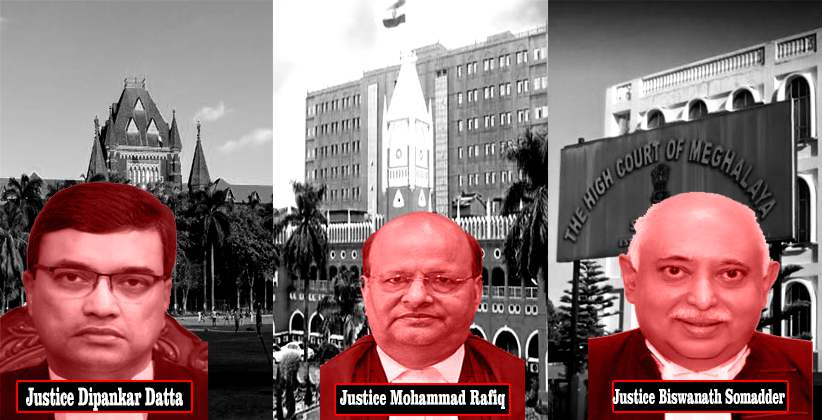
A companion analysis of the transcripts reveals a striking asymmetry in how the nine judges actually engaged. Of the Bench's 13,713 words, just 13 percent of the total hearing, the overwhelming share came from five judges: CJI Surya Kant (6,593 words, 546 turns), Justice B.V. Nagarathna (2,076 words, 182 turns), Justice Dipankar Datta (1,926 words, 126 turns), Justice Joymalya Bagchi (1,766 words, 67 turns, the highest words-per-turn ratio on the Bench), and Justice P.S. Narasimha (1,258 words, 67 turns). Together, these five accounted for 99 percent of all Bench speech.
Justices Alok Aradhe and Vipul M. Pancholi did not speak once across three days. Justices Satish Chandra Sharma and Ujjal Bhuyan together intervened just eleven times, for a combined 94 words, an estimated 40 seconds of speech each. As with the historic silence of U.S. Justice Clarence Thomas, this need not signal a lack of substantive engagement; all nine judges will participate in the eventual decision on equal terms.
The Bench's engagement also varied sharply by day, rising to 16.5 percent of spoken words on 18 March, when the wider definition was being defended by the respondents, compared to roughly 11 percent on the days it was being attacked or summed up.
The sharpest exchange came on 17 March, when ASG K.M. Nataraj argued that the not-yet-fully-enforced Industrial Relations Code, 2020, was "in the nature of a clarificatory law" that could be used to read down Bangalore Water Supply. Justice Bagchi pressed him repeatedly, ultimately asking: "Are you going to pass off a wolf in sheep's clothing?", voicing concern that accepting the argument would mean the Bench was "unwittingly giving retrospectivity through our judicial imprimatur" to a statute still being rolled out, while reviewing a 48-year-old precedent.
What remains to be seen
With judgment reserved, the central question is whether the Court will revisit the triple test itself, and potentially overturn Bangalore Water Supply in its entirety, or confine itself to narrower issues, such as the treatment of hospitals and educational institutions that the 2005 reference specifically flagged. Given the IR Code's already-underway rollout, the ruling's practical reach may ultimately depend as much on legislative timing as on judicial reasoning.
Case: State of U.P. v. Jai Bir Singh, reference arising from Bangalore Water Supply & Sewerage Board v. R. Rajappa, 1978 AIR 548. Bench: Nine judges comprising CJI Surya Kant, Justices B.V. Nagarathna, P.S. Narasimha, Dipankar Datta, Ujjal Bhuyan, S.C. Sharma, Joymalya Bagchi, Alok Aradhe and Vipul M. Pancholi. Provision under review: Section 2(j), Industrial Disputes Act, 1947. Hearings: 17 to 19 March 2026. Status: Judgment reserved.
Bangalore Water Supply & Sewerage Board v. R. Rajappa, 1978 AIR 548.