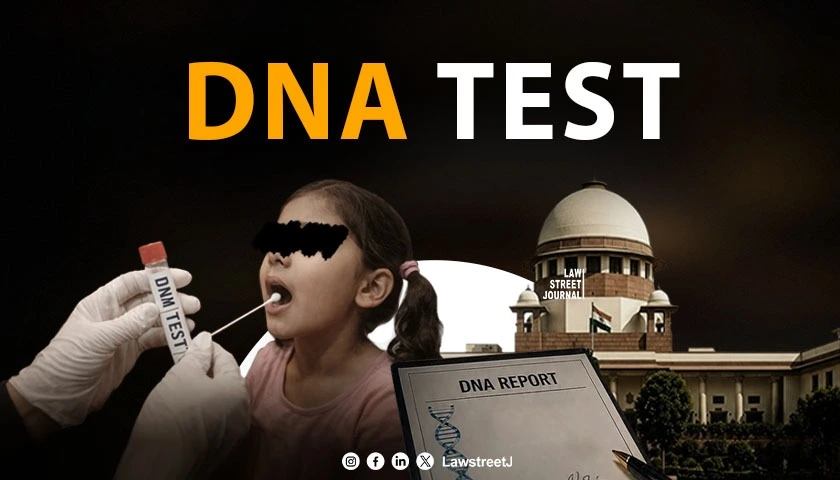
New Delhi: The Supreme Court has held that while considering whether to direct a DNA test, courts must examine whether the result of such a test is directly in issue, whether the controversy can be effectively resolved on the basis of other available evidence, and whether directing the test would serve the interests of the parties and the administration of justice.
A Bench of Justice Sanjay Karol and Justice Nongmeikapam Kotiswar Singh upheld concurrent orders of the trial court and the Chhattisgarh High Court directing the appellant to undergo a DNA test to determine the paternity of the first respondent, and dismissed the appeal.
The first respondent, Amar Pradhan, claimed that he was born on 10 September 1999 from a consensual relationship between his mother and the appellant, Chaturbhuj Pradhan, in January 1999. The appellant denied paternity and relied upon his acquittal in a rape case registered by the second respondent under Section 376 of the Indian Penal Code, 1860. Earlier maintenance proceedings between the parties had resulted in observations that the respondents failed to establish any relationship with the appellant, though such observations were not rendered after a full-fledged trial. A criminal appeal arising from those proceedings was later disposed of before a Lok Adalat by the Supreme Court, noting that Amar, who was a minor at the time of institution of the proceedings, had attained the age of 24 years and nothing survived for consideration.
After attaining majority during the pendency of the proceedings before the Supreme Court, Amar instituted a civil suit seeking a declaration that he is the son of the appellant and consequently entitled to a one-third share in the appellant’s property. The trial court allowed an application for DNA testing, and the appellant’s challenge before the Chhattisgarh High Court was dismissed, with the High Court observing that no other evidence would conclusively determine the issue of paternity.
Before the Supreme Court, the appellant contended that he cannot be compelled to undergo a DNA test, that no eminent need existed for directing such a test, that no adverse inference under Section 114(h) of the Indian Evidence Act could be drawn against him at that stage, and that the civil suit was barred by the principle of res judicata.
The Court surveyed the governing precedents on the issue of DNA testing in paternity disputes. Referring to Goutam Kundu v. State of West Bengal, the Court reiterated that DNA tests cannot be directed as a matter of course, that courts must avoid permitting roving inquiries, and that no person can be compelled to provide a blood sample for analysis. From Dipanwita Roy v. Ronobroto Roy, the Court reaffirmed that directions for DNA testing should ordinarily be avoided, particularly where the legitimacy of a child may be adversely affected.
Relying on Aparna Ajinkya Firodia v. Ajinkya Arun Firodia, the Court observed that DNA testing may be ordered only in exceptional cases where it becomes indispensable for resolving the controversy, while keeping in view the possible social stigma and inheritance-related consequences. The Court also referred to Ivan Rathinam v. Milan Joseph and noted the two-fold test governing such directions: first, whether the existing evidence is insufficient to adjudicate the dispute; and second, whether the balance of interests justifies ordering the test.
Applying these principles, the Court observed that the alleged relationship between the appellant and the second respondent dated back to January 1999, and Amar was born in September 1999. The appellant had consistently denied paternity, and there was no other evidence capable of conclusively determining the issue of paternity. The Court also noted that it was not the case of any party that the second respondent had maintained an intimate relationship with any other person during the relevant period.
The Court further held that the earlier observations against the second respondent and Amar were not rendered after a full-fledged trial and therefore could not operate as res judicata in the present civil suit instituted by Amar to establish his paternity. The objection based on res judicata was accordingly rejected.
On the question of balancing competing interests, the Court observed that Amar had grown up with his mother consistently asserting that the appellant was his father, while judicial and administrative findings had repeatedly gone against that claim. The Court noted that unless a definitive determination was reached, Amar could be permanently deprived of rights to which he may be entitled as the appellant’s son.
Balancing the appellant’s right to privacy, which the Court acknowledged is not absolute, against Amar’s legitimate interest in obtaining certainty and closure regarding his paternity, the Court held that the balance of convenience overwhelmingly favoured Amar. Consequently, the Court found no infirmity in the concurrent orders directing DNA testing.
The appeal was dismissed with no order as to costs, and the concerned Civil Court was directed to fix a date for conducting the DNA test and proceed further in the civil suit in accordance with the result.
Case Title: Chaturbhuj Pradhan v. Amar Pradhan & Anr.