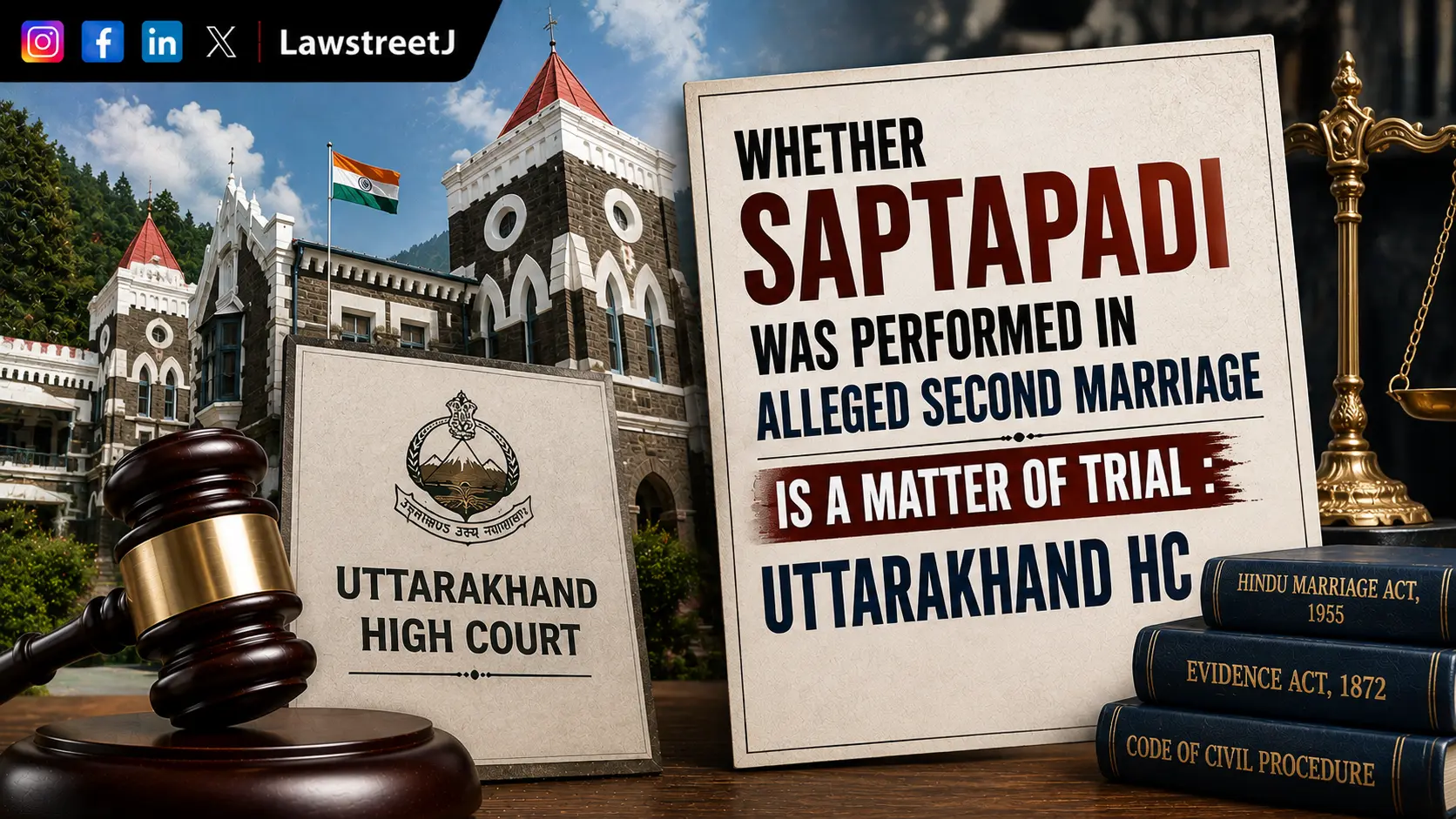
Nainital: The High Court of Uttarakhand at Nainital has refused to quash criminal proceedings against a man accused of bigamy under Section 494 of the Indian Penal Code, holding that whether the essential ceremonies of the alleged second marriage, including Saptapadi, were actually performed is a question that must be decided at trial and cannot be examined at the stage of summoning or quashing.
Justice Siddhartha Sah was hearing a Criminal Misc. Application filed under Section 482 of the Code of Criminal Procedure, 1973, by Kharak Singh Dhapola, seeking to quash the summoning order as well as the judgment of the Revisional Court that had upheld it.
The proceedings arose out of a complaint filed by the applicant's wife, alleging that he had contracted a second marriage on 4 July 2010 without dissolving his first marriage with her, solemnised in 1988. Acting on her statement recorded under Section 200 Cr.P.C. and a police report, the Judicial Magistrate had summoned the applicant under Sections 494 and 504 of the IPC by order dated 4 August 2016, which the Sessions Court subsequently upheld in revision.
Before the High Court, counsel for the applicant argued that no offence under Section 494 IPC could be made out in the absence of proof that the second marriage was solemnised through the Saptapadi ceremony, relying on the Allahabad High Court's decision in Nisha v. State of U.P., which had held that the absence of any averment regarding Saptapadi rendered the complaint deficient in the basic ingredients of the offence. Counsel for the complainant-wife, in response, relied on the Delhi High Court's ruling in Pooja Sharma Bajaj v. Kunal Bajaj and the Supreme Court's decision in K. Neelaveni v. State of T.N., arguing that whether the essential ceremonies of the second marriage were performed is itself a matter for trial and cannot be demanded of a complainant at the summoning stage.
Faced with these conflicting lines of authority, the Court held that the view taken by the Supreme Court in K. Neelaveni must prevail. It noted that the Delhi High Court in Pooja Sharma Bajaj had itself relied on K. Neelaveni to hold that requiring a complainant to prove every ceremony of a husband's second marriage before summons could even issue would place an unreasonable burden on her, particularly since such marriages are seldom conducted with the first wife's knowledge or in circumstances that allow her to gather evidence of the ceremonies performed.
The Court held: “The sole question that falls for determination in this case is whether the essential ceremonies of marriage were performed or not would be a matter of trial, or even at the initial stage of summoning the accused, the said essentials have to be proved by the complainant for the passing of a summoning order.”
Answering this in favour of the complainant, the Bench held that the ceremony of Saptapadi is one of the essential ceremonies of marriage that would fall for consideration by the trial court during trial, and that this question cannot be gone into at the primary stage of taking cognizance.
Finding no error in either the summoning order or the order of the Revisional Court, the Court declined to interfere and dismissed the Section 482 application.
Case Title: Kharak Singh Dhapola v. State of Uttarakhand and Another, Criminal Misc. Application No. 1176 of 2021





![Relocation of Uttarakhand HC outside Nainital: SC stays HC's order [Read Judgment]](/secure/uploads/2024/05/lj_5859_3966274a-4508-4c77-88bb-74263432a8aa.webp)