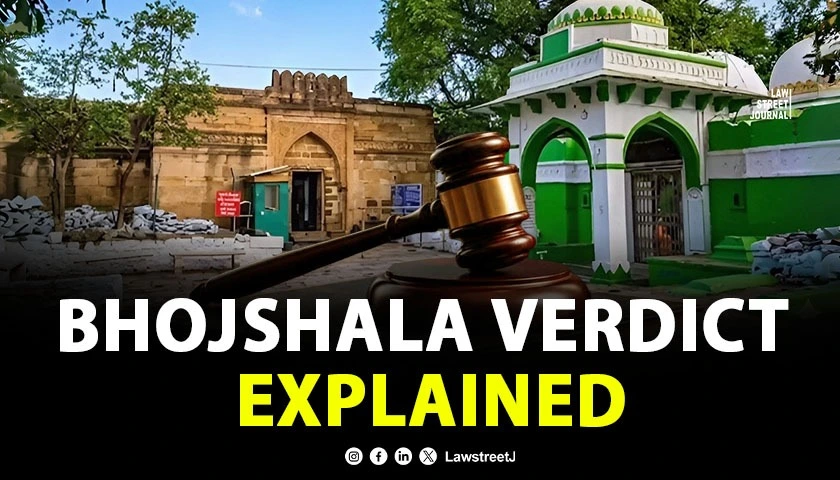
Madhya Pradesh: On 15.05.2026, a Division Bench of the High Court of Madhya Pradesh comprising Justices Vijay Kumar Shukla and Alok Awasthi delivered a landmark judgment, holding that the disputed area at Dhar known as Bhojshala and Kamal Maula Mosque bears the religious character of a Bhojshala with a temple of Goddess Vagdevi (Saraswati).
The petitions of the Hindu community were allowed, the ASI’s order dated 07.04.2003 restricting Hindu worship and permitting Friday namaz was quashed, and the petitions filed by the Muslim parties were dismissed. The judgment’s reasoning operated across six distinct planes: preliminary objections, the statutory framework, the Places of Worship Act, the 1935 Ailan, the ASI scientific survey, and the application of the Ayodhya principles.
The dispute traces to the ASI’s administrative order of 07.04.2003, which regulated access to the Bhojshala complex, allowing Hindus to worship only on Tuesdays and on Vasant Panchami, while permitting Muslims to offer Friday namaz in the same area. Hindu petitioners challenged this as an unconstitutional restriction on their fundamental right of worship under Articles 25 and 26, contending that the site was originally a Saraswati temple and centre of Sanskrit learning built by Raja Bhoja in 1034 AD, later destroyed and converted by medieval Islamic rulers.
The Muslim parties sought recognition of continuing mosque rights based on historic Friday namaz and the 1935 Ailan of the Dhar State. The Jain community separately claimed that the idol preserved in the British Museum was of Jain goddess Ambika, not Saraswati. The State of Madhya Pradesh supported the Hindu petitioners’ position and urged final adjudication to end recurring communal tension, noting that nearly 8,000 security personnel had been deployed in sensitive years, with curfews, FIRs, and injuries to government officials.
The respondents raised five preliminary objections, which the Court rejected one by one. First, on locus standi, the Court found that the petitioners had adequately disclosed their public standing, professional status, and public-spirited antecedents, and that their fundamental right of worship under Articles 25 and 26 was directly in issue, warranting relaxation of strict locus requirements.
Second, on maintainability, the respondents argued that title disputes cannot be adjudicated in Article 226 writ jurisdiction and must be pursued by a civil suit. The Court held that the petitions did not seek a declaration of title but raised enforcement of fundamental religious rights and statutory compliance by the ASI under Section 16 of the Ancient Monuments and Archaeological Sites and Remains Act, 1958. The Court recognised that while it ordinarily declines to adjudicate seriously disputed facts in writ proceedings, this is not an inflexible rule of exclusion; where fundamental rights are in issue and the evidence consists entirely of historical records, government documents, and the ASI survey report, without requiring oral evidence, writ jurisdiction is appropriately invoked.
Third, on res judicata, the Court held that the issues raised in the present petitions were not directly and substantially adjudicated in prior proceedings, particularly the earlier Single Judge order in the case of Qazi Zakaullah, which had declined relief on a narrow ground and had not addressed the larger questions of worship rights, the ASI’s statutory obligations, and the character of the monument.
Fourth, on delay and laches, the Court held that the challenge to the ASI order of 2003 presented a continuing cause of action, as the restriction on Hindu worship was subsisting and operative, and that subsequent Supreme Court orders in the matter had, in any event, superseded the question of delay.
Fifth, the Court noted that the Supreme Court’s order dated 22.01.2026 in SLP No. 7023/2024 (filed by Maulana Kamaluddin Welfare Society) had specifically remanded the matter for adjudication before the High Court, conclusively disposing of the contention that the proceedings were non-maintainable in light of the Supreme Court’s interim order dated 12.12.2024 in Ashwini Kumar Upadhyay v. Union of India, which applied only to suits and not to writ petitions under Article 226.
The Muslim parties raised a major bar under the Places of Worship (Special Provisions) Act, 1991, which freezes the religious character of places of worship as of 15.08.1947 and bars conversion or alteration of such character. The Court held that this bar was entirely inapplicable. It held that Section 4(3) of the 1991 Act expressly excludes from its operation any ancient monument or archaeological site covered under the Ancient Monuments and Archaeological Sites and Remains Act, 1958.
Since the Bhojshala complex has been a protected monument of national importance under the 1958 Act and its predecessor enactments, namely the Ancient Monuments Preservation Act, 1904 and the Ancient and Historical Monuments and Archaeological Sites and Remains (Declaration of National Importance) Act, 1951, the 1991 Act creates no bar whatsoever to examining the monument’s character or adjudicating the worship rights of any community therein.
A central argument of the Muslim respondents was the Ailan (declaration) dated 24.08.1935 issued by the Dhar State, which they contended recognised the structure as a mosque and continued to operate as existing law under Article 372 of the Constitution.
The Court rejected this contention on multiple grounds. First, the Government of India Act, 1935 came into force only on 01.04.1937; therefore, the Ailan, having been issued on 24.08.1935, could not derive legislative sanction from provisions not yet operational.
Second, the 1935 Ailan was, at best, an executive or administrative arrangement and not a legislative enactment; only instruments possessing genuine legislative character survive under Article 372.
Third, even if the Ailan possessed legislative character, it could not override fundamental rights guaranteed under Part III of the Constitution, and any pre-constitutional law inconsistent with those rights would be void under Article 13.
Fourth, the Court held that even the 1935 proceedings themselves supported the Hindu petitioners; they recognised the structure primarily as an archaeological monument called Bhojshala, recorded that Muslim prayers had begun only around 1919–20, noted that the traditional name “Bhojshala” could not be removed at Muslim demand, and demonstrated the existence of competing claims rather than exclusive mosque usage.
On the statutory question of protected monument status, the Court held that the disputed area has been a protected monument since 18.03.1904 under the Ancient Monuments Preservation Act, 1904, with the deeming effect flowing through the 1951 Act and continuing under the 1958 Act. Section 16 of the 1958 Act mandates that a protected monument which is a place of worship shall not be used for any purpose inconsistent with its character, and that the Collector must protect it from pollution or desecration.
The Court held that the ASI’s order dated 07.04.2003, which permitted Muslim namaz in the disputed area, was passed without any scientific basis or proper statutory inquiry and violated Section 16 of the 1958 Act. The ASI had no authority under law to alter the religious character of the monument or confer worship rights on any community through an administrative order.
The centrepiece of the Court’s substantive reasoning was the multi-volume scientific survey conducted by the ASI pursuant to the High Court’s order dated 11.03.2024, which the Supreme Court later affirmed with minor modifications while maintaining status quo. The survey employed Ground Penetrating Radar, GPS mapping, XRF compositional analysis, and stratigraphic excavation across systematically divided 5×5 metre grids, with representatives of both communities present throughout the process. The findings were comprehensive and decisive.
The stratigraphic analysis revealed a pre-existing structure extending four to five metres below the present floor level, dated by architectural and material analysis to the Paramara period of the 10th–11th century CE. The excavation also recovered 94 sculptures and sculptural fragments depicting distinctly Hindu iconography, including Ganesha, Brahma, Narasimha, Bhairava, Kirtimukha motifs, and mythological animals, several of which had been deliberately defaced.
The survey further recorded more than 150 Sanskrit and Prakrit inscriptions, all predating the Arabic and Persian inscriptions at the site, thereby establishing prior occupation. The 106 pillars and 82 pilasters were identified as reused temple-style architectural members.
Critically, a 15th-century Khilji inscription on the adjacent tomb gateway explicitly recorded the destruction of idols and the conversion of the temple into a mosque, constituting a contemporaneous admission of the site’s prior Hindu character. The ASI’s scientific conclusion was that the existing structure had been constructed using parts of earlier temples and that a large structure associated with literary and educational activity—the Sharda Sadan—had existed at the site during the Paramara period.
The Court rejected all objections to the report’s impartiality and methodology, noting that representatives of both communities had participated throughout the exercise, all artefacts were numbered, documented, and photographed, and allegations of bias against a statutory body remained wholly unsubstantiated.
The Court also applied the ten principles drawn from M. Siddiq (D) Thr. Lrs. v. Mahant Suresh Das (the Ayodhya judgment) to assess the evidentiary record. It reiterated that the governing standard was the civil standard of preponderance of probabilities and not proof beyond reasonable doubt.
Within this framework, the ASI report was accorded significant probative value as expert evidence founded upon a methodology whose integrity remained unimpeached. The Court further observed that findings regarding demolition or conversion may legitimately be drawn inferentially where the later structure lacks an independent foundation and is shown to rest upon pre-existing walls, a circumstance that was found to exist in the present case.
In addition, the continuity and genuineness of Hindu worship and religious belief associated with the site were treated as relevant corroborative factors. Applying Principle 8 of the Ayodhya judgment, the Court rejected the plea of waqf by user, holding that internal religious doctrines cannot be invoked in a manner that extinguishes the established religious rights of another community where the prior religious character of the site stands supported by convergent archaeological, historical, and scientific evidence.
The Court also addressed the Jain community’s petition, which claimed that the idol preserved in the British Museum was Jain goddess Ambika rather than Saraswati. The Court held that both the Vagdevi and Amba idols in the London museum represented forms of the divinity of Saraswati.
It further observed that Jainism and Hinduism in India have evolved side by side, sharing deities and iconographic traditions, and that the presence of Jain Tirthankara figures recovered during excavation was entirely consistent with the site’s character as a Saraswati temple. The discovery supported, rather than contradicted, the Hindu character of the original structure. Consequently, after determining the religious character of the disputed area to be that of a Bhojshala with a temple of Goddess Vagdevi (Saraswati), the Court dismissed WP No. 8986/2026 filed by Salek Chand Jain.
In its final directions, the Court quashed paragraph 3 of the ASI order dated 07.04.2003 insofar as it restricted Hindu worship while permitting Friday namaz within the disputed premises. The ASI was consequently vested with full supervisory authority over the preservation, conservation, and regulation of religious access to the site.
The Union Government was further directed to take appropriate decisions regarding the administration and management of the Bhojshala temple, including the preservation and continuation of Sanskrit learning within the complex. The Court also observed that any representations seeking the return of the Saraswati Pratima from the British Museum should be duly considered by the Government of India.
At the same time, in an effort to balance competing community interests, the Court directed the State Government to consider, in accordance with law, any application submitted by the Muslim community for allotment of a suitable permanent parcel of land in Dhar for the construction of a mosque and related religious facilities.
Case Title: Hindu Front for Justice (Regd. Trust No. 976) v. Union of India and Others [2026:MPHC-IND:8805], WP No. 10497/2022 and connected petitions.


.jpeg)
![Supporting defamatory WhatsApp posts doesn’t constitute involvement in offence of defamation: MP HC [Read Order]](/secure/uploads/2024/09/lj_6675_WhatsApp_Image_2024-09-16_at_12.24.54_PM.webp)