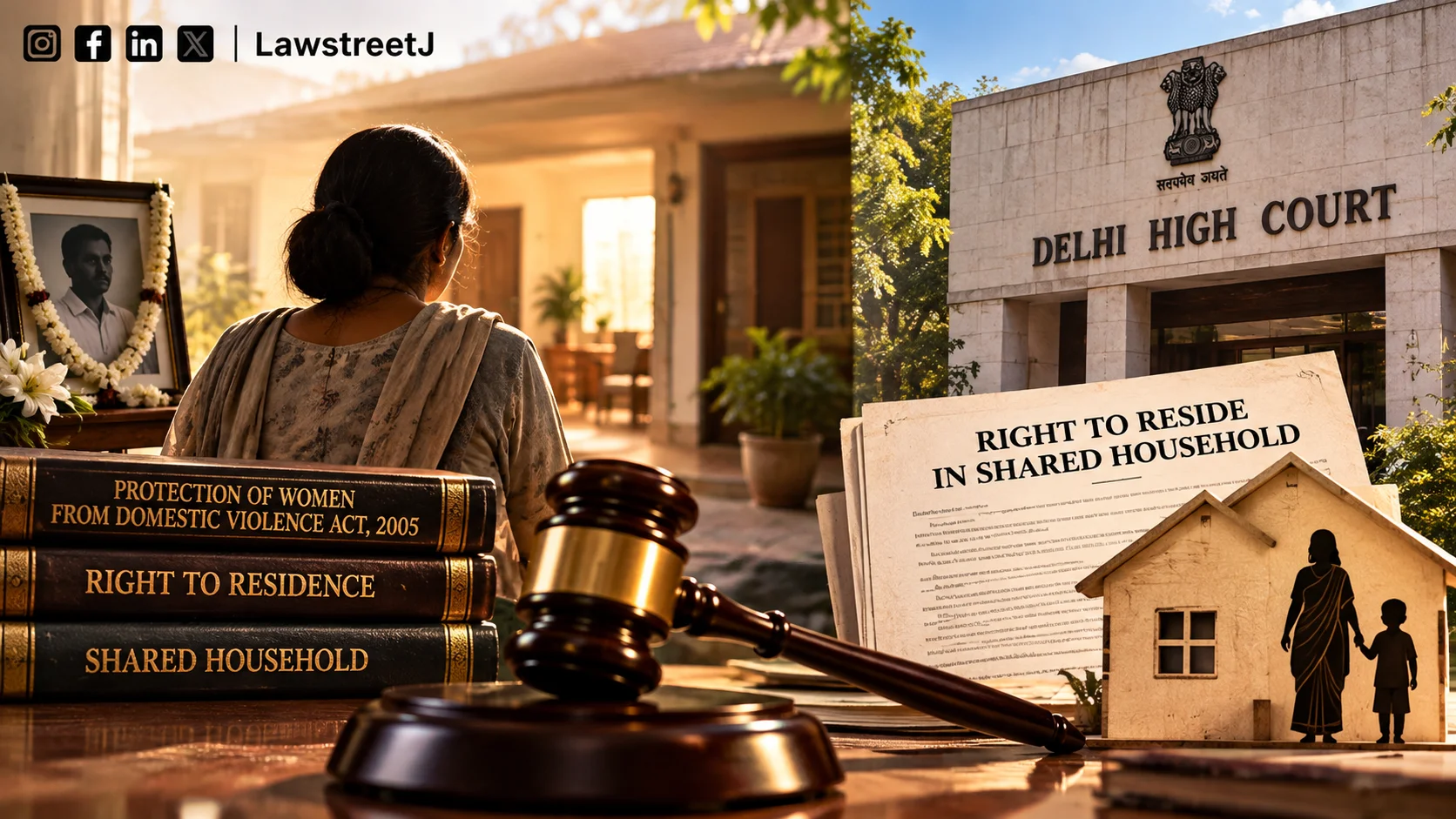
New Delhi: The Delhi High Court has held that a widowed daughter-in-law who has lived for over two decades in her father-in-law's self-acquired flat has an independent right of residence there as her shared household under the Protection of Women from Domestic Violence Act, 2005, and has directed that a decree for possession in the father-in-law's favour can be executed only after he secures suitable alternate accommodation for her or pays her rent of Rs. 15,000 per month.
Justice Neena Bansal Krishna decided the Regular First Appeal (RFA No. 778/2023), titled Late Raj Kumar @ Babbal (deceased) through LRs v. Attar Singh, on 12.10.2026. The appeal was filed by the widow and two daughters of the deceased son against a judgment and decree dated 22.05.2023 of the Additional District Judge, Delhi, which had directed them to hand over vacant possession of a Paschim Vihar flat and to pay damages at Rs. 10,000 per month from 01.01.2013.
The respondent, Attar Singh, claimed to have bought the flat in 1988 through an agreement to sell, powers of attorney, a receipt and a will. He stated that his elder son and the son's family were allowed to live there only as licensees, that the son had inducted commercial occupants and disputed his ownership, and that his licence was terminated by a legal notice dated 01.12.2012. He also relied on a public notice of 04.06.2006 disowning the son and his wife.
The son had pleaded that he was a tenant paying Rs. 1,000 a month. His defence was struck off on 16.09.2014 for non-payment of costs of Rs. 5,000. He died on 25.07.2015, and his widow and daughters were brought on record as legal representatives. The trial court held that his occupation was permissive, that the legal representatives were barred by Section 116 of the Evidence Act from challenging the owner's title, and decreed the suit.
Before the High Court, the appellants argued that the flat was the shared household of the widow under Sections 2(s), 17 and 19 of the Domestic Violence Act, that she had lived there since her marriage and was in a domestic relationship with the respondent, and that the trial court had not examined the plea. They relied on Satish Chander Ahuja, Prabha Tyagi, Preeti Satija and Ravneet Kaur, and also claimed the flat was joint family property.
The Court first rejected the challenge to the owner's title. It noted that the son had never claimed ownership and had in fact admitted the respondent's title, that the appellants stood in his shoes as legal representatives, and that there was no evidence of a joint family business or of any contribution to the purchase. Relying on D.S. Lakshmaiah v. L. Balasubramanyam, it said there is no presumption that property is joint family property merely because the family is joint.
The question of the shared household had not been pleaded in the written statement, but the Bench took it up as a pure question of law that could be raised even in appeal, noting that Section 26 of the Domestic Violence Act allows such relief to be sought in any civil proceeding. Relying on Prabha Tyagi, Satish Chander Ahuja and the Division Bench ruling in Navneet Arora v. Surender Kaur, it held that the widow had entered the flat on marriage and lived there as a member of the family, so the flat was her shared household irrespective of title.
It held that her right was "an independent right and not merely a right derived through her husband", and that neither her husband's death nor the owner's public notice disowning the family effaced the domestic relationship, citing Seema Bansal v. Durga Dass Bansal on the limited effect of disowning a son. A decree based only on title and licence, without examining this right, is not eviction in accordance with the procedure established by law.
The Court then turned to the father-in-law's obligation. It relied on Section 19 of the Hindu Adoptions and Maintenance Act, 1956, under which a widowed daughter-in-law who cannot maintain herself is entitled to maintenance from her father-in-law, and on Section 3(b), which includes residence within maintenance. It also referred to the Supreme Court's decision in Kanchana Rai v. Geeta Sharma, 2026 INSC 54. As no earnings or property of the widow were shown, the Court held that the father-in-law's duty included providing her a residence.
Balancing this with the owner's rights, the Bench noted that the respondent himself has lived elsewhere since 2001-02 and that the widow and her daughters have no other residence on record. Following Ravneet Kaur, it said the right of residence is not an absolute bar to recovery of possession, but the relief must be moulded so that the woman is not left without shelter.
The appeal was partly allowed. The decree for possession was upheld, but it will be executable only after the respondent secures suitable alternate accommodation for the widow in the same or a nearby locality, commensurate with what she now enjoys, or pays Rs. 15,000 per month as rent. The Executing Court has to ensure compliance first. The award of damages or mesne profits was set aside, as no evidence of letting value was led and the appellants cannot be treated as unauthorised occupants until alternate accommodation is secured.
Appearances:
For the Appellants: Mr. Tripurari Jha and Mr. Brajesh Kumar, Advocates.
For the Respondent: Mr. Shantanu Singh and Mr. Rajneesh Tingal, Advocates.
Case Title: Late Raj Kumar @ Babbal (Deceased) through L.Rs. vs. Sh. Attar Singh, RFA No. 778/2023


![Delhi High Court Sets Aside Arbitral Tribunal's Award Against NHAI in Highway Project Delay Case [Read Judgment]](/secure/uploads/2023/07/lj_9605_23374c2e-392c-4491-a2fe-f2f12fc5272f.jpg)
![Delhi Court Rejects Stay Request in Defamation Case Against Rajasthan CM Ashok Gehlot [Read Order]](/secure/uploads/2023/08/lj_5208_80de1ddc-d76a-4f7f-b180-408e3ae14fb4.jpg)

.jpeg)