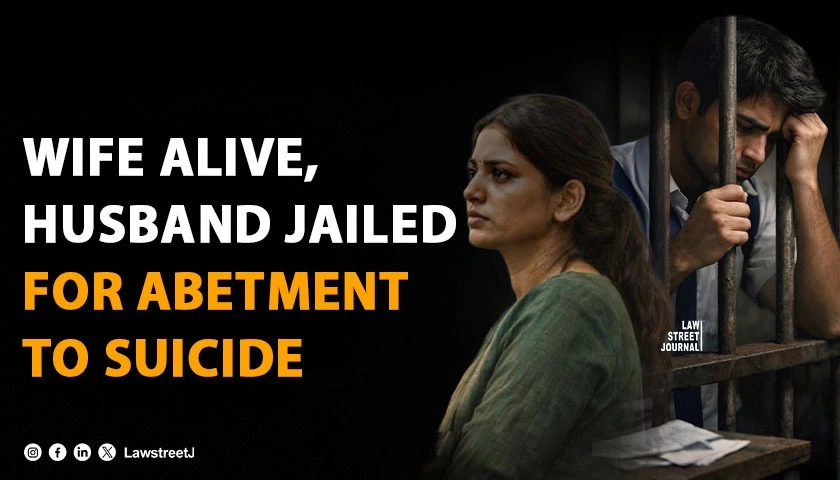
Karnataka: The Karnataka High Court has quashed criminal proceedings against a husband who had been kept in prison for six months on a charge of abetment of suicide under Section 108 of the Bharatiya Nyaya Sanhita, 2023, even though the alleged victim, his wife, was alive, healthy, and in fact standing in the courtroom beside her counsel when the matter was heard.
Justice M. Nagaprasanna, delivering a sharply worded order, directed the husband’s immediate release and ordered a departmental enquiry against the investigating officer responsible for the prosecution.
The facts of the case were straightforward and, as the Court observed, made the invocation of Section 108 legally impossible on its face. The petitioner, Nixon, and his wife, Priya, had been married for seven years. On the night of 20 October 2025, the petitioner returned home in an inebriated state and tried to assault his wife. In the course of the altercation, the wife attempted to jump from the second floor of their house. She did not die, but sustained injuries to her back and both legs. She was taken to hospital and treated. She thereafter approached the police and lodged a complaint.
Based on that complaint, Crime No. 687 of 2025 was registered under Sections 108, 62, 85 and 352 of the BNS, the primary charge being Section 108, abetment of suicide. The husband was arrested and taken into custody. The police then conducted an investigation and filed a chargesheet for the same offences. The husband remained in custody throughout.
By the time the matter came before the High Court, the couple had reconciled. They appeared together seeking closure of the case on the basis of a settlement, with the wife expressly stating that she did not wish to pursue the prosecution further. The Court noted that the wife was present in the courtroom, identified by her own counsel, hale and healthy. It was in this context that the Court trained its focus not merely on the question of settlement, but on the alarming conduct of the police.
The Court examined Section 108 of the Bharatiya Nyaya Sanhita, 2023, which corresponds to Section 306 of the Indian Penal Code and criminalises the abetment of suicide. It emphasised that the provision is attracted only when a person has in fact committed suicide, making the occurrence of suicide an indispensable precondition for the offence.
Finding the statutory requirement to be clear and unequivocal, the Court observed that the prosecution had proceeded on a fundamentally flawed premise by registering an offence and filing a chargesheet for abetment of suicide despite the absence of any suicide. Criticising the prosecution’s approach, the Court remarked:
“Section 108 is neither ambiguous nor elastic. It stands anchored upon the un-denial prerequisite that, ‘if any person commits suicide’ only then culpability for abetment would arise. Yet, in an astonishing display of recklessness or prosecutional haste, the crime is registered for abetment to suicide and a charge sheet is also filed against the petitioner for the offence of abetment of suicide, an offence whose very foundation is actual commission of suicide.”
The Court noted that the wife had survived and no suicide had in fact occurred. Despite the absence of this essential ingredient, the police registered an FIR for abetment of suicide, conducted an investigation, and ultimately filed a chargesheet. The Court criticised this approach as a case of mechanical prosecution and reckless invocation of a penal provision whose basic statutory requirement was admittedly absent from the very outset.
The Court also highlighted the serious consequences of the prosecution’s error. It noted that the petitioner had remained incarcerated for six months on a charge that was legally unsustainable from the outset, even though the wife, whose alleged abetment to suicide formed the basis of the case, was alive. Describing the situation as deeply disturbing, the Court observed that the case reflected investigative imprudence and a troubling disregard for personal liberty, resulting in the deprivation of the petitioner’s freedom without any valid legal foundation.
“What shocks the judicial conscience is not merely the erroneous invocation of the provision, but the grave consequence that followed in its wake. The petitioner-husband is languished behind the prison walls for six long months, deprived of his liberty under the shadow of a charge sheet that could not even remotely sustain legal scrutiny. The wife alleged to be the victim of abetment to suicide stands alive before this Court… thereby rendering the very substratum of accusation wholly illusory. The incarceration of the petitioner, in such circumstances, paints a deeply troubling portrait of investigative imprudence and indifference to personal liberty.”
The Court stated.
Additionally, the Court made it clear that although the parties had settled their disputes and the proceedings could have been brought to an end on that basis alone, the facts of the case raised concerns that could not be ignored. In its view, merely recording the settlement and closing the matter would have allowed a serious instance of investigative misconduct to escape scrutiny.
The Court then observed that the criminal justice system cannot be reduced to a mechanism where penal provisions are invoked without even examining whether their basic ingredients are satisfied. It found the case to be far more than a mere error of judgment, describing it as a glaring instance of non-application of mind that resulted in a citizen being deprived of his liberty for six months for an offence that was legally incapable of being made out. Stressing that personal liberty cannot be sacrificed to investigative negligence, the Court held that such abuse of authority must necessarily be followed by accountability.
Accordingly, the Court passed a five-part order. The criminal proceedings were quashed. The husband was directed to be released from prison forthwith, without any delay, with the Registry instructed to communicate the order to the prison authorities immediately. A departmental enquiry was directed against the officer-in-charge of the police station, who had filed the chargesheet for Section 108 despite the admitted absence of any suicide. The Court expressly directed that this enquiry shall not be a ritualistic exercise but a meaningful examination into the casualness with which personal liberty was imperilled. A compliance report was ordered to be placed before the Court within three months.
Case Title: Nixon v. State by Banaswadi Police Station & Anr., Criminal Petition No. 5622 of 2026, High Court of Karnataka at Bengaluru.


![Karnataka High Court: Cabinet Rank Status Not Equivalent to Ministerial Position [Read Order]](/secure/uploads/2023/09/lj_2318_fc1b99b7-aeed-472b-836e-33750bedb394.jpg)


![Woman living in adultery cannot claim maintenance: Karnataka High Court [Read Order]](/secure/uploads/2023/10/lj_3083_Women_living.jpg)