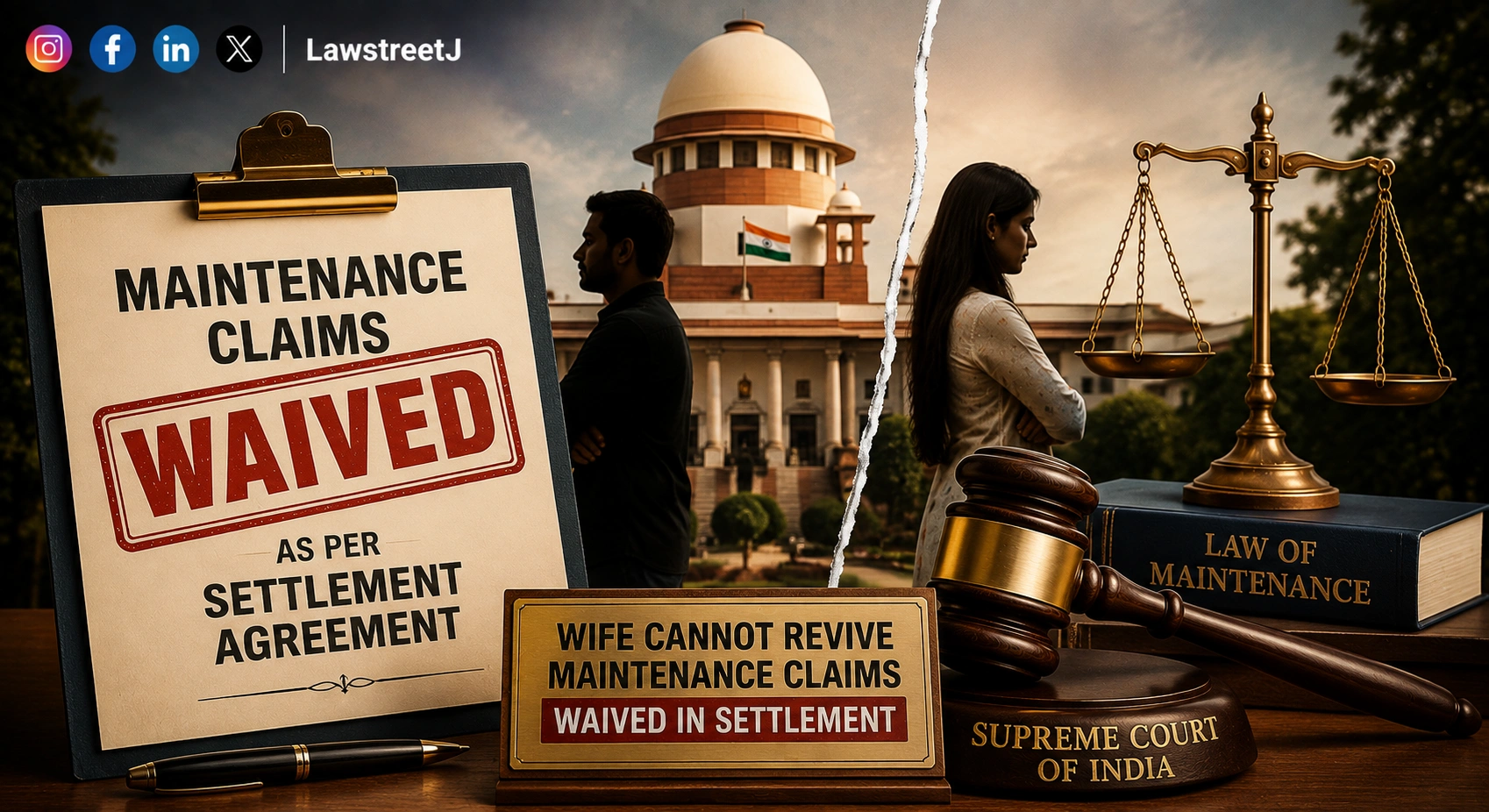
New Delhi: The Supreme Court has held that a wife who voluntarily relinquished her right to maintenance under a settlement agreement and a sworn affidavit before the Family Court cannot revive such claims through a subsequent complaint under the Protection of Women from Domestic Violence Act, 2005, , while clarifying that the couple's adult daughter who was not a party to the settlement remains free to pursue her own monetary claims independently.
Background
A Bench of Justice Sandeep Mehta and Justice Manmohan was hearing an appeal filed by the husband against a judgment and order dated 26th October 2018, passed by the High Court of Kerala in Crl. MC No. 8568/2017, by which his petition seeking quashing of a complaint filed by his former wife and daughter under the DV Act had been dismissed.
The husband and wife had earlier entered into a Settlement Agreement dated 23rd July 2016, following which they filed a joint application under Section 10A of the Divorce Act, 1869, and obtained a decree of divorce dated 30th January 2017. Despite this, the wife and daughter subsequently initiated proceedings against the husband under the DV Act, prompting him to seek quashing of the complaint before the Kerala High Court, without success.
Arguments
Counsel for the appellant-husband submitted that the DV Act proceedings had been initiated after the parties' disputes stood settled, and that under the Settlement Agreement, the wife had specifically agreed not to raise any monetary or maintenance claims against him. It was pointed out that the daughter had also received two properties from the husband, which she had since sold, and that the subsequent complaint sought to reagitate claims that had already been extinguished.
Counsel for the respondents did not dispute that the wife had agreed to forgo monetary claims, but contended that the Settlement Agreement had been executed under duress, as the family was keen to secure a speedy divorce ahead of their intended migration to the United States. It was argued that a settlement agreement providing no consideration or statutory maintenance to the wife was void as against public policy, and that the two properties referred to by the husband's counsel were, in any case, already held in the daughter's name and had not been given to her by him.
Analysis
The Court held that once the wife had voluntarily relinquished all monetary claims, including maintenance, the “proceedings under the DV Act constitute an abuse of process,” and their revival through subsequent litigation could not be permitted. It noted that the wife had not merely signed the Settlement Agreement, in which the parties recorded that they “will not make any monetary claim in future against each other,” but had gone on to file an affidavit dated 24th January 2017 before the Family Court reiterating that waiver and affirming that “there is no coercion or undue influence in filing this petition.”
The Court observed that the domestic violence complaint pertained to acts alleged to have occurred prior to the Settlement Agreement, and that the respondents had pleaded no fresh cause of action arising after the divorce. Significantly, the wife had never instituted any proceedings to set aside the divorce decree or to seek a declaration invalidating the Settlement Agreement mere averments of coercion, unaccompanied by any such legal challenge, could not suffice, particularly where the parties were well educated and conscious of their rights when they executed the agreement and the joint divorce petition.
Referring to its recent decision in Dhananjay Rathi v. Ruchika Rathi, the Court reiterated that parties who resile from a validly executed settlement agreement ought to be burdened with heavy costs, and that such deviation strikes at the foundation of the settlement process. It also drew on the earlier ruling in Gimpex Private Limited v. Manoj Goel, which had held that a settlement agreement subsumes the original complaint and that parties cannot pursue both the original and any subsequent proceedings once they have voluntarily agreed to abide by its terms.
The Court, however, drew a distinction in respect of the daughter, noting that the Settlement Agreement had been executed solely between the husband and wife, and that the daughter who had attained majority before the settlement was signed was not a party to it. It accordingly held that she could not be said to have waived her own right to monetary claims.
Conclusion
The appeal was allowed and the impugned judgment and order of the Kerala High Court dated 26th October 2018 was set aside, resulting in the quashing of proceedings in M.C. No. 23/2017 pending before the Judicial First Class Magistrate Court, Kalamassery.
The Court clarified that the daughter would remain at liberty to initiate fresh proceedings seeking monetary relief against the appellant, if so advised, to be decided in accordance with law. Pending applications, if any, were disposed of.
Case Title: Reji Baby vs. Subi Mary & Ors., Criminal Appeal No. 1346 of 2021