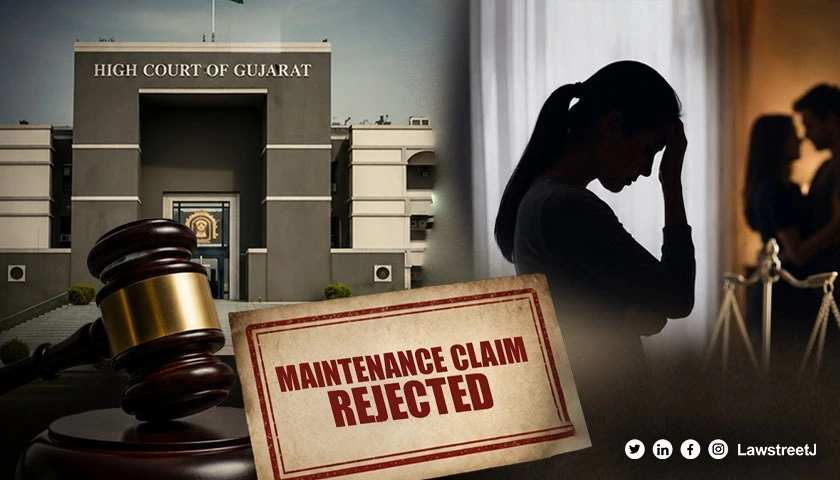
Ahmedabad: The Gujarat High Court has upheld the rejection of a wife's application for maintenance under Section 125 of the Code of Criminal Procedure, 1973, holding that the Family Court's finding that she was living in adultery and had voluntarily left the matrimonial home attracted the statutory bar under Section 125(4) of the Code.
A Single Judge Bench of Justice S.V. Pinto, while dismissing the Criminal Revision Application, held that the applicant had failed to demonstrate any perversity or patent illegality in the findings of the Family Court warranting interference in the limited revisional jurisdiction of the Court.
The marriage between the applicant and the respondent-husband was solemnised on 8 June 2021, but the matrimonial relationship subsisted only briefly. The applicant left the matrimonial home on 14 August 2021, and two days later, on 16 August 2021, the parties executed a deed of divorce by mutual consent. The applicant subsequently instituted proceedings under Section 125 of the Code claiming maintenance, alleging that she had been subjected to ill-treatment and harassment by the respondent and his family members and was compelled to leave. The respondent denied the allegations and contended that the applicant had voluntarily left the matrimonial home and was living in adultery, and was therefore barred from claiming maintenance under Section 125(4) of the Code.
The Family Court, Bhavnagar, after appreciating the oral and documentary evidence, found that the applicant had failed to substantiate her allegations of cruelty and ill-treatment, and further recorded a finding that she had left the matrimonial home voluntarily and was living in adultery. The application for maintenance was accordingly rejected, prompting the applicant to approach the High Court in revision under Sections 397 and 401 of the Code.
Before the High Court, it was argued on behalf of the applicant that the findings regarding voluntary departure and adultery were contrary to the evidence on record, and that she had no independent source of income while the respondent was financially capable of maintaining her. The State and the respondent jointly supported the impugned judgment, submitting that the Family Court's findings were based on a detailed appreciation of evidence and disclosed no perversity or illegality warranting interference.
Reiterating the limited scope of revisional jurisdiction, the Court relied on the Supreme Court's rulings in State of Kerala v. Puttumana Illath Jathavedan Namboodiri and Amit Kapoor v. Ramesh Chander, observing that a Revisional Court is not expected to reappreciate evidence merely to arrive at a different conclusion unless the findings are shown to be perverse or suffer from a manifest error of law.
The Court noted that “unless the findings recorded by the learned Family Court are shown to be perverse, based on no evidence, contrary to the material on record or suffering from a manifest error of law, this Court would not be justified in interfering with such findings merely by undertaking a fresh reappreciation of the evidence,”
Examining the scope of Section 125(4), the Court explained that the provision bars a wife from receiving maintenance in three situations where she is living in adultery, where she refuses without sufficient reason to live with her husband, or where the parties are living separately by mutual consent.
The Court held that “a mere inability to prove allegations of cruelty does not invariably lead to the conclusion that a wife has left the matrimonial home without sufficient cause. Each case must necessarily depend upon its own evidence,” but found that in the present case, the Family Court had considered the entire evidence and recorded a specific finding on the circumstances of the applicant's departure, including the swift execution of the divorce deed within two days of her leaving, which lent further support to the finding of voluntary separation.
The Court clarified that it did not find it necessary to independently pronounce on the validity of the divorce deed, since the rejection of the maintenance claim was founded principally on the factual findings attracting the statutory bar under Section 125(4).
Holding that the applicant's submissions essentially sought a fresh reappreciation of evidence, which is impermissible in revisional jurisdiction, the Court dismissed the Criminal Revision Application and confirmed the order of the Family Court, Bhavnagar, rejecting the maintenance claim. Rule was discharged, and interim relief, if any, stood vacated. The Court clarified that its observations were confined to the present proceedings and would not affect any other independent proceedings between the parties.
Appearances:
For the Applicant: Mr. Parth S. Tolia and Mr. Shirishchandra B. Tolia, Advocates.
For Respondent No.1 (State): Mr. Soaham M. Joshi, Additional Public Prosecutor.
For Respondent No.2: Mr. Tulshi R. Savani, Advocate.
CaseDetails: Criminal Revision Application (for Maintenance) No. 666 of 2023


![Supreme Court Affirms Women's Right to Reproductive Choices as Central to Human Dignity [Read Order]](/secure/uploads/2023/08/lj_5007_Right_to_Reproductive.jpg)